

A referee’s status matters less than what they can reliably confirm. Contact them directly, establish how they know the applicant, and ask focused rental reference check questions about tenancy, rent payments, income and character.
It’s sensible to seek clear, consistent information before making a rental decision. A referee’s response can help verify details in an application, but it shouldn’t stand alone. Consider it alongside the other information available.
This guide explains what to ask previous and current rental providers, how to follow up on rent history, and how to verify income if an employer can’t provide details. It also covers practical questions for character referees, such as how long they’ve known the applicant and whether they consider them reliable and respectful of another person’s property.
Key Takeaways
- Ask previous landlords to verify tenancy details and describe how rent, property care and any issues were handled.
- If an employer can’t provide income details, consider suitable proof from the applicant alongside confirmation of their employment.
- Look at rent payment history in context, and weigh it with the rest of the application rather than relying on one response.
- Use character referees to learn how they know the applicant and whether they regard them as trustworthy and reliable.
1. Questions for previous landlords about rent and tenancy
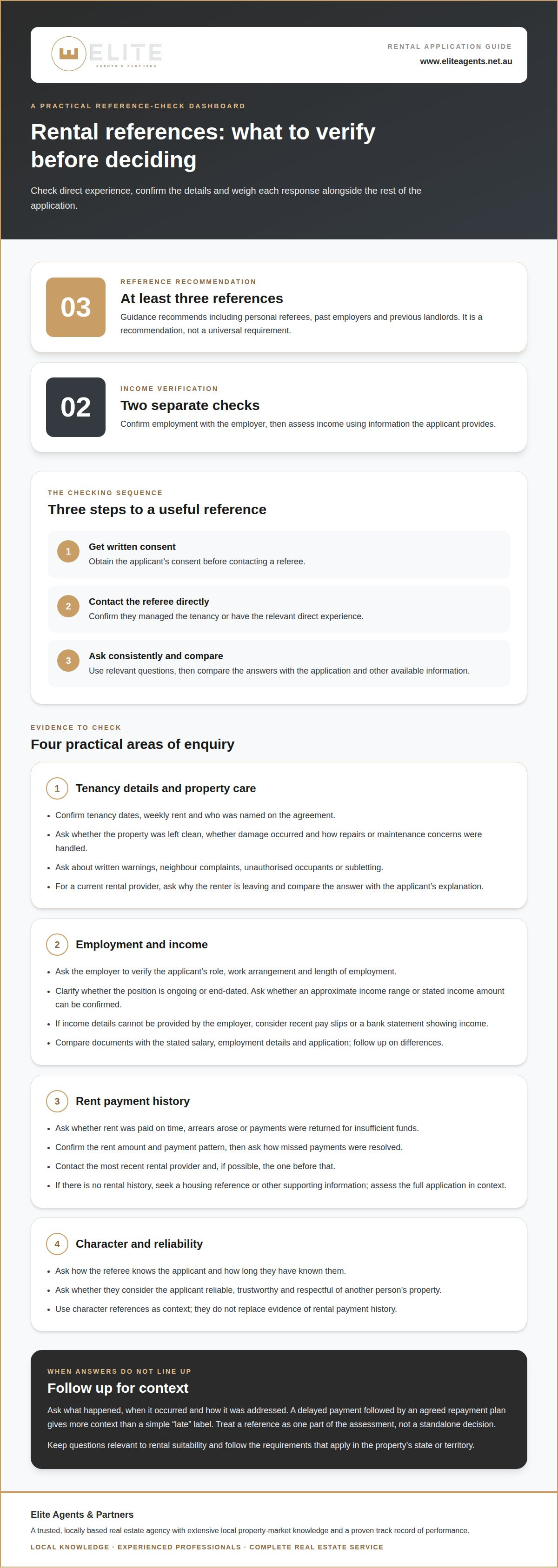
Keep previous landlord reference checks focused on verifiable tenancy details. In Australia, a landlord can ask about rent payments, the property’s condition, complaints and whether the applicant followed notice and move-out requirements. Ask about the reference’s direct experience rather than relying on a general impression.
Useful rental reference check questions include: “What were the tenancy dates and weekly rent?” “Were payments made on time, and did arrears arise?” “Who was named on the previous rental agreement?” Ask whether the renter left the property clean, caused damage or reported maintenance issues, and how any concerns were addressed. If a rental provider mentions damage, for example, ask what happened and whether repairs were completed.
First, obtain the applicant’s written consent to contact a referee. Then contact the previous rental provider or property manager directly, confirm they managed the tenancy, and compare their answers with the application. Ask about written warnings, neighbour complaints, unauthorised occupants or subletting. If the current rental provider is the referee, ask why the renter is leaving and compare the answer with the applicant’s explanation.
Rental reference checks generally follow a straightforward sequence: get consent, contact the referee, verify the tenancy and ask consistent questions. The applicant’s preparation is practical: provide accurate tenancy dates, the correct landlord or property manager contact details, and a clear explanation of any short tenancy or payment issue. Australian application guidance recommends at least three references, including personal referees, past employers and previous landlords; this is a recommendation, not a universal requirement.
Reference-check processes can differ between Australian states and territories. Keep questions relevant to the tenancy and follow the requirements that apply to the property’s jurisdiction. A reference can inform the decision, but compare it with the application and other available information.
2. Verifying income when an employer will not provide details
An employer may confirm someone’s employment without disclosing their income. Treat these as separate checks: establish whether the applicant works there, then assess income using information the applicant provides. An automated employment or personal reference request can help with initial enquiries, but a brief response may not answer specific questions. Follow up rather than treating a standard confirmation as a complete income check.
Ask the employer to verify the applicant’s role, work arrangement and length of employment. Clarify whether the position is ongoing or end-dated, and ask whether they can confirm an approximate income range or that the applicant meets a stated income amount. You can also ask whether attendance is reliable and pay generally arrives consistently. Keep questions specific to the rental application.
If the employer can’t discuss income, ask the applicant to provide evidence directly. Their recent pay slips may help; a bank statement showing income may also be relevant. Compare documents with the applicant’s stated salary, employment details and rental application. For example, if the application lists an ongoing role but the employer confirms an end-dated arrangement, clarify the difference before assessing affordability.
Income verification can help assess whether rent is manageable, but one document doesn’t tell the whole story. Consider stated income, employment status and the consistency of the evidence together. If information conflicts, ask the applicant for an explanation and consider supporting documents before deciding. Ask each applicant the same employment and income questions to support a consistent assessment.
For landlords reviewing applications as part of a broader rental process, discuss your property management needs with a local property professional.
A financial check can also form part of tenant referencing, helping assess whether a prospective renter can afford the rent. Applicants may be asked about their income or salary.
3. Rent payment history
Ask the previous rental provider or property manager whether rent arrived on time, whether arrears arose, and whether any payments were returned for insufficient funds. Confirm the rent amount and payment pattern, then ask how missed payments were resolved. A delayed payment followed by an agreed repayment plan, for example, gives more context than a simple “late” label.
Ask about utility bills only if the referee has direct knowledge. Keep the question specific: “Were rent and utility payments generally made by their due dates?” A previous rental provider may not manage utility accounts, so treat the answer as one part of the financial history, not proof of every bill’s status.
Contact the property manager for the applicant’s most recent rental and, if possible, the one before that. Ask each referee consistent questions, then compare the answers with the dates and payment details in the application. Contradictory information, repeated arrears or returned payments calls for follow-up. Ask what caused the issue, when it occurred and how it was addressed.
If an applicant has no rental history, personal references alone provide limited evidence about rent payments. Seek a housing reference or other supporting information, and weigh the full application rather than treating missing rental history as a negative mark. Context matters: a previous rental provider’s account of payment difficulties should prompt questions about the circumstances, not an automatic conclusion about suitability.
Australian landlords should keep questions relevant to rental suitability, such as payment history, ability to meet rent and care of the property. Avoid asking about protected personal characteristics or unrelated private matters; the specific legal protections depend on the applicable state or territory rules.
4. Character referee questions
A character referee can add context when rental records don’t show how an applicant behaves. Start by asking how long they’ve known the applicant and in what capacity. A referee who knows someone through work, volunteering or a long-standing friendship may offer different observations. Ask for specific examples, not just a general endorsement.
Use direct prompts: “Do you consider the applicant trustworthy and reliable?” “Would they respect and care for another person’s property?” “Is there anything else helpful for a rental provider to know?” Follow up with “What have you observed that supports that view?” This encourages a detailed response rather than a bare yes.
Listen for first-hand examples. A referee might describe the applicant consistently keeping commitments or communicating when plans change. That offers more substance than labels such as “great” or “easy-going”. Keep the conversation focused; one relevant example can be more useful than broad, unrelated discussion.
Confirm the referee’s connection to the applicant before weighing their comments. If a personal referee has limited experience of the applicant’s day-to-day responsibilities, note that context. Their view may speak to reliability or care, but it doesn’t establish rent payment history or income. Assess those points using relevant application details and supporting information.
Ask each applicant the same core character questions, then consider the answers alongside tenancy and employment information. A positive reference is one data point, not a decision by itself. If a response raises a concern, ask what specifically happened and whether it’s relevant to renting. This keeps the assessment grounded in evidence and consistent across applicants.
Elite Agents & Partners: Houses for rent
Elite Agents & Partners provides property management for rental properties in Berwick and surrounding areas, including Narre Warren, Cranbourne and Pakenham. Local knowledge can help owners consider their property’s rental potential and management needs.
Turn to the team for guidance on managing a rental property and making informed decisions about the local market. Elite Agents & Partners offers personalised property management, including renter selection and rent collection, with communication focused on owners’ needs.
To discuss managing your rental property, contact Elite Agents & Partners or request a rental appraisal.
Make your next rental decision with confidence
Set a clear process before the next application arrives. Decide which information is relevant to the property, use consistent criteria, and record the evidence behind each decision. This supports a considered approach, especially when a referee’s account is brief or differs from the application.
Well-framed rental reference check questions help distinguish relevant details from personal impressions. Focus on information connected to tenancy, financial capacity and care of a home. If an answer raises a concern, consider its context alongside the other material rather than letting one comment determine the outcome.
If your property plans change, Elite Agents & Partners also offers residential property sales and project marketing alongside professional property management. As a trusted, locally based agency serving Berwick, Narre Warren South, Hallam and nearby suburbs, our experienced team combines extensive local market knowledge with a proven track record of results. Speak with us for personalised, practical advice tailored to your needs.
Contact Elite Agents & Partners to discuss your property goals and the support you need.
Frequently Asked Questions
Why are Screening Questions Important?
Consistent screening questions help rental providers compare applications using relevant, similar information. They can clarify gaps, such as an unexplained break between tenancies, and distinguish a verifiable concern from a vague opinion. Ask each referee how they know the applicant and what they personally observed, then record key answers alongside the application so the decision reflects the full set of information.
What questions should tenants expect their employer or personal references to answer?
Employers may be asked to confirm the applicant’s role, work arrangement and length of employment. Personal referees may be asked how they know the applicant and whether they consider them dependable. Referees should answer from direct knowledge. Applicants can let referees know they may be contacted and ensure their contact details are current.
What are red flags in a rental reference check?
Follow up on contradictions between an application and a reference, unexplained gaps, repeated concerns or a referee who can’t confirm their connection to the applicant. A negative comment alone isn’t proof of unsuitability. Ask for specific examples and context, then compare the account with other information. Weigh a current rental provider’s unfavourable view as one piece of evidence, not the whole decision.
What should a landlord do if a rental applicant has no rental history or references?
Consider other relevant evidence rather than treating limited rental history as an automatic rejection. The applicant could provide employment details, income documents or a personal referee who can speak to their reliability. Ask how they have managed accommodation previously, such as living with family or sharing a home, and assess the explanation consistently alongside the rest of the application.
What rental reference questions are prohibited under Australian privacy and anti-discrimination laws?
Avoid questions about protected personal characteristics or unrelated private matters. The specific protections depend on the property’s state or territory.
Disclaimer
Disclaimer: This article was prepared with the assistance of artificial intelligence and reviewed for general informational purposes. While reasonable care has been taken to ensure accuracy, property-market conditions, prices, legislation and other information may change. The content does not constitute legal, financial, taxation, valuation or other professional advice. Readers should verify information and obtain advice appropriate to their circumstances before making property decisions. Elite Agents & Partners does not guarantee any specific sale price, rental return or outcome.


