

The annual test is only one part of a landlord’s smoke alarm responsibilities. In Victoria, landlord obligations for smoke alarms include testing each installed alarm at least once every 12 months, in accordance with the manufacturer’s instructions, according to Consumer Affairs Victoria.
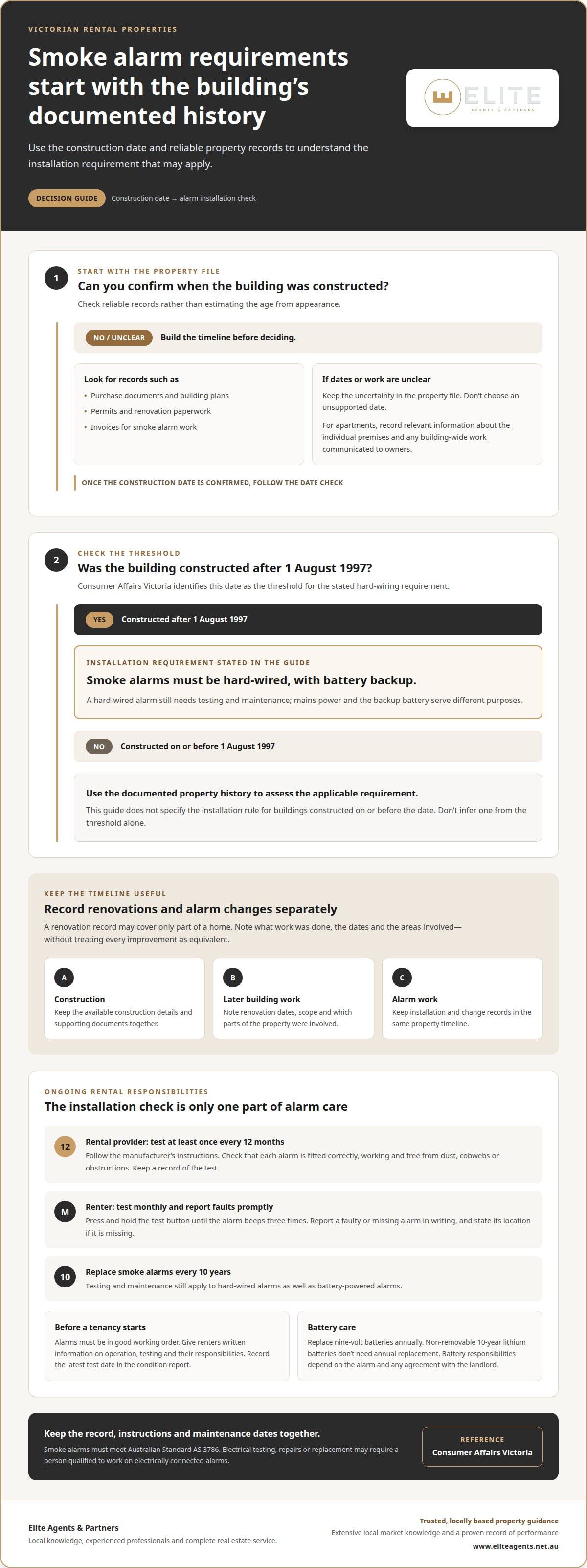
It’s also important to understand how installation requirements relate to a property’s construction date. In Victoria, buildings constructed after 1 August 1997 must have hard-wired smoke alarms with battery backup, according to Consumer Affairs Victoria. This guide explains when to check, test and service alarms, what to do if one is faulty, and how requirements vary by construction date, so you can manage your rental property with clarity and care.
Key Takeaways
- Keep smoke alarm maintenance on a regular schedule, and follow the manufacturer’s instructions for testing and care.
- Use the property’s construction and renovation history to understand which alarm installation requirements apply.
- Respond promptly to reports of faulty alarms and keep clear records of maintenance and replacements.
- Electrical repairs, testing or replacement may require a person qualified to work on electrically connected smoke alarms.
How Often Should Landlords Check Smoke Alarms in Victoria?
Victorian rental providers must test each installed smoke alarm at least once every 12 months, following the manufacturer’s instructions, according to Consumer Affairs Victoria. The annual check should confirm the alarm is fitted correctly, working and free from dust, cobwebs or obstructions. In Victoria, buildings constructed after 1 August 1997 must have hard-wired smoke alarms with a battery backup, according to Consumer Affairs Victoria.
Before a tenancy starts, alarms must be in good working order. The rental provider must give renters written information about how each alarm operates and how to test it, plus their responsibilities for avoiding tampering and reporting faults. The condition report must include the date of the most recent smoke alarm test. For wider context on local property conditions, explore Victorian property news.
During a rental agreement, renters should test smoke alarms monthly and report a fault promptly. They must not remove batteries, disable alarms or otherwise tamper with them. Battery responsibilities depend on the alarm: tenants are responsible for replacing batteries in battery-powered alarms unless the landlord has agreed to handle this. Landlords or agents must replace batteries as required, and annual cleaning should include gentle dusting, vacuuming or wiping around the cover. Replace nine-volt batteries annually; alarms with non-removable 10-year lithium batteries don’t need annual battery replacement.
Replace smoke alarms every 10 years. A hard-wired alarm still needs testing and maintenance; its mains power and backup battery serve different purposes. Rooming houses in Victoria must have hard-wired alarms. The residential rental checks described here don’t cover every requirement that may apply to short-stay accommodation.
For apartments, the building’s construction date helps determine the alarm requirements, including whether alarms must be hard-wired with battery backup. Before each tenancy, confirm the alarms work, provide the required written instructions and record the latest test date. These steps help clarify landlords’ and renters’ responsibilities under Victoria’s residential tenancies framework.
Annual smoke alarm testing
Annual testing is the rental provider’s scheduled compliance check, while renters also have an ongoing role. Monthly checks can help identify faults between annual inspections.
Testing and Maintenance
Victorian rental providers must test each installed smoke alarm at least once every 12 months, following the manufacturer’s instructions, according to Consumer Affairs Victoria. Testing and maintenance help identify alarms that are faulty, obstructed or no longer operating as intended.
Renters can press and hold the test button until the alarm beeps three times. They should also check for dust, cobwebs or objects blocking the alarm. These checks apply to both wired and battery-powered smoke alarms. The power source affects battery care, but not the need to test the alarm.
Annual testing complements, rather than replaces, monthly renter checks. For example, a working alarm during an annual inspection may still develop a fault before the next scheduled test. Keeping a record of the annual test supports clear maintenance tracking across residential tenancies. Smoke alarms must meet Australian Standard AS 3786.
Tenant Testing and Fault Reporting
Renters should test alarms monthly and promptly report any fault or missing device to the rental provider or agent. If an alarm does not work, notify the landlord in writing as soon as possible.
Don’t remove a battery, disable an alarm or tamper with its components. If an alarm is missing, state this clearly in the report and include its location. A written report gives both parties a record to follow up and identifies the affected room or area.
The rental agreement should explain how each alarm operates and how to test it. If you manage a rental and want support coordinating property matters, discuss rental management support.
In Victoria, renters must test smoke alarms monthly and report faults or failures to the landlord immediately. Landlords are responsible for replacing smoke alarms, while renters must report faulty alarms. The rules were unclear about who should regularly check that alarms work.
Smoke alarm installation requirements by construction date
A property’s building history helps landlords understand which smoke alarm installation requirements may apply. Start by establishing when the home was built and whether later building work changed the relevant areas. The aim is to assess the property’s history accurately, rather than relying on appearance or assumptions about its age.
Useful records may include purchase documents, building plans, permits, renovation paperwork and invoices for alarm work. Compare dates across documents, as a renovation record may cover only part of a home. Keep the information together so the property’s timeline is easy to follow when maintenance or a change of tenancy prompts a review.
For a renovated property, record what work was done and which parts of the home it involved. A kitchen update, for example, may have a different scope from a broader renovation. Clear notes distinguish the building’s original history from later changes without treating every improvement as equivalent.
A rental apartment can have a more complex history than a standalone house. Record information relevant to the individual premises and any building-wide work communicated to owners. If documents show different dates or describe unclear work, keep that uncertainty in the property file rather than choosing an unsupported date.
Keep a simple timeline alongside the documents that support it. Include the property’s construction details, later renovation dates, and records of alarm installation or changes. This makes it easier to explain the basis for a future assessment and share useful information among owners, property managers and renters.
Understanding a landlord’s smoke alarm obligations in Victoria starts with a reliable property history. Review it when taking on a rental or after substantial building work, then ensure the installation assessment reflects the documented details. A clear record gives future decisions a sounder starting point.
Annual smoke alarm servicing
Annual servicing in Victoria should confirm each rental property’s alarms are correctly installed and working. Since 25 November 2025, rental properties must have annual smoke alarm safety checks. These checks bring installation and operation into the maintenance routine, rather than treating a successful test as the only sign of a serviceable alarm.
Consumer Affairs Victoria says rental providers must test each installed alarm at least once every 12 months, following the manufacturer’s instructions. A useful service record identifies the alarm, records the test date and notes faults or work completed. Landlords must keep records of smoke alarm installations, maintenance, issues and replacements, creating a clear history for future checks.
During maintenance, check the alarm for dust, cobwebs and obstructions, then gently clean around its cover. Confirm it works by following the manufacturer’s test instructions. Check the power source and backup battery during the same visit. A nine-volt battery model has different battery requirements from a hard-wired alarm or one with a non-removable lithium battery.
Electrical work requires particular care. Under section 68AA, repairs, testing or replacement of an electrically connected smoke alarm must be done by a person qualified to fix electric smoke alarms. A landlord should arrange qualified help for a hard-wired alarm that fails its test, rather than treating it like a simple battery change. Replacing an alarm also calls for recording the new installation and any related maintenance.
Keep service records together with the rental property’s other maintenance documents. If a renter reports a fault between scheduled checks, record the issue and the action taken. An annual service does not replace responding to reported problems. Clear dates and notes show when alarms were inspected, whether they worked, and when repairs or replacement followed.
Fire services recommend photoelectric smoke alarms and replacing ionisation alarms with photoelectric models. They also recommend installing alarms inside bedrooms, in addition to the minimum locations described.
Elite Agents & Partners
Elite Agents & Partners is a trusted, locally based agency with extensive knowledge of the Victorian property market, years of industry experience and a proven track record of results. Its professional Property Management service supports landlords with tenancy communication, maintenance coordination and day-to-day rental decisions. The team’s understanding of local conditions informs practical advice tailored to each property and its market.
If smoke alarm checks have prompted a broader review of your rental’s management, a conversation can help clarify the support you need. Contact Elite Agents & Partners to discuss your property and management needs.
Make confident decisions for your property
Smoke alarm obligations for Victorian landlords are part of the broader responsibility to manage a rental property carefully. Use this guide to shape consistent property oversight, maintenance records and communication with renters. When a fault or installation issue arises, an organised management process helps make the next steps clear.
Elite Agents & Partners offers Property Management, Residential Property Sales and Project Marketing. As a trusted, locally based agency with extensive industry experience and a proven track record, it provides personalised advice informed by local market knowledge, helping landlords consider ownership, leasing or sale and protect their interests over the long term.
Take the next step by making a considered plan for your property and the decisions ahead.
Frequently Asked Questions
Which types of smoke alarms are required in Victorian rental properties?
Required alarm types depend on the property’s construction or renovation history. Properties built before 1 August 1997 are identified as requiring standalone nine-volt battery alarms; buildings constructed after that date require hard-wired alarms with battery backup. For properties constructed or renovated after 1 May 2014, interconnected, hard-wired alarms with backup batteries are identified as required. Alarms must meet Australian Standard AS 3786.
How many smoke alarms must a rental property in Victoria have, and where must they be installed?
Victorian homes must have at least one smoke alarm on each level. Position alarms between bedroom areas and the rest of the home, and inside a bedroom where someone sleeps with the door closed. In a two-storey home, alarms are required on each storey along the evacuation path. When assessing coverage, consider both the upper and lower levels, for example.
How often must Victorian landlords test and maintain smoke alarms?
Rental providers must test each installed alarm at least once every 12 months, following the manufacturer’s instructions, according to Consumer Affairs Victoria. Renters should also test alarms monthly and promptly report faults. For a practical record, note the test date and outcome, then record any reported fault and subsequent action. This helps distinguish a routine check from follow-up maintenance.
What penalties or consequences apply if a Victorian landlord fails to meet smoke alarm obligations?
Failing to maintain a working alarm can leave the rental provider with an unresolved repair duty. If a provider cannot be contacted or does not immediately fix an urgent smoke alarm fault, a renter may authorise an eligible urgent repair costing up to A$2,500. The provider must reimburse an eligible urgent repair within 7 days. These are repair consequences; no specific fine amount is given here.
Disclaimer
Disclaimer: This article was prepared with the assistance of artificial intelligence and reviewed for general informational purposes. While reasonable care has been taken to ensure accuracy, property-market conditions, prices, legislation and other information may change. The content does not constitute legal, financial, taxation, valuation or other professional advice. Readers should verify information and obtain advice appropriate to their circumstances before making property decisions. Elite Agents & Partners does not guarantee any specific sale price, rental return or outcome.


