

A notice to vacate isn’t a one-size-fits-all countdown. The notice to vacate period in Victoria depends on who gives notice, the reason and whether the rental agreement is fixed-term. Renters must give 28 days’ notice to leave at the end of a rental agreement, while a rental provider’s notice period varies by reason.
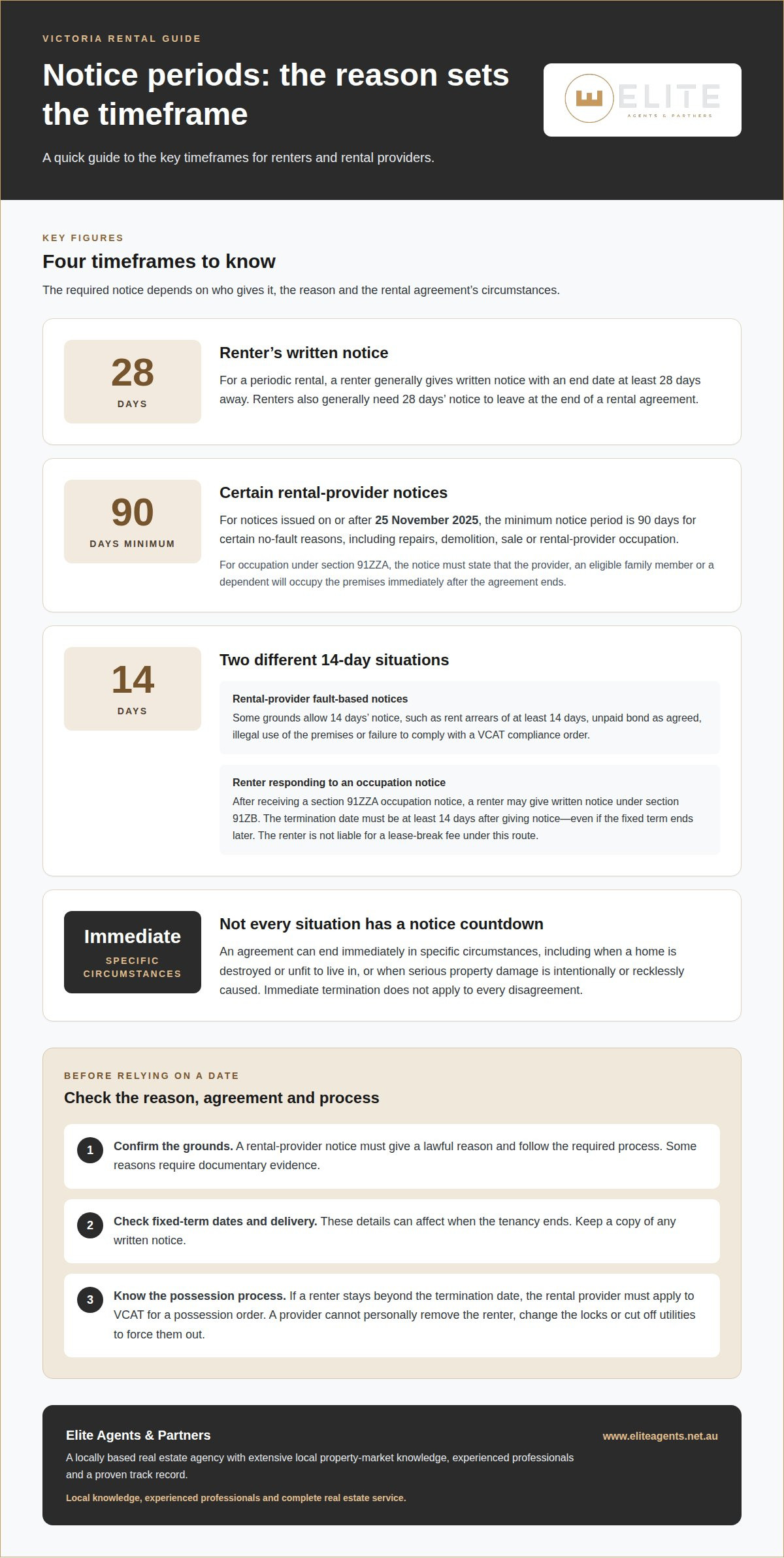
It’s understandable to expect the same timeframe to apply to renters and rental providers, but the rules differ. For certain no-fault reasons, including repairs, demolition, sale or rental provider occupation, the minimum notice period is 90 days for notices issued on or after 25 November 2025.
This guide explains what a notice to vacate means, how renters give notice and how rental-provider notice periods work in Victoria. It also covers why the reason for ending an agreement matters, how a fixed-term agreement can affect dates, and what to consider when a notice arrives. Understanding these points can help renters and property owners plan their next steps.
Key Takeaways
- Renters generally need to give 28 days’ notice to leave at the end of a rental agreement, but the reason for leaving can change the required period.
- Some urgent situations, such as a property becoming unsafe or unfit to live in, can allow immediate notice to vacate.
- Rental-provider notices must have a lawful reason and follow the required process; for certain reasons, the minimum notice period is 90 days for notices issued on or after 25 November 2025.
- Fixed-term dates and the way notice is delivered can affect when a tenancy ends, so understand how these details apply before making plans.
What is a notice to vacate?
A notice to vacate is a rental provider’s written notice requiring a renter to leave by a stated date. The required period depends on the reason and circumstances. In specific situations, an agreement can end immediately.
Immediate termination circumstances
Immediate termination means a rental agreement can end without the usual notice period in specific circumstances. An immediate notice may require swift action, but it does not apply to every disagreement between renters and rental providers.
A renter may receive immediate notice if the home is destroyed or unfit to live in, or if the renter or a visitor intentionally or recklessly causes serious property damage. A renter may also give immediate notice if the premises are destroyed or become unfit for human habitation and unsafe. Before the renter takes possession, a rental provider may end the agreement immediately if the property is unfit, destroyed or unsafe. If a property does not meet rental minimum standards, the renter may need to consider their options before taking possession.
Notice to vacate versus intention to vacate
A notice to vacate is given by a rental provider and tells the renter to leave for a stated reason. A notice of intention to vacate is the renter’s written notice that they plan to end the agreement. It is not a request for the rental provider’s consent; it communicates the renter’s decision and proposed end date.
The distinction matters for fixed-term agreements, where the end date can affect when a renter may leave. For help challenging a notice, renters can apply to VCAT in relevant circumstances. A renter affected by personal or family violence may apply within 30 days to dismiss most fault-based notices. VCAT is also where rental providers apply for possession if a renter remains after the notice date.
Staying beyond the notice date
If a renter does not leave by the termination date, the rental provider must apply to VCAT for a possession order. The date on the notice does not authorise the rental provider to remove the renter personally. VCAT can make a possession order only if the notice was validly given and granting possession is reasonable and proportionate.
The hearing must take place after the notice’s termination date. A rental provider cannot change the locks or cut off utilities to force the renter out before following the legal process. The renter’s continued possession does not make the notice valid or guarantee a possession order. VCAT considers whether the notice was lawful and whether possession should be granted.
How can I end my lease by ‘giving notice’ if I have a periodic lease?
For a periodic rental, a renter generally gives written notice with an end date at least 28 days away. A rental provider’s notice depends on the reason, including whether they intend to occupy the rented premises.
Notice periods for rental provider occupation
For notices issued on or after 25 November 2025, a rental provider seeking possession to move in must give at least 90 days’ notice. Under section 91ZZA, the notice must state that the provider, an eligible family member or a dependent will occupy the premises immediately after the agreement ends.
The reason for a notice must be genuine and supported by any required documentary evidence. Occupation notices have specific conditions, not just a minimum notice period. For example, a notice naming a family member must identify that person’s intended occupation. A renter can challenge a notice at VCAT if its reason is not legally valid.
Other reasons rental providers can give notice
Some fault-based reasons allow a rental provider to give 14 days’ notice. These include rent arrears of at least 14 days, unpaid bond as agreed, or using the rented premises for illegal purposes. A provider may also give 14 days’ notice if a renter fails to comply with a VCAT compliance order.
Other grounds include subletting or allowing additional renters without consent, or repeating a breach after receiving two breach of duty notices. Each notice must state a lawful reason and follow the required process. The minimum period depends on the conduct alleged, not simply on whether the tenancy is periodic.
Transferring or subletting a rental
Transferring a rental agreement and subletting are different arrangements, but both can affect who occupies the property. If a renter brings in another renter or sub-letter without the rental provider’s consent, the provider may have grounds to give 14 days’ notice. A renter considering a change should obtain consent before making that arrangement.
For rental planning shaped by local property conditions, discuss your property plans with the local team.
Minimum notice periods for ending an agreement early
Ending a rental agreement early depends on the reason and the agreement’s terms. In Victoria, renters may have specific grounds to end a tenancy without treating it as an ordinary lease break. Written notice is required for listed reasons, and some special-circumstance grounds also require documentary evidence.
A renter given a rental-provider occupation notice under section 91ZZA can give their own notice of intention to vacate under section 91ZB. The renter’s termination date must be at least 14 days after giving that notice, even if the fixed-term agreement ends later. This route matters because the renter does not have to wait until the fixed term expires.
There is also a specific lease-break consequence: a renter who gives notice under section 91ZB after receiving a section 91ZZA notice isn’t liable for a lease break fee. The notice should identify the termination date and be given in writing. Keeping a copy helps establish when the notice was provided and which provision the renter relied on.
A different rule applies to a long-term agreement that was verbal or didn’t use the correct form. In that situation, a renter may give 28 days’ notice. The agreement’s form therefore affects the minimum period, even when the renter’s reason for leaving is otherwise clear. Check the agreement type and the applicable ground before setting a move-out date.
Under the Residential Tenancies Act 1997, termination rules sit within Part 2, Division 9. A notice can be invalid if it doesn’t meet the requirements for the reason relied on. For special circumstances, supporting documents may be required alongside written notice. For example, a renter relying on a listed ground should include the evidence that applies to that ground, rather than assume a short notice period applies automatically.
For housing decisions, distinguish between a renter’s notice of intention to vacate and a rental provider’s notice to vacate. Consumer Affairs Victoria is a relevant body in Victoria’s rental system. The practical step is to match the written notice, its reason and termination date to the applicable legal provision.
Landlord notices to vacate and notice periods
In Victoria, a rental provider must have a lawful reason to end a residential tenancy and give written notice. The notice must use the prescribed form, state the reason and be served appropriately. The notice period runs from when the renter receives the notice, not when it is sent. This distinction can affect the termination date, particularly when notice is posted.
For certain no-fault reasons, the minimum period is now 90 days. This applies to notices for repairs, demolition, sale and rental-provider occupation issued on or after 25 November 2025. An occupation notice must include supporting documentary evidence. If the agreement is fixed-term, a 90-day notice must set a termination date on or after the agreement’s last day.
Fault-based notices range from immediate notice to 28 days, depending on the reason. For example, a rental provider may give 14 days’ notice when rent is at least 14 days overdue. If the renter has been at least 14 days late on four other occasions in the previous 12 months, a further notice may be given within 14 days. Renters can remedy the first four non-payment notices issued within that 12-month period by paying all arrears before the termination date.
Since 25 November 2025, landlords can’t rely on an end-of-fixed-term notice to vacate for agreements shorter or longer than five years. A notice must instead rely on a lawful reason that applies to the circumstances. For example, intending to sell a property doesn’t remove the requirement to provide the correct notice period and supporting evidence where required. A renter may challenge a notice at VCAT if it lacks a valid reason, wasn’t served properly or was issued because of direct discrimination.
A notice date does not give a rental provider permission to remove a renter. If the renter remains after the termination date, the rental provider must apply to VCAT for a possession order. Changing the locks or cutting off utilities to force the renter out is not permitted without following the legal process.
Elite Agents & Partners
Elite Agents & Partners is a trusted, locally based real estate agency with extensive local market knowledge, industry experience and proven results. The team provides personalised service and practical advice for homeowners, investors, buyers and landlords. If a notice to vacate affects your plans, this can help you consider the implications for your rental property and next steps.
Services include residential sales, professional property management, sales and rental appraisals, and strategic property marketing. If a tenancy is ending and you are weighing up whether to retain or sell, the team can discuss options in light of local conditions. Notice requirements depend on the reason and applicable rules.
Plan the next move with confidence
Once your intended move-out or possession date is clear, consider how it fits the property’s next chapter. A rental transition can affect decisions about managing, retaining or selling a home, so it helps to connect the timing with your broader property plans. The notice to vacate period in Victoria is one part of that decision; the next step is setting a practical direction for the property and the people involved.
Elite Agents & Partners brings together property management, residential property sales and project marketing, with advice informed by local market knowledge. Whether you’re a landlord planning beyond a tenancy or a renter preparing for a move, a focused conversation can help clarify the property-related decisions ahead. For questions about legal rights or challenging a notice, seek guidance from an appropriate tenancy authority.
Take the next step with a clear plan for your property.
Frequently Asked Questions
Can I end my lease?
Yes. A renter can end a rental agreement by giving the required notice or relying on an applicable legal ground. For example, a renter may give immediate notice if the home becomes unsafe or unfit to live in. If a rental provider’s notice asks you to leave, a separate notice option may apply. The reason for ending the agreement determines which route is available.
Can I just move out of the property without telling my landlord?
No, moving out alone doesn’t give the rental provider formal notice that you’re ending the agreement. Give written notice and specify the termination date, or the agreement may continue beyond your move. For example, a fixed-term agreement becomes periodic if you don’t give at least 28 days’ notice before its end date. Keep a copy of your notice and evidence of when you sent it.
How can I end my lease by applying to the Victorian Civil and Administrative Tribunal (VCAT)?
You can ask VCAT to resolve a rental dispute or make an order where the law allows. Set out the issue, the outcome you seek and relevant supporting documents, such as the rental agreement, notices and correspondence. If you’re challenging a notice, explain why its reason or service is disputed. Some notice challenges have a 30-day application window, so note when you received the notice.
How much notice must a tenant give to vacate a rental in Victoria, Australia?
Usually, a renter must give 28 days’ written notice to leave at the end of a rental agreement. A shorter period can apply in specific circumstances, such as when the rental provider breaches a VCAT compliance or compensation order. Immediate notice may apply if the premises become unfit for human habitation or are destroyed and unsafe. The reason for leaving and any fixed-term end date affect the correct termination date.
How much notice must a landlord give to end a tenancy in Victoria?
It depends on the reason. Certain no-fault grounds, including sale, repairs, demolition and rental-provider occupation, require at least 90 days for notices issued on or after 25 November 2025. Fault-based periods range from immediate notice to 28 days. A valid notice must state a lawful reason and use the prescribed form. The renter’s receipt date, rather than the sending date, affects the notice period.
What are the Victorian notice to vacate periods for each reason?
Periods vary by ground: immediate for a destroyed or unfit home, or serious intentional or reckless damage; 14 days for specified breaches, including rent arrears, unauthorised subletting or illegal use; and 28 days for keeping a pet after VCAT orders its removal. Certain no-fault grounds, including sale, repairs, demolition and occupation, require 90 days for notices issued on or after 25 November 2025. Fixed-term dates may also affect the termination date.
Disclaimer
Disclaimer: This article was prepared with the assistance of artificial intelligence and reviewed for general informational purposes. While reasonable care has been taken to ensure accuracy, property-market conditions, prices, legislation and other information may change. The content does not constitute legal, financial, taxation, valuation or other professional advice. Readers should verify information and obtain advice appropriate to their circumstances before making property decisions. Elite Agents & Partners does not guarantee any specific sale price, rental return or outcome.


