

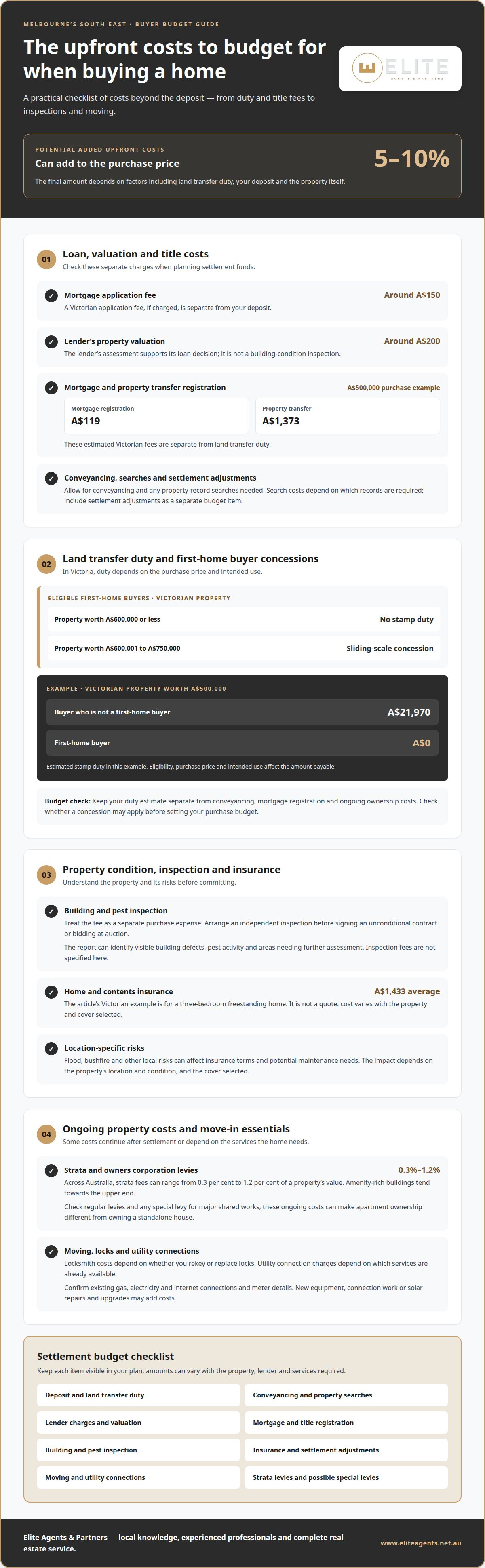
The deposit is only part of the upfront cost. The hidden costs of buying a house in Melbourne’s south east can add 5% to 10% of the purchase price, with the final amount shaped by factors such as land transfer duty, your deposit and the property itself.
It’s easy to focus on the purchase price and overlook the costs involved in completing a purchase. Conveyancing is one common expense, but it’s only part of the budget you’ll need to plan.
This guide covers key upfront expenses, including conveyancing, Victorian land transfer duty, first-home buyer concessions, and building and pest inspections. It also explains how costs can add up, so you can better plan for buying in Melbourne’s south east.
Key Takeaways
- Include lender application and valuation charges in your borrowing budget, as well as the purchase price and deposit.
- Check whether Victorian first-home buyer concessions may reduce the land transfer duty payable on your purchase.
- Arrange building and pest inspections before you commit unconditionally or bid at auction, so you can factor the findings into your decision.
- Build your upfront budget around the full settlement picture, including conveyancing and any adjustments for property charges.
What Are the Common Upfront Costs of Buying a Home?
Beyond the deposit and land transfer duty, budget for loan, title, inspection and moving expenses. Your upfront costs will depend on the property, lender and services you need.
Mortgage and Valuation Fees
These charges cover loan setup and the lender’s property assessment. They are separate from your deposit, so include them when planning the funds you’ll need for settlement.
A Victorian mortgage application fee, if charged, is around A$150, while a Melbourne property valuation costs around A$200.
Registration and Property Transfer Fees
Registration fees record the mortgage and property transfer against the title. For a A$500,000 Victorian purchase, estimated mortgage registration and transfer fees are A$119 and A$1,373 respectively.
These are separate from land transfer duty. A conveyancer or solicitor also reviews the seller’s Section 32 Vendor Statement and may arrange searches to examine property records. Search costs depend on which records are needed, so include them as a separate part of your settlement budget.
Strata and Owners Corporation Costs
Buying a strata property can mean paying owners corporation levies for shared maintenance and building expenses. Across Australia, strata fees can range from 0.3 per cent to 1.2 per cent of a property’s value, with amenity-rich buildings tending towards the upper end.
Budget for regular levies and check whether the property has additional charges, such as a special levy for major shared works. These expenses can make the ongoing costs of owning an apartment different from those of a standalone house.
Moving and Utility Connection Costs
Locksmith costs depend on whether you rekey or replace the locks. Utility connection charges depend on which services are already available at the property.
For gas, electricity and internet, arrange accounts and confirm existing connections and meter details. Upgrades may add costs if the property needs new equipment or connection work. If the home has solar, find out whether the system needs repairs or an upgrade before arranging work.
Victorian land transfer duty and first-home buyer concessions
Land transfer duty, often called stamp duty, is a major upfront expense in Victoria. The charge depends on the property’s purchase price and intended use. For buyers who don’t qualify for a concession, it can amount to tens of thousands of dollars.
Eligible first home buyers purchasing a Victorian property worth A$600,000 or less pay no stamp duty, according to sro.vic.gov.au. Eligible first home buyers purchasing a Victorian property worth A$600,001 to A$750,000 may receive a stamp duty concession calculated on a sliding scale, according to sro.vic.gov.au. These concessions can substantially change the expenses due at settlement.
For example, stamp duty on a A$500,000 Victorian property is estimated at A$21,970 for buyers who aren’t first-home buyers. The estimate is A$0 for first-home buyers. That difference shows why eligible buyers should account for concessions before setting their purchase budget. A property’s price and intended use affect the calculation, so ownership plans matter too.
In Victoria, stamp duty is calculated on a sliding scale based on the property’s purchase price and intended use. A higher purchase price can mean more duty, while an eligible concession may reduce the amount. Keep your duty estimate separate from other settlement expenses when planning the funds you’ll need.
Use a calculator to estimate the duty based on the property price and any applicable concessions. Stamp duty is separate from conveyancing, mortgage registration and ongoing ownership costs, so list each one individually in your budget. This gives you a clearer view of the upfront amount before committing to a purchase.
For a local perspective on property values in Melbourne’s south east, speak with a local property professional.
Building and pest inspections
A pre-purchase building and pest inspection can reveal issues affecting a property’s condition and future maintenance. Treat the fee as a separate purchase expense, not as part of your deposit or the lender’s valuation.
Arrange an independent inspection before signing an unconditional contract or bidding at auction. The report can give you information about visible building defects and pest activity, helping you assess possible repairs before committing. It may also identify areas that need further assessment. An inspection and a lender’s valuation have different purposes: the valuation supports the lender’s assessment, while the inspection focuses on the property’s condition.
Flood, bushfire and other location-specific risks can affect insurance terms and potential maintenance needs in Melbourne’s south east. The impact depends on the property’s location and condition, as well as the cover selected. Consider these factors alongside the inspection findings.
Insurance is another upfront consideration. The average home and contents insurance cost in Victoria is A$1,433 for a three-bedroom freestanding home. This is an example, not a quote for every property: an apartment, house and contents policy can have different costs depending on the property and cover.
Inspection findings can help you understand whether repairs or follow-up assessments may affect your plans. If a report identifies a concern, consider how it could change the property’s maintenance needs and insurance requirements. Understanding how professional property inspection and assessment teams operate, such as foxclaimsconsultants.com, can also provide helpful context on how structural and weather-related issues are evaluated. A clear report does not rule out every possible expense: inspections assess observable conditions, while insurance covers specified risks under a policy.
Include inspection and insurance planning in your purchase budget. Lenders may assess the property’s value, but you are responsible for understanding condition-related expenses. Budgeting for these alongside other upfront costs can help avoid unexpected repair or insurance expenses after settlement.
Total upfront buying costs
The purchase price is only part of the cash you’ll need to buy in Victoria. Budget for the deposit, land transfer duty, conveyancing, inspections, lender charges, title registration and settlement adjustments. These costs arise at different stages, so plan for contract signing and settlement separately.
That broad range reflects differences in buyers’ circumstances and the cost assumptions used. A first-home buyer eligible for a concession may face a different total from a buyer paying full duty. Property type, loan arrangements and inspection needs also affect the final figure.
Use a written budget to separate the purchase price from other expenses. List costs due before settlement, then add amounts payable at settlement. These adjustments are separate from duty and lender application charges.
- Before settlement: allow for conveyancing, building and pest inspections, loan application charges and any valuation fee.
- At settlement: account for land transfer duty, title fees and adjustments for property charges.
- After settlement: set aside funds for moving, utility connections, insurance and any maintenance identified during inspections.
Those categories help clarify what a headline estimate includes. The A$650,000 estimate is not a substitute for calculating the costs attached to a specific contract. Duty depends on price and eligibility; lender charges depend on the loan, while inspection and moving expenses depend on the property and arrangements.
Keep mortgage interest separate from one-off purchase costs. Interest accrues over the loan term, while application and settlement expenses arise around the purchase. Review each contract and the settlement figures so recurring ownership expenses aren’t mistaken for upfront fees.
Elite Agents & Partners: Houses for rent
If renting is more suitable while you reassess your plans, Elite Agents & Partners offers houses for rent and Property Management services for renters and property owners. Its Residential Property Sales and Project Marketing services also support people preparing to buy or sell.
If you’re weighing buying against renting, local property insight can help you consider what suits your plans and budget. Elite Agents & Partners brings local market knowledge and personalised service to property decisions across the area.
Contact Elite Agents & Partners to discuss your property plans.
Plan your next property move with confidence
Understanding the hidden costs of buying a house in Melbourne’s south east can help you choose a path that suits your priorities. Let your budget guide your next steps: consider which property features matter most, how a purchase fits your plans, and whether buying now is right for you.
As you weigh your options, keep the hidden costs of buying a house in Melbourne’s south east in view. Elite Agents & Partners offers Residential Property Sales, Property Management and Project Marketing. As a trusted, locally based agency with experienced professionals and a proven track record, it combines local market knowledge with practical advice to help buyers, owners and investors consider their property options. If renting suits you better for now, explore that pathway before deciding to buy.
Take the next step at your own pace. A considered decision today can help you move towards a property plan that feels right for the long term.
With the right local guidance, you can approach your next move with greater clarity.
Frequently Asked Questions
How much are solicitor and conveyancing fees?
The work may include reviewing the contract and Section 32 Vendor Statement, coordinating searches and preparing settlement documents. A straightforward purchase and a more complex transaction can involve different work, so include conveyancing as its own budget item rather than grouping it with government charges.
What are the upfront costs of buying a house in Melbourne's south east, including conveyancing and inspections?
Upfront costs include government duty and transaction expenses, with the total depending on the purchase price, eligibility and property. Use estimates to frame your budget, but remember that a different price, loan or inspection needs will change the calculation.
How much is Victorian stamp duty on a house purchase at different prices?
Victorian stamp duty increases with property price and may be reduced by first-home buyer concessions. For example, the estimated duty on a A$500,000 property is A$21,970 without the first-home buyer concession, while the estimate for an A$825,000 property is A$44,570. Eligible first-home buyers may pay no duty at lower property values or receive a sliding-scale concession in the applicable range.
What are typical building and pest inspection costs in south-east Melbourne?
Inspection costs can vary with the property type, size and location, so a house and an apartment may have different fees. An inspection provides information about the property’s condition and possible pest activity. Include it as a separate purchase expense, particularly when deciding how much cash to keep available before settlement.
What are the ongoing council rates and water charges for homes in Melbourne's south-east?
Council rates depend on the property’s location and local charges. These figures describe different types of charges, so don’t treat them as interchangeable. For a particular home, its rates notice and water account show the relevant charges.
What are typical home and contents insurance costs in Melbourne's south-east, and what affects premiums?
Treat this as a dated illustration, not a current quote. Premiums depend on the home, insured value, contents cover and selected policy. Property type and location, including relevant local risks, can also influence the cover and cost.
Disclaimer
Disclaimer: This article was prepared with the assistance of artificial intelligence and reviewed for general informational purposes. While reasonable care has been taken to ensure accuracy, property-market conditions, prices, legislation and other information may change. The content does not constitute legal, financial, taxation, valuation or other professional advice. Readers should verify information and obtain advice appropriate to their circumstances before making property decisions. Elite Agents & Partners does not guarantee any specific sale price, rental return or outcome.


