

This rental property condition report guide for VIC explains the record used to document a property’s condition when a tenancy begins. It should cover each room, included items and any existing damage, even when no bond is paid. Clear written notes and dated photos help establish what was already there.
A thorough report gives renters and rental providers a clear reference if questions about damage, cleaning or missing items arise later. Photos can support the record, but they do not replace the written report.
This guide explains what the report records, how to document pre-existing damage and what the rental provider or agent must do at the start of a tenancy, including providing the report before move-in and completing and signing it.
Key Takeaways
- Record the condition of each room and any items included with the rental, so the report gives a clear starting point for the tenancy.
- Use dated, labelled photos to support written notes about existing damage; photos don’t replace the report.
- Understand what the rental provider or agent must complete, sign and give the renter before move-in.
- Use the entry report as a reference at the end of the tenancy to distinguish pre-existing issues from later changes and fair wear and tear.
What is a condition report?
In Victoria, a condition report records the rental property’s state when a tenancy begins. It gives the renter and rental provider a shared reference for existing damage, cleanliness and included items.
The rental provider or agent must give the report to the renter before they move in. Consumer Affairs Victoria provides the standard form, required for properties rented out from 29 March 2021.
Inspection and record keeping
The inspection checks each room and relevant item so the report records the property’s condition at the start of the rental agreement. It should cover common areas and anything included with the rental, such as appliances or furniture.
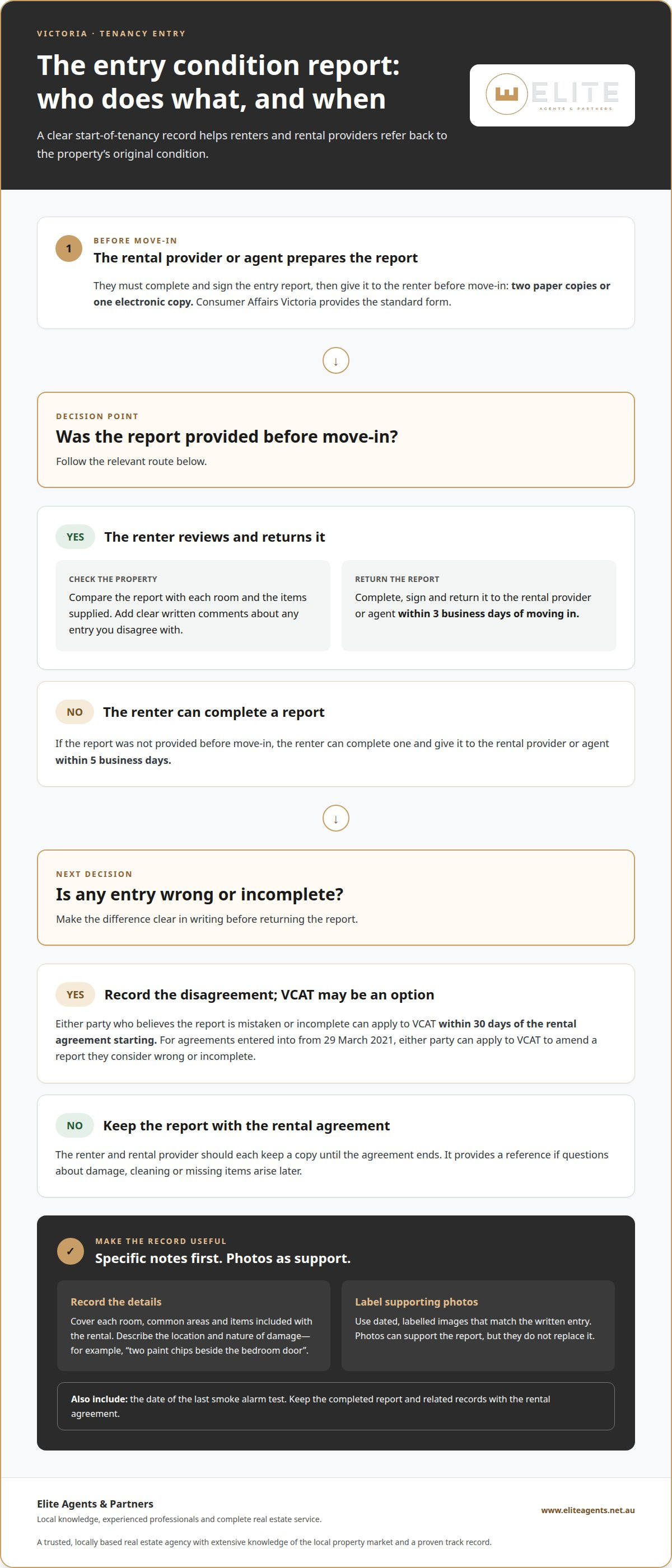
Specific observations are more useful than general comments. For example, note whether an oven is clean and working, or whether a wall has marks. The report must also include the date of the last smoke alarm test. The renter and rental provider should each keep a copy until the agreement ends.
Defects and existing damage
Describe existing damage clearly in the relevant section, identifying its location and nature. “Two paint chips beside the bedroom door” is more useful than “wall damaged”. Dated, labelled photographs can support the written details, but do not replace the report.
Accurate notes help distinguish a pre-existing defect from a change during the tenancy. If either party believes the report contains a mistake or is incomplete, they can apply to VCAT within 30 days of the rental agreement starting.
After receiving the report, the renter should review it, add comments about any entries they disagree with, and return it to the rental provider or agent. If they disagree with an entry, they can add comments before returning it. For Victorian rental agreements entered into from 29 March 2021, comments about defects or repairs act as written notice to the rental provider or agent.
A property manager can coordinate the entry inspection, provide the report and retain the relevant copy. Keeping the record with the rental agreement makes it easier to refer to the original condition later. For broader local context, follow Victorian property news alongside the property’s own report.
Photographs and evidence of pre-existing damage
In Victoria, dated, labelled photos can strengthen the written record of a property’s condition at the start of an agreement. A rental property condition report guide VIC renters use should explain that images support the condition report, but do not replace it.
Photographs and video evidence
Photos and video provide visual context for written observations, helping show where a defect is and what it looks like. A renter’s completed report can be evidence of the property’s condition when they moved in under section 36 of Victoria’s Residential Tenancies Act 1997.
Take a clear image of the affected area, followed by a closer view of the defect. For example, a photo of a marked wall can show where it is, while a close-up reveals the mark’s size. Video can capture a wider view, but neither format replaces the official written template.
Dated supporting evidence
Date and label each photo, then attach it to the condition report. A label such as “bedroom, left wall, near window” links the image to a specific part of the property. In a rental property condition report guide VIC renters follow, clear labels make evidence easier to understand alongside written comments.
Keep the images with the report and relevant rental agreement records. Their usefulness depends on how clearly they match the written entry. A photo that cannot be linked to a room or identified defect provides less context than one labelled with its location.
Photographs with condition notes
Pair each image with a concise, specific note rather than relying on the photo alone. “Two paint chips, approximately 10 mm each, beside the hallway door” describes the location and condition more precisely than “paint damaged”.
This detail helps distinguish recorded damage from changes during the tenancy, including fair wear and tear. A condition report alone does not automatically entitle a rental provider to claim money from a renter. Any proposed claim needs relevant supporting evidence and must comply with Victoria’s rental laws.
For guidance on rental matters beyond documenting condition, speak with the local team.
Rental provider responsibilities at the start of a tenancy
In Victoria, the rental provider or agent must give the condition report to the renter before move-in. The renter then completes, signs and returns it within three business days of moving in. These steps establish a written record of the property’s starting condition before questions arise.
Tenant inspection and report amendments
The renter reviews the report against the property and records disagreements in writing before returning it. This makes any differences clear while the tenancy is beginning. For VIC renters, a rental property condition report guide should explain how to describe a disputed entry clearly, rather than simply marking it as incorrect.
If the report wasn’t provided before move-in, the renter can complete one and give it to the rental provider or agent within five business days. For rental agreements entered into from 29 March 2021, either party can apply to VCAT to amend a report they consider wrong or incomplete.
Tenant and landlord responsibilities
The rental provider or agent must complete and sign the entry report, then give the renter two paper copies or one electronic copy before move-in. The renter should review the details, add relevant comments and return the signed report within the required period.
These responsibilities create a written record of the property, including the condition of fixtures and items supplied with it. Keep the completed copies with the rental agreement so the original record is available if questions or claims arise later. A rental property condition report guide for Victoria should make each party’s role clear.
Accessing the official Victorian form
Consumer Affairs Victoria provides the standard condition report form. Renters and rental providers can download it from the Consumer Affairs Victoria website and use the template to record the property’s condition.
The form identifies the Residential Tenancies Act 1997 as its governing legislation. It includes spaces for room-by-room observations and relevant property details, helping both parties record information consistently.
At the tenancy’s end, the rental provider or agent must complete the exit condition report in the same report given before move-in. They must do this within 10 days after the rental agreement ends, and the renter must be present or have a reasonable opportunity to attend. Comparing the entry and exit records helps identify changes during the tenancy, while allowing for fair wear and tear. Each party should retain their copy until the rental agreement ends.
Purpose of a rental property condition report
A condition report is more than a room-by-room description. In a Victorian residential tenancy, it provides a reference point for comparing the property’s condition at the beginning and end of the agreement. That comparison can help clarify whether an issue was already present or arose during the tenancy.
The report can support discussions or disputes about cleaning, damage, safety and missing items. For example, an entry note recording a cracked bathroom tile gives both parties a specific starting point if the tile is raised later. An accurate record keeps the discussion grounded in documented facts rather than competing recollections.
At the end of the tenancy, the rental provider or agent completes the exit report using the same report provided before move-in. Comparing the records helps identify changes to rooms, fixtures and included items. A scuffed floor noted at entry, for example, should be considered differently from damage that was not recorded initially.
The comparison must also account for fair wear and tear. Victorian renters must leave the property reasonably clean and in the same condition as at move-in, allowing for fair wear and tear. Ordinary ageing from living in a home is not the same as a specific new break or stain. The report helps frame the distinction, but does not resolve every disagreement by itself.
For a rental provider, the document supports a clear account of the property and any proposed claim. A report alone does not automatically entitle the rental provider to claim money from a renter. Relevant evidence must support a proposed claim, which must comply with Victoria’s rental laws. The renter can use the entry record to show that an issue was present from the start.
The practical takeaway is to treat the entry report as a baseline, not a guarantee that no dispute will arise. Specific observations, retained copies and a careful exit comparison give both parties a more reliable record to refer to if questions develop.
Elite Agents & Partners: Houses for rent
Elite Agents & Partners is a trusted local agency with extensive knowledge of the Berwick property market and surrounding areas, including Narre Warren, Cranbourne, Hallam and Pakenham. With extensive industry experience and a proven track record, the team provides personalised service and informed advice to renters exploring houses for rent and rental providers considering professional Property Management.
For landlords, Property Management is a practical next step when you want support overseeing a rental property and its tenancy arrangements. Renters looking for a home can explore available houses for rent, while homeowners considering a sale can seek guidance on Residential Property Sales. Advice can be shaped by local property values, rental demand and the needs of each client.
Contact Elite Agents & Partners to discuss your rental property or housing needs.
Plan your next property decision with confidence
A rental property condition report guide for VIC can help you treat tenancy records as part of a broader property plan. For rental providers, a next step may be considering how ongoing management fits their goals. For buyers or owners weighing a change, local market insight can help inform the decision.
Elite Agents & Partners offers Property Management, Residential Property Sales and Project Marketing. The team serves property owners, investors and buyers across Berwick and surrounding areas, including Narre Warren South, Dandenong, Clyde North and Beaconsfield. A conversation can connect your rental questions with your wider property priorities.
Whether you’re planning to lease, buy or sell, take the next step when it suits you.
Make your next property move with informed local support.
Frequently Asked Questions
What if the tenant disagrees?
If a renter or rental provider disputes an entry, either can apply to VCAT to amend a report considered wrong or incomplete, for rental agreements entered into from 29 March 2021. The application must be made within 30 days of the rental agreement starting. Keep the disputed entry specific, such as identifying the room and describing what the report records incorrectly.
What if the tenant does not return the report?
Keep the rental provider or agent’s signed copy and records showing when it was given. A missing renter signature does not document the property’s condition by itself. If a question about damage or the bond arises later, consider the available condition notes and supporting evidence. A condition report alone does not automatically establish a right to claim money from the renter.
What is a rental property condition report in Victoria?
A condition report is a written record of the property’s condition when the tenancy begins, which can later be compared with its condition at the end. Alongside rooms and included items, the Victorian form records details such as the last smoke alarm test date and telephone or internet connections. For a property with a pool, it also records the date of the last pool barrier compliance check.
Who must complete and provide the condition report in a Victorian rental?
The rental provider or agent must complete and sign the entry report, then give it to the renter before move-in. They provide two paper copies, or one electronic copy. A report is required for a Victorian rental property even when no bond is paid, so the tenancy still has a documented starting point.
How should renters complete and return a Victorian condition report?
Inspect the property, record any differences or omitted details, then sign and return the report within three business days of moving in. Use the comments to identify the room and describe the issue plainly. For example, distinguish a loose kitchen cupboard hinge from a missing cupboard door. Keep a copy of the completed report for your records.
What photos and evidence should be included in a rental condition report?
Include dated, labelled photos that clearly show existing damage and identify its location. A wide view can establish the room, while a closer image shows the defect. Attach the images to the written report and match each one to a relevant comment. Video may support the record, but cannot replace the written report required in Victoria.
Disclaimer
Disclaimer: This article was prepared with the assistance of artificial intelligence and reviewed for general informational purposes. While reasonable care has been taken to ensure accuracy, property-market conditions, prices, legislation and other information may change. The content does not constitute legal, financial, taxation, valuation or other professional advice. Readers should verify information and obtain advice appropriate to their circumstances before making property decisions. Elite Agents & Partners does not guarantee any specific sale price, rental return or outcome.


