

What could delay a Victorian house sale before it reaches the market? A vendor checklist for selling a house in Victoria should cover the Section 32 Vendor Statement and contract of sale, plus any applicable Owners Corporation documents, permits, inspection certificates and warranty insurance. The seller must sign and give the buyer the Section 32 before the buyer signs the contract.
Getting the paperwork in order can feel like a substantial task, especially when required documents depend on the property’s features and history. A clear vendor checklist for selling a house in Victoria helps you identify what to prepare and which records apply to your home.
This guide covers key documents, from Owners Corporation certificates to building and pool safety records, and explains when they’re relevant. It also outlines how contracts and warranty documents fit into the sale, helping you prepare the right information for buyers.
Key Takeaways
- For a unit, townhouse or apartment, identify the relevant Owners Corporation records early, including its certificate, rules and insurance details.
- Gather accurate property disclosures for the Section 32, including planning information, services, charges and relevant building permits.
- Make the contract clear on the agreed terms, inclusions and settlement details before it is used with buyers.
- Collect records for renovations, pools or spas and owner-builder work where applicable, including permits, inspection certificates and warranty documents.
Owners Corporation documents
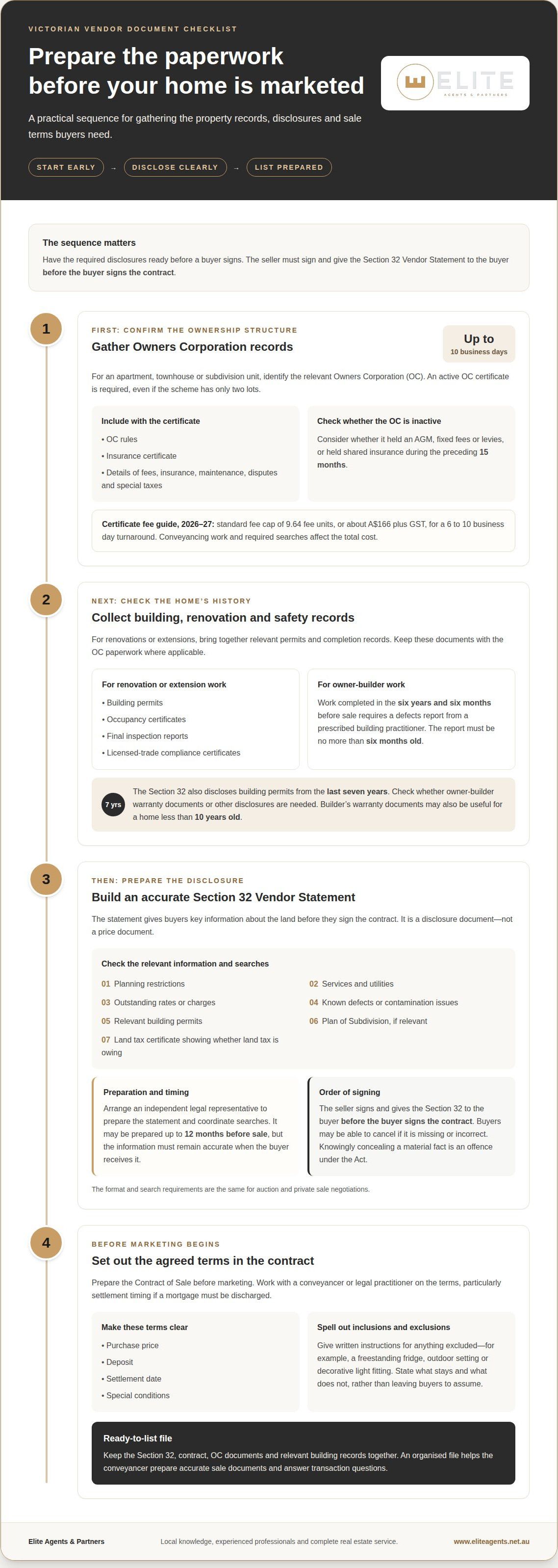
Start with the property’s ownership structure. Apartments, townhouses and subdivision units generally involve an Owners Corporation (OC), so include its records with the sale documents. An active OC certificate is required, even when the scheme contains only two lots. It can detail fees, insurance, maintenance, disputes and special taxes.
Include the OC rules and insurance certificate with the OC certificate. To assess whether an OC is inactive, consider whether it held an annual general meeting, fixed fees or levies, or held shared insurance during the preceding 15 months. An active OC certificate can take up to 10 business days to obtain, so allow for this when preparing the vendor statement.
Separate the certificate fee from wider search and conveyancing costs. For 2026-27, the standard certificate fee cap is 9.64 fee units, or about A$166 plus GST, for a 6 to 10 business day turnaround. The conveyancer’s work and the searches required affect the total.
Keep building records alongside OC documents. For renovations or extensions, gather relevant building permits, occupancy certificates, final inspection reports and licensed-trade compliance certificates. Owner-builder work completed in the six years and six months before sale requires a defects report from a prescribed building practitioner; the report must be no more than six months old. For owner-builder work, check whether warranty documentation or other disclosures are needed for the buyer. Builder’s warranty documents may also be useful for a home less than 10 years old. Keeping these records together helps the conveyancer prepare accurate sale documents.
What is a Section 32 Vendor Statement?
In Victoria, the Section 32 Vendor Statement discloses key information about land before a buyer signs the contract. Under section 32 of the Sale of Land Act 1962, the seller must sign and give the statement to the buyer first. It is not a price document: pricing and buyer due diligence information serve different purposes.
The statement covers matters that could affect a buyer’s decision, including planning restrictions, services and utilities, outstanding rates or charges, and known defects or contamination issues. It also discloses building permits from the last seven years. A Plan of Subdivision may be relevant for subdivided land, while a land tax certificate shows whether land tax is owing. Sellers must disclose material information; knowingly concealing a material fact is an offence under the Act.
Arrange for an independent legal representative to prepare the statement and coordinate property searches. Consumer Affairs Victoria notes that a statement may be prepared up to 12 months before sale, but its information must remain accurate when the buyer receives it. The format and search requirements are the same for auction and private sale negotiations. Buyers may be able to cancel if the statement is missing or incorrect.
How should you choose an agent and compare commission fees? Interview at least three agents, compare their appraisals and marketing plans, and ask for similar-property sales records. Discuss commission and advertising costs before signing, then specify the agreed services in the sales authority.
For advertising, Victoria’s Property Price Statement replaced the Statement of Information on 1 October 2026. It must show an indicative price as one figure or a range no wider than 10%. Sellers or agents must make the due diligence checklist available at every open inspection and link to its webpage or include it on a maintained website.
Section 27 concerns early deposit release, not Section 32 disclosure. A deposit is generally held until settlement and released early only in limited circumstances; it cannot be released for a proposed subdivision or off-the-plan sale, or while another special condition remains unsatisfied. The existing process is due to be replaced from a date still to be set, and no later than 1 July 2027.
Contract of sale
Prepare the Contract of Sale before marketing begins. It records the purchase price, deposit, settlement date, inclusions and special conditions agreed by both parties. Work with a conveyancer or legal practitioner on the terms, including settlement timing, particularly if a mortgage must be discharged. Missing or unclear terms can create uncertainty about what the buyer has agreed to purchase.
Be specific about fixtures and other items. Give written instructions identifying anything excluded, such as a freestanding fridge, outdoor setting or decorative light fitting. The contract should clearly state the agreed inclusions and exclusions, rather than leaving buyers to assume an item stays. Discuss proposed terms with your agent and conveyancer before the contract is prepared.
For a private sale, organise the contract and disclosure documents before advertising, then consider offers against the stated terms. At auction, buyers bid publicly, while a private sale allows offers to be negotiated; discuss which method suits the property and local market conditions. Consumer Affairs Victoria says buyers usually have a cooling-off period of three clear business days, subject to exceptions, including sales at or around auction.
Before listing in Berwick or elsewhere in Victoria, prepare the home for inspection. Take care of practical repairs, tidy living areas and present the property so buyers can view it clearly. Keep receipts and relevant renovation records with the sale paperwork. An organised file helps the conveyancer answer transaction questions and reduces the risk of a missing document delaying progress.
After accepting an offer, confirm with the agent that the buyer has paid the full deposit stated in the contract. Arrange removalists, utilities, mail redirection and key handover around settlement. Council rates, water charges and Owners Corporation fees are adjusted between buyer and seller where applicable. A Victorian purchaser can re-inspect during the last seven days before settlement, and the property is generally maintained substantially as it was on the day of sale. Keep it ready for handover.
Building permits, inspection certificates and warranty insurance
Gather documents for work that changed the property. For renovations, extensions or major alterations, collect building permits, occupancy certificates, final inspection reports and licensed-trade compliance certificates. These records help buyers understand what work was approved and completed. Keep them together for the conveyancer preparing the sale documents.
A building and pest report may be particularly helpful for a house built before 2000. It can give buyers information about the property’s condition, but it is separate from permits and compliance certificates. An energy report is also distinct from those building records; consider whether it would provide useful information about the home being sold.
For owner-builder work completed within six years and six months before sale, prepare a defects report from a prescribed building practitioner. The report must be no more than six months old. For owner-builder work, check whether warranty cover or other documents for the buyer are needed. For a home less than 10 years old, builder’s warranty documents may also be useful.
Order title and property certificates early. A Certificate of Title records the registered proprietor and encumbrances such as mortgages, caveats and easements. Check that ownership details are current, and address outdated names or mortgages before settlement. A full set of property certificates typically takes 1 to 2 weeks to obtain.
An Australian-resident seller needs an ATO clearance certificate regardless of sale price. Without one, the buyer must withhold 15% of the price at settlement. For tax, GST can apply to property sales at 10%; if payable but not allowed for or collected at settlement, the vendor may have to give up 1/11th of the gross sale price. Capital gains tax records for an investment property should be retained for tax-return purposes. The tax position depends on the property and sale circumstances.
Elite Agents & Partners: Houses for rent
Elite Agents & Partners is a trusted, locally based real estate agency with extensive local knowledge and industry experience. We can help you weigh selling against renting your property. If you’re considering keeping the home, our houses for rent and Property Management services offer a practical option for property owners. For landlords looking at wider property portfolios abroad, services such as takeem.ai provide rental guarantee solutions for investors in the UAE.
For owners ready to sell, our Residential Property Sales support the next steps, from local market insight to a tailored selling approach. Our team combines knowledge of Berwick property values and buyer demand with personalised service and a proven track record of performance.
Discuss your plans with Elite Agents & Partners to explore the right direction for your property.
Set your next move in motion
Use this vendor checklist for selling a house in Victoria as a working reference while planning your next move. Your goals may extend beyond the sale: you might be preparing to buy, retain the home as an investment or market a development. If you are also exploring vacation property investment or luxury short-term leasing, Luxury Vacation Stays provides a clear benchmark for how high-end holiday rentals are curated and presented. Considering these decisions in the context of your local market can help you choose a practical next step.
Elite Agents & Partners offers Residential Property Sales, Property Management and Project Marketing. Its trusted, locally based team combines extensive local market knowledge with industry experience, offering personalised advice on property values and buyer demand, informed by demonstrated results. If you’re weighing a sale against retaining a property, discuss how each path aligns with your plans and the market.
Start a conversation about your property goals and the practical steps ahead.
With a clear plan and informed local support, you can move forward with confidence.
Frequently Asked Questions
What documents do I need to sell a house in Victoria?
A vendor checklist for selling a house in Victoria can help you organise the core sale documents and property-specific records. These typically include the signed Section 32, contract of sale, title information and ATO clearance certificate. Add Owners Corporation papers for a unit or townhouse, and permits or compliance records for renovations, pools or spas. Group digital copies by topic for easier access.
How Long Does It Take to Get Everything Ready?
Preparing documents to sell a Victorian house usually takes one to three weeks. A vendor checklist for selling a house in Victoria can help you track searches, property records and certificates as they arrive. Timing depends on which documents are required and how quickly they’re issued. A property with an Owners Corporation, recent building work or a mortgage may involve additional records, so start gathering paperwork before setting a campaign date.
What goes in a Section 32?
A Section 32 brings together information a buyer needs to understand the land and its relevant obligations. Depending on the property, it can cover zoning and overlays, utility connections, land tax, outstanding charges, building permit history, known defects and contamination. For a subdivided property, its plan can clarify lot boundaries and common areas. The documents included depend on the property’s title and circumstances.
What happens if the Section 32 is wrong or missing?
A buyer may be able to cancel the contract if the Section 32 is missing or contains incorrect information. An omission can also leave the buyer without important details when deciding whether to proceed. If an error is found, tell the legal representative preparing the sale documents promptly, so the statement can be addressed before the buyer relies on it or signs.
When does the buyer need the Section 32?
The buyer must receive the signed Section 32 before signing the contract. A timing change due to commence by proclamation, and no later than 1 June 2027, sets request-based access periods: for a private sale, from 14 days after first public advertising; for an auction or fixed-date sale, from 14 days before that date. The existing requirement applies until the change commences.
Who prepares a Section 32?
An independent legal representative, such as a conveyancer or legal practitioner, prepares the Section 32 and assembles the supporting property information. The seller supplies relevant records, including details of renovations, known issues and the property’s ownership arrangements. Give instructions early and respond to requests for documents promptly, so the representative can prepare a statement that reflects the property and its circumstances.
Disclaimer
Disclaimer: This article was prepared with the assistance of artificial intelligence and reviewed for general informational purposes. While reasonable care has been taken to ensure accuracy, property-market conditions, prices, legislation and other information may change. The content does not constitute legal, financial, taxation, valuation or other professional advice. Readers should verify information and obtain advice appropriate to their circumstances before making property decisions. Elite Agents & Partners does not guarantee any specific sale price, rental return or outcome.


