

What if the highest suggested asking price could make it harder to attract buyer interest? Choosing a pricing strategy to sell your house can feel uncertain when comparable sales, online listings and advice from people you trust point in different directions. A sales appraisal is a useful starting point, but it is not a guaranteed sale price, and your priorities matter too.
The right approach balances relevant local evidence with buyer response and the outcome you want from your sale. This guide explains how to assess comparable properties, distinguish an appraisal from your chosen asking price and have an informed discussion with your selling agent. You’ll also learn what buyer feedback may signal and when a review could make sense. Based in Berwick, Elite Agents & Partners can bring local property knowledge and personalised advice to the conversation, with clear, constant communication and an “always available” approach.
Key Takeaways
- A considered pricing strategy to sell your house balances relevant sales evidence with your selling priorities, rather than relying on a single figure.
- Compare your property with recent, nearby sales that share meaningful features. Treat active listing prices as asking prices, not confirmed sale evidence.
- Agree on your objectives, choose a pricing approach with your agent, then use buyer feedback to decide whether a review is warranted.
- Ask a local agent to explain the evidence behind their appraisal and how it informs the campaign. Elite Agents & Partners offers sales appraisals and local advice in Berwick, supported by clear, constant communication and an “always available” approach.
House pricing strategy: what the asking price needs to do
A pricing strategy to sell your house is an evidence-based way to choose and review the asking price used in your campaign. That price sets an expectation for buyers and helps shape how they consider your property. It is a considered starting point, not a promise of the result.
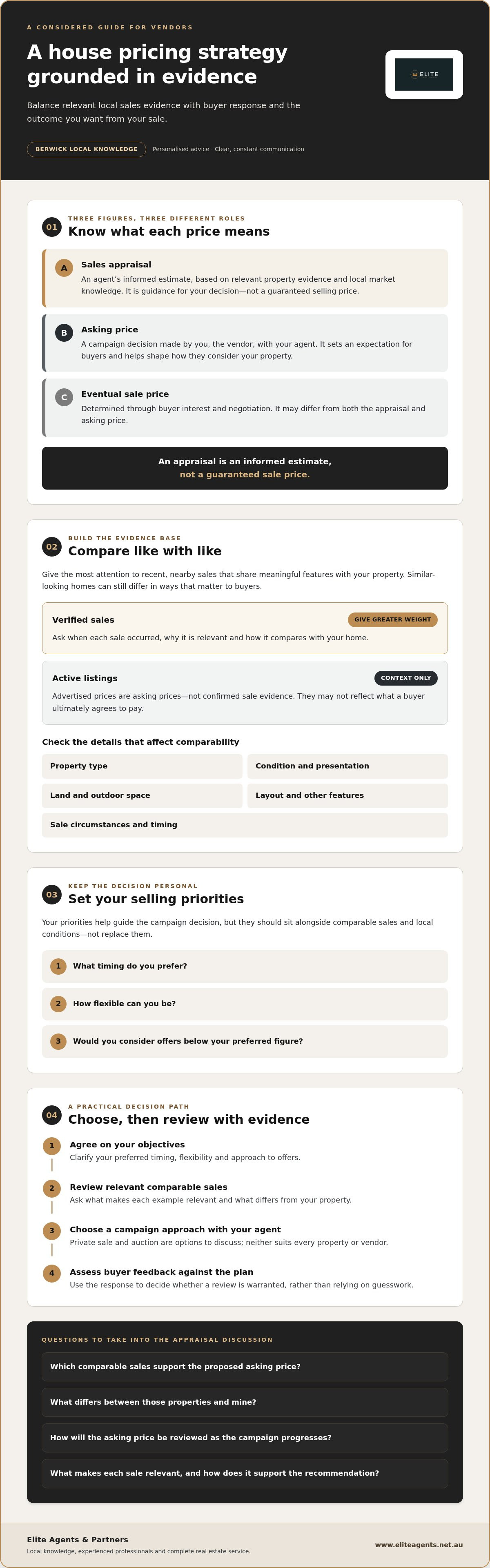
A sales appraisal is an agent’s informed estimate, based on relevant property evidence and local market knowledge. The asking price is a campaign decision made by you, the vendor, with your agent. The eventual sale price is determined through buyer interest and negotiation. Comparable sales can help inform an appraisal: the Sales comparison approach describes how similar properties can be used to assess value.
An appraisal is an informed estimate, not a guaranteed selling price.
Asking price, sales appraisal and sale price: how they differ
Think of an appraisal as guidance for your decision, not a figure you are obliged to use. For example, an agent might assess a home against similar properties, while you and the agent decide how to position its asking price for the campaign. Internationally, reputable property and valuation agencies such as FUNDAM&T Makelaars en Taxateurs emphasise this distinction, guiding buyers and sellers with structured appraisals grounded in local market data. If buyers make offers or negotiate, the final sale price may differ from both the appraisal and the asking price. No figure can guarantee a particular outcome.
Start with your priorities as a vendor
Be clear about what matters to you before agreeing on a campaign price. Consider your preferred timing, how flexible you can be and whether you are open to considering offers below your preferred figure. These priorities help guide decisions, but should not replace evidence about comparable sales and local conditions.
For vendors in Berwick, Elite Agents & Partners can bring local property knowledge to the appraisal discussion and help you weigh the evidence against your selling priorities. Ask your agent to explain the proposed price, including which comparable properties informed it and how the asking price will be reviewed as the campaign progresses.
Build a house pricing strategy from comparable sales and local evidence
A sound pricing strategy to sell your house starts with evidence that reflects your property and its market context. In Berwick, ask your agent which comparable sales inform their appraisal and why those examples are relevant. You can also review recently sold properties, while remembering that each home has its own characteristics and sale circumstances.
Which comparable properties deserve the most weight?
Start with properties that are nearby and similar in type, condition, land and features. A house that looks alike in online photos may still differ in layout, presentation, outdoor space or other details that affect how buyers assess it. The circumstances and timing of its sale may also differ. Ask your agent to explain these differences rather than relying on surface similarities alone.
Active listings can show what buyers are currently being asked to consider, but their asking prices are not confirmed sale evidence. An advertised price may not reflect what a buyer ultimately agrees to pay. Give greater weight to verified sales, and ask when each sale occurred and how it compares with your property.
Use local evidence without treating it as a prediction
Request current local examples and separate confirmed details from assumptions. For each comparable sale, ask: What makes this property relevant, what differs from mine, and how does the sale support the proposed asking price? This makes the reasoning behind the recommendation clearer without treating past sales as a promise of your result.
For broader context, use local market analysis only when its information is current and relevant to your property. A market overview can help frame the discussion, but it should not replace property-specific evidence. Elite Agents & Partners, based in Berwick, can discuss comparable sales and local conditions as part of a sales appraisal. If you are weighing up the evidence, explore a property appraisal with the team.
Choose and review a pricing approach as buyer feedback comes in
A clear process helps keep your pricing decision grounded in evidence rather than guesswork. Agree on your selling objectives, review comparable sales, choose a campaign approach with your agent, then assess buyer feedback against the original plan. A private sale and an auction are both options to discuss. Neither is the right pricing solution for every property or vendor.
What should vendors ask before agreeing on an asking price?
Ask which comparable sales support the recommendation and what differences between those properties and yours matter. Clarify how the campaign will communicate your home’s appeal to buyers, and how often your agent will share feedback and discuss next steps. These questions help you understand the reasoning behind the proposed price and how the campaign will be managed.
When might a vendor review the asking price?
Look for patterns, not a single reaction. Consider whether buyers are enquiring, attending open for inspections and commenting on the property or its price. Discuss that feedback with your agent alongside current comparable evidence, campaign activity and your original priorities. For example, repeated comments about value may warrant a closer review, while one buyer’s opinion on its own may not.
Buyer feedback is evidence to consider, not a guaranteed signal of the price your property will achieve. A review does not automatically mean changing the asking price. It is a chance to check whether the campaign approach still aligns with the evidence and your objectives. Elite Agents & Partners emphasises clear, constant communication and an “always available” approach, so vendors can discuss campaign feedback and possible next steps with their agent.
Work with a local agent to set a considered house pricing strategy
A sound pricing recommendation should be supported by clear comparable evidence, explained assumptions and room for your questions. Do not choose an agent based only on an unsubstantiated price promise; established property professionals, such as the team at Integrity Estates Realty, consistently emphasise transparent market data over guesswork. Check that the advice reflects your property’s features, local conditions and priorities as a vendor.
| Evidence to request | Question to ask | Decision it informs |
|---|---|---|
| Relevant comparable sales | How does each sale compare with my property? | Whether the proposed asking price is supported by local evidence |
| Property features and presentation | What will buyers notice, and how will the campaign communicate its appeal? | How to position the home and tailor its marketing |
| Campaign feedback plan | How will you share buyer comments and discuss next steps? | How you’ll assess feedback and consider a review |
Prepare for a focused sales appraisal conversation
Before meeting an agent, note your property’s key features, condition and any updates that may shape its appeal. Bring your selling priorities too. Ask which comparable sales inform the appraisal, how the marketing will present your home, and how feedback will be communicated. Treat the appraisal as the start of a discussion, not a guaranteed result.
Elite Agents & Partners is based in Berwick and offers residential property sales, sales appraisals, local advice and tailored marketing. These services can help vendors consider the evidence and campaign choices relevant to their property. The agency’s brand message is “We bring your home to life”, supported by clear, constant communication and an “always available” approach. For further guidance, read the Berwick home-selling guide.
Move forward with a considered asking price
A confident pricing strategy to sell your house starts with clear evidence and a campaign approach that reflects your priorities. Elite Agents & Partners can help you consider the local market through residential sales appraisals and advice, then tailor marketing to present your property. Buyer feedback can inform discussions as the campaign progresses, without making any sale outcome certain.
Based in Berwick, Elite Agents & Partners offers residential property sales, property management and rental appraisals. For a sales campaign, its marketing can include professional photography, video production and open-house experiences. The agency emphasises clear, constant communication and an “always available” approach, alongside its brand message, “We bring your home to life”.
With local guidance and a considered plan, you can approach your next property decision with greater confidence.
Frequently Asked Questions
How do I negotiate an asking price with a real estate agent?
Start by explaining your priorities as a vendor, including your preferred timing and flexibility. Ask which comparable sales support the recommendation, how the agent views buyer expectations and how feedback will be reported once the campaign begins. You make the pricing decision. A clear explanation helps you weigh the advice and evidence without mistaking an appraisal estimate for a promised sale price.
Should I price my house above what my agent recommends?
You can discuss a higher asking price, but first ask the agent to explain the evidence and possible trade-offs. The price may influence which buyers consider your property, though the effect depends on the home and market response. Review comparable sales, your priorities and campaign feedback together. A pricing strategy to sell your house should be evidence-based, not built around a price point that guarantees a result.
What evidence should an agent use to recommend a house asking price?
Ask for recent, relevant comparable sales and a clear explanation of how location, property type, condition, land and features affect each comparison. For example, a similar-looking home may differ in land size or condition. Active listing prices can offer context, but they are not completed sales. Ask the agent to explain their reasoning and ensure local figures are current and verified before relying on them.
Can I change my asking price after my house is listed?
Yes, you can discuss a pricing review with your agent after the campaign begins. Consider patterns in buyer enquiries, open-for-inspection attendance and comments alongside comparable evidence, rather than reacting to one opinion. Discuss whether the campaign approach still suits your property and priorities, and what any adjustment would mean. Reviewing the price can inform your next decision, but it cannot guarantee a particular sale outcome.
Is a sales appraisal the same as an asking price?
No. A sales appraisal is an agent’s informed estimate based on available property and market information. The asking price is a campaign decision made by you, the vendor, after considering the appraisal, comparable sales and your priorities. Elite Agents & Partners provides sales appraisals and local property advice in Berwick, Narre Warren, Narre Warren South, Narre Warren North, Hallam, Hampton Park, Dandenong, Doveton, Cranbourne, Cranbourne East, Clyde, Clyde North, Officer, Pakenham, Beaconsfield and Drouin. Neither figure guarantees the final sale price.
Disclaimer
Disclaimer: This article was prepared with the assistance of artificial intelligence and reviewed for general informational purposes. While reasonable care has been taken to ensure accuracy, property-market conditions, prices, legislation and other information may change. The content does not constitute legal, financial, taxation, valuation or other professional advice. Readers should verify information and obtain advice appropriate to their circumstances before making property decisions. Elite Agents & Partners does not guarantee any specific sale price, rental return or outcome.


