

A fair final rental inspection is a documented comparison, not a subjective cleanliness test. The property shouldn’t be expected to look brand new: assess its condition against the ingoing condition report, allowing for fair wear and tear. Knowing how to conduct a final rental inspection helps rental providers and renters focus on clear evidence rather than assumptions.
It’s understandable to be unsure what to check, how to distinguish cleaning issues from damage, or which records to have ready. This guide sets out a practical room-by-room checklist for assessing the property, recording findings and preparing for a constructive discussion. You’ll also learn how to organise photos and documents, communicate concerns clearly and consider next steps if there’s a disagreement. Elite Agents & Partners is a locally based real estate agency with knowledge of the local rental market. Our professional property management includes Lease Administration, supporting consistent inspection records and follow-up.
Key Takeaways
- Learn how to conduct a final rental inspection by using the original condition report as your reference, rather than expecting the property to be perfect.
- Prepare relevant documents and organise the inspection so you can assess each room and included feature consistently.
- Record specific observations and supporting evidence to make follow-up discussions clearer and more constructive.
- Handle differing views by keeping communication focused on documented facts and the applicable Victorian process.
What is a final rental inspection and its purpose?
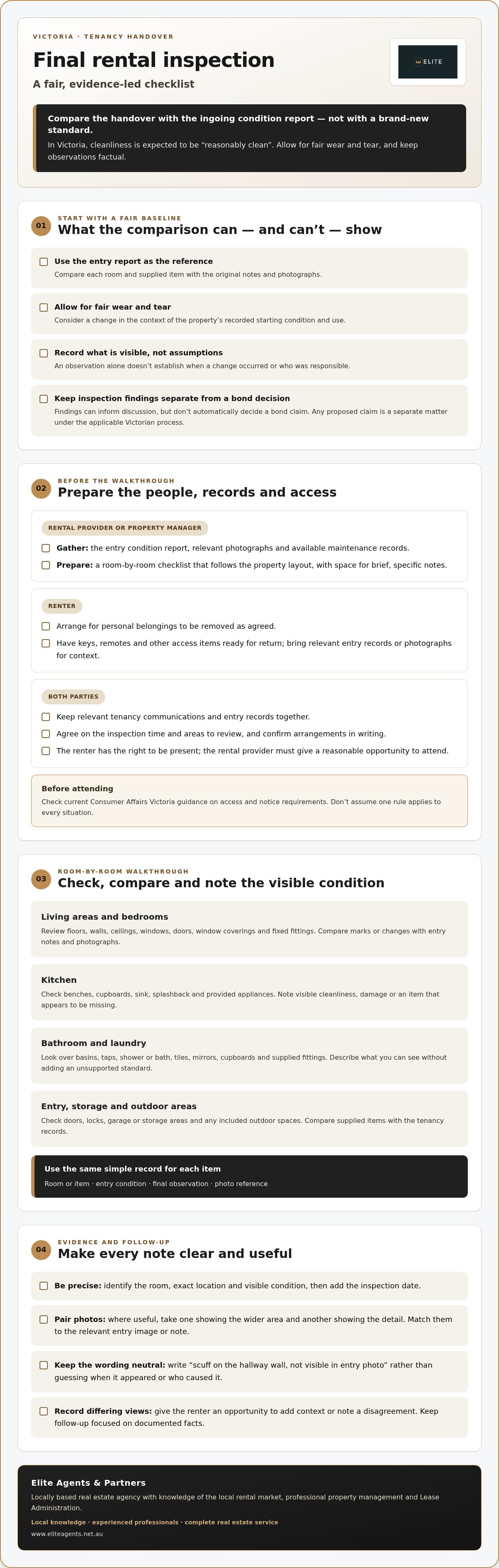
A final rental inspection is a documented review of a rental property at the end of a tenancy. The rental provider or property manager records its condition and compares it with the ingoing condition report, rather than judging it against a fresh or perfect standard. In Victoria, the expected cleanliness is “reasonably clean”, with fair wear and tear taken into account.
This comparison helps distinguish ordinary changes from possible damage or missing items. A worn patch of carpet, for example, should be considered in the context of its recorded condition at the start of the tenancy and the property’s use. A new break or an item noted at entry but absent at handover may need closer review. The observation itself doesn’t establish when a change occurred or who was responsible.
Inspection findings can inform discussion, but they don’t automatically decide a bond claim. Keep observations factual and supported by records. Any proposed bond claim is a separate matter to be considered through the applicable Victorian process, with evidence relevant to the condition comparison. General landlord-tenant law provides broader context, but Victorian requirements are specific to the local framework.
Why compare the final condition with the entry report?
The entry report gives both parties a reference for assessing changes. Dated notes and photographs can show whether a mark, fixture or supplied item was already recorded, helping avoid reliance on memory alone. To conduct a final rental inspection fairly, describe what you can observe, then compare it with that evidence.
Write “scuff on the hallway wall, not visible in entry photo” rather than assuming when it appeared or who caused it. The final inspection records the property’s observed condition at handover alongside its documented condition at the start of the tenancy. Clear, neutral wording makes follow-up discussion more constructive.
How to prepare for a fair final rental inspection in Victoria
Preparation makes the handover clearer for everyone. Before setting a time, gather the records, agree on access arrangements and keep the inspection focused on documenting the property’s condition, not assigning blame. Confirm arrangements in writing so each party can refer back to them.
- Rental provider or property manager: Locate the entry condition report, relevant photographs, available maintenance records and a room-by-room checklist.
- Renter: Arrange for personal belongings to be removed as agreed, and have keys, remotes and other access items ready for return.
- Both parties: Keep relevant tenancy communications and entry records together. Agree on the inspection time and the areas to be reviewed.
- Before attending: Check current Victorian guidance on access and notice requirements rather than assuming one rule applies to every situation.
In Victoria, the renter has the right to be present at the final inspection, and the rental provider must give them a reasonable opportunity to attend. Arrange the details respectfully, and check current Consumer Affairs Victoria guidance if you’re unsure how the requirements apply to your circumstances.
What should each party bring or prepare?
The property manager’s checklist should follow the property layout and leave space for brief, specific notes. The renter can bring relevant entry records or photographs to add context. Keep keys and remotes together, and record what has been returned. For rental providers seeking ongoing support, Elite Agents & Partners provides property management and Lease Administration, including move-in and move-out inspections and condition reporting.
How can both parties keep the inspection constructive?
Describe what’s visible without speculating about its cause. “Chip on the kitchen benchtop” is more useful than an accusation. Give the renter an opportunity to add context or record a disagreement. A consistent approach to how to conduct a final rental inspection keeps the discussion grounded in observations and supports clear follow-up.
Final rental inspection checklist: what to check and record
Work through the property in a consistent order, using the entry report as your reference. For each room, note cleanliness, visible damage, missing items and the condition of fixtures or provided appliances. Record outdoor areas and equipment only where they are included in the tenancy records. A simple checklist can use columns for the room or item, entry condition, final observation and any photo reference.
Room-by-room checks for the walkthrough
- Living areas and bedrooms: Review floors, walls, ceilings, windows, doors, window coverings and fixed fittings. Compare marks or changes with the entry notes and photographs.
- Kitchen: Check benches, cupboards, sink, splashback and provided appliances. Note visible cleanliness, damage or an item that appears to be missing.
- Bathroom and laundry: Look over basins, taps, shower or bath, tiles, mirrors, cupboards and supplied fittings. Describe what you can see without applying a standard that isn’t supported by the agreement or Victorian guidance.
- Entry, storage and outdoor areas: Check doors, locks, garage or storage areas and any included outdoor spaces. Compare supplied items with the tenancy records.
How to document cleaning, damage and fair wear
Make each note specific: identify the room, exact location and visible condition, then add the inspection date. For example, “rear bedroom, small dent on the lower section of the door” is clearer than “door damaged”. Where useful, take one photograph showing the wider area and another showing the detail, then match them to the relevant entry image or note.
Describe the observation, not who you think caused it. Compare like with like, and don’t automatically treat every change as damage. In Victoria, assess the condition against the entry report, taking fair wear and tear into account. Check current Consumer Affairs Victoria guidance if you need to clarify how this applies. Comparable notes and photographs make the condition record easier to review.
Consistent documentation is part of professional property management. Elite Agents & Partners’ Lease Administration includes move-in and move-out inspections and condition reporting.
After the final rental inspection: records, discussion and next steps
After the walkthrough, complete the inspection record using the applicable Victorian process. Check current Consumer Affairs Victoria guidance for requirements about completing and sharing the exit condition report, including any timing that applies. Keep the report, supporting photographs and relevant tenancy communications together so the record is clear and easy to refer to.
Separate factual observations from proposed follow-up. The record can describe a difference in condition; any discussion about cleaning, repairs or a bond claim should be documented separately and supported by relevant evidence. Knowing how to conduct a final rental inspection also means keeping these matters distinct, so disagreement about one item doesn’t blur the overall condition record. While statutory rules differ across jurisdictions, structured documentation remains a standard practice for residential managers worldwide—overseas full-service providers such as tbmpropmanagement.com, for instance, similarly emphasise rigorous property condition checks to protect investor assets and maintain clear tenancy records.
What if the renter and rental provider disagree?
Stay specific. Record each party’s view beside the disputed item, then identify the evidence that relates to it, such as an entry photograph, a dated note or a relevant maintenance record. The inspection itself doesn’t determine a bond dispute. If agreement isn’t reached, consult current Consumer Affairs Victoria guidance for the applicable Victorian resolution pathways rather than relying on processes used in another state.
When can property management support help?
Consistent record-keeping and clear follow-up can make tenancy handovers easier to manage. Elite Agents & Partners is a locally based Berwick agency providing professional property management. Its Lease Administration includes move-in and move-out inspections and condition reporting, while renter communication can support follow-up. If an inspection identifies a maintenance matter, Maintenance and Repairs includes request handling and coordination with licensed contractors.
For rental providers seeking ongoing support, contact Elite Agents & Partners to discuss professional property management for your rental property.
Make your next tenancy handover more straightforward
A clear handover can help set a consistent standard for the next tenancy. Use the experience to refine how records are organised and shared, so future discussions stay focused on documented facts. For rental providers, reliable property management also means keeping communication and follow-up connected throughout the tenancy, not just at move-out.
Elite Agents & Partners combines local property knowledge with personalised service and professional property management. Based in Berwick, the agency serves rental providers across Berwick, Narre Warren, Narre Warren South, Narre Warren North, Hallam, Hampton Park, Dandenong, Doveton, Cranbourne, Cranbourne East, Clyde, Clyde North, Officer, Pakenham, Beaconsfield and Drouin. Lease Administration includes move-in and move-out inspections and condition reporting, alongside renter communication.
If you’re considering how to conduct a final rental inspection as part of a more consistent management approach, speak with a team that understands the local market and community.
With an organised process and knowledgeable local support, you can approach each handover with greater clarity and confidence.
Frequently Asked Questions
Can a renter attend the final rental inspection in Victoria?
Yes. In Victoria, a renter has the right to be present at the final inspection, and the rental provider must give them a reasonable opportunity to attend. Agree on a time and access arrangements in writing, then note who attended and any comments raised. Check Consumer Affairs Victoria for current guidance on arranging access and any notice requirements relevant to the circumstances.
What should be checked during a final rental inspection?
Check each room against the entry condition report, including cleanliness, visible damage, fixtures and supplied items. For example, note whether a listed remote or appliance is present and describe any visible change to a surface. Record the location of each observation and take clear photographs where useful. Avoid conclusions about responsibility, and use current Victorian guidance to distinguish ordinary use from damage.
Does a final rental inspection determine whether the renter gets the bond back?
No. The inspection records the property’s condition and may inform discussion, but it doesn’t by itself decide the bond outcome. If an item is disputed, compare the entry and exit evidence and keep any related communication together. Bond matters follow a separate Victorian process, so consult Consumer Affairs Victoria for current information about the relevant steps. This is general information, not legal advice.
What is the difference between a final inspection and a condition report?
The final inspection is the review of the property; the condition report is the written record of observations made during that review. The entry report gives context for the final record. For clarity, describe an item by its room and location, then match it with a relevant photograph where available. Check Consumer Affairs Victoria for current requirements on completing and sharing reports in Victoria.
How should fair wear and tear be considered at a final inspection?
Ordinary use shouldn’t automatically be labelled renter-caused damage. Consider the item’s recorded starting condition, the tenancy duration and relevant photographs or maintenance records, without assuming who caused a change. If the evidence doesn’t settle the question, document what remains unclear and discuss it calmly with the other party. Use current Consumer Affairs Victoria guidance to understand the applicable Victorian distinction.
Disclaimer
Disclaimer: This article was prepared with the assistance of artificial intelligence and reviewed for general informational purposes. While reasonable care has been taken to ensure accuracy, property-market conditions, prices, legislation and other information may change. The content does not constitute legal, financial, taxation, valuation or other professional advice. Readers should verify information and obtain advice appropriate to their circumstances before making property decisions. Elite Agents & Partners does not guarantee any specific sale price, rental return or outcome.


