

Understanding which rental costs can be passed on to renters helps rental providers manage their properties correctly and avoid disputes. In Victoria, rental providers can collect agreed rent and recover certain expenses, but additional charges must be permitted by law. Including a fee in a rental agreement does not automatically make it enforceable.
This guide explains the main charges for residential rental properties, based on Consumer Affairs Victoria’s guidance current at 15 October 2026.
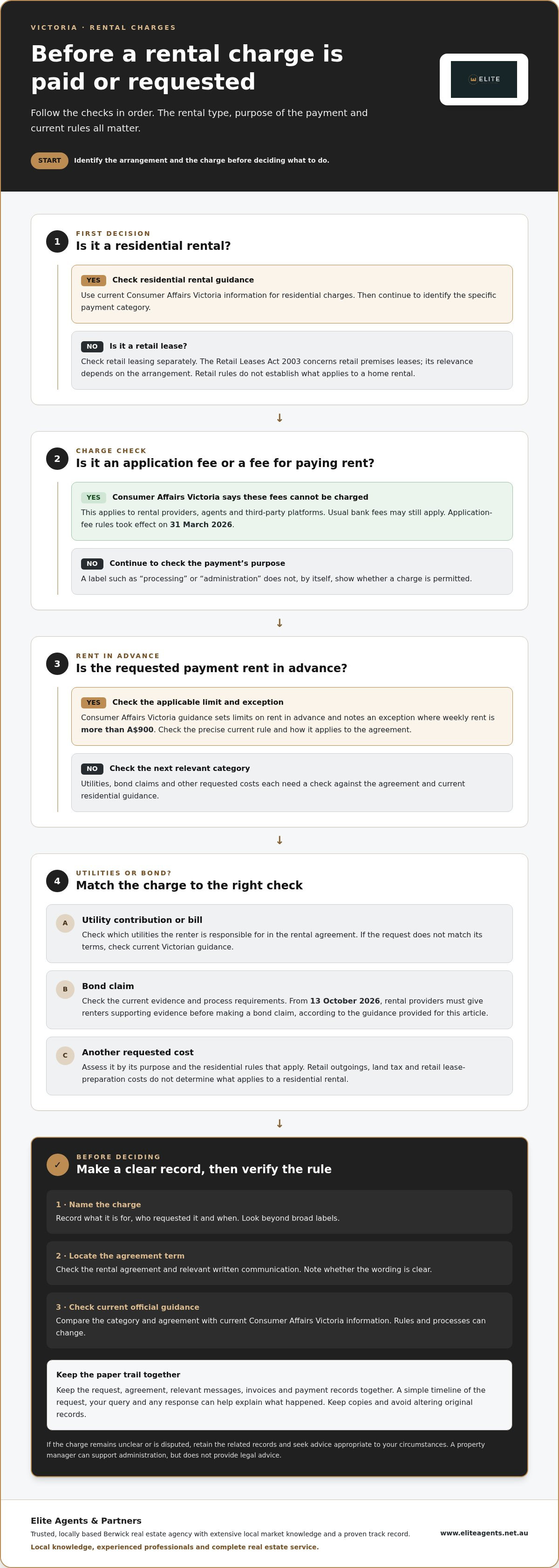
1. Rent and Rent in Advance
Rental providers can collect rent at the amount and frequency stated in the rental agreement.
For most residential rentals, the maximum rent in advance is:
- One month’s rent where rent is paid monthly or at another agreed frequency.
- 14 days’ rent where rent is paid weekly.
Where rent exceeds $900 per week, different rules allow a larger advance payment, up to the full value of the agreement. Rent in advance covers an upcoming rental period; it is separate from the bond.
Rent increases must also follow the correct process. In most cases, rent cannot increase more than once every 12 months. Rental providers must give at least 90 days’ notice, use the prescribed form and explain the calculation. During a fixed term, an increase must be permitted by the agreement, which must state how it will be calculated.
2. Rental Bonds
A rental provider can request a bond as security against certain unpaid amounts or losses at the end of the agreement.
Generally, the bond cannot exceed one month’s rent. A higher bond may be permitted where weekly rent exceeds $900 or VCAT has authorised a higher amount.
The bond is held by the Residential Tenancies Bond Authority (RTBA). It remains the renter’s money unless a valid claim is established; it is not an additional management fee or income for the rental provider.
3. Water, Electricity, Gas and Internet
Utility responsibilities depend on the service and whether the property is separately metered.
- Water: Where the property has its own meter, renters generally pay water usage and the sewage disposal charge, unless the rental provider agrees otherwise. Rental providers pay water supply charges and sewerage infrastructure charges. Without a separate meter, the rental provider pays.
- Electricity and gas: Renters generally pay supply and usage charges where separately metered, unless otherwise agreed. Rental providers pay for initial installation and connection of the supply.
- Bottled gas: Renters generally pay for gas supplies and bottle hire.
- Phone and internet: Renters generally pay ongoing usage and connection to an existing telephone line. Rental providers pay initial installation costs, including an initial NBN connection.
A rental provider may be responsible for excess utility charges caused by a hidden fault, subject to conditions including prompt notification and the renter not causing the fault. Bills should be checked carefully before reimbursement is requested.
4. Damage Beyond Fair Wear and Tear
Rental providers may seek compensation for damage for which the renter is responsible. However, renters cannot be charged for fair wear and tear or repairs that are the rental provider’s responsibility.
Consumer Affairs Victoria distinguishes deterioration from ordinary use or environmental exposure from damage. For example, faded curtains may be fair wear and tear, while ripped curtains may be damage.
The entry condition report, exit inspection and photographs help establish whether the condition changed during the rental agreement.
5. Cleaning at the End of the Agreement
Renters must leave the property reasonably clean and in the same condition as at the beginning, allowing for fair wear and tear. Where that standard has not been met, the rental provider may seek compensation for necessary additional cleaning.
Professional cleaning is not an automatic requirement for every vacating renter. For agreements entered into from 29 March 2021, restrictions apply. The requirement must relate to restoring the property’s starting condition, allowing for fair wear and tear, or circumstances where professional cleaning is needed.
A routine cleaning charge should not replace an assessment of the property’s actual condition. Condition reports and photographs provide the basis for discussing any cleaning claim.
6. Costs When a Renter Breaks the Agreement
A renter who leaves early may have to compensate the rental provider for certain losses. Depending on the circumstances, recoverable costs can include:
- Lost rent while reasonable efforts are made to find another renter.
- Reasonable advertising expenses actually incurred.
- A proportionate re-letting fee where an agent is used.
The rental provider must take reasonable steps to re-let promptly. Rent cannot continue to be claimed from the outgoing renter after the property is re-let.
Re-letting fees generally reflect the proportion of the agreement remaining. For example, if half the agreed term remains, the renter would generally be responsible for half the re-letting fee.
These costs are compensation, rather than a penalty. Some lawful early termination grounds allow renters to leave without lease-break costs, so the reason for leaving must be checked first.
7. Fees Rental Providers Cannot Charge
Rental providers cannot charge renters late-rent fines or fees for processing rent, issuing rent cards or establishing direct debit facilities. Ordinary fees charged by a renter’s own bank are a separate matter.
From 13 October 2026, rental providers and agents are expressly prohibited from charging rental application or rent-payment fees. This extends the ban applying to third-party rental platforms since 31 March 2026.
Rental agreements also cannot require renters to pay agreement-preparation fees, arrange or pay for safety-equipment maintenance that is the rental provider’s responsibility, or automatically pay the rental provider’s insurance excess. Prohibited terms remain invalid even when included in a signed agreement.
A separate pet bond cannot be charged, although renters remain responsible for meeting their cleanliness and damage obligations when keeping pets.
8. Supporting and Resolving Claims
Before lodging a bond claim, rental providers must notify the renter at least three business days in advance and provide supporting evidence, such as invoices, receipts, quotes or photographs. The evidence must not contradict the condition report.
Disputed amounts should be discussed with clear supporting records. Rental Dispute Resolution Victoria can assist with unresolved bond disputes, with VCAT available where a decision is required.
At Elite Agents & Partners, we help rental providers manage rental payments, inspections and supporting records with clear communication. Contact our Berwick team to discuss property management for your investment.
This article provides general information about residential renting in Victoria. Refer to Consumer Affairs Victoria for current guidance relevant to your circumstances.
Disclaimer
Disclaimer: This article was prepared with the assistance of artificial intelligence and reviewed for general informational purposes. While reasonable care has been taken to ensure accuracy, property-market conditions, prices, legislation and other information may change. The content does not constitute legal, financial, taxation, valuation or other professional advice. Readers should verify information and obtain advice appropriate to their circumstances before making property decisions. Elite Agents & Partners does not guarantee any specific sale price, rental return or outcome.


