

What if the 2021 Victorian rental law reforms weren't a barrier to your property success, but a sophisticated framework for your protection? Most rental providers feel a genuine sense of unease when faced with the VCAT process for landlords, particularly with an eight week average wait time for possession applications. It's understandable to feel anxious about representing yourself or confused by the shift from "landlord" to "rental provider" while your rental income remains at risk. You deserve a resolution that respects your time and your investment.
By mastering the complexities of the Victorian Civil and Administrative Tribunal, you can safeguard your assets and resolve disputes with professional poise. We've curated this guide to provide a clear roadmap of the application and hearing process. You'll gain the confidence to ensure your evidence is sufficient and your documentation is flawless. This strategic approach allows you to minimise financial loss through a swift, decisive resolution, ensuring your Victorian property portfolio continues to perform at its peak.
Key Takeaways
- Understand the transition to 'Rental Provider' terminology and VCAT's role as a quasi-judicial body to navigate the system with professional precision.
- Master the VCAT process for landlords by utilising the online portal and identifying the specific legislative sections required for your possession or bond claim.
- Prepare an elite-standard evidence bundle, prioritising the Entry Condition Report as the cornerstone of your successful dispute resolution.
- Navigate virtual hearing rooms with confidence and learn to leverage mediation as a strategic tool for reaching an efficient settlement.
- Gain a clear roadmap for enforcing VCAT Orders through the Magistrates' Court to recover debts and secure your property investment.
Understanding the VCAT Process for Landlords: A Professional Overview
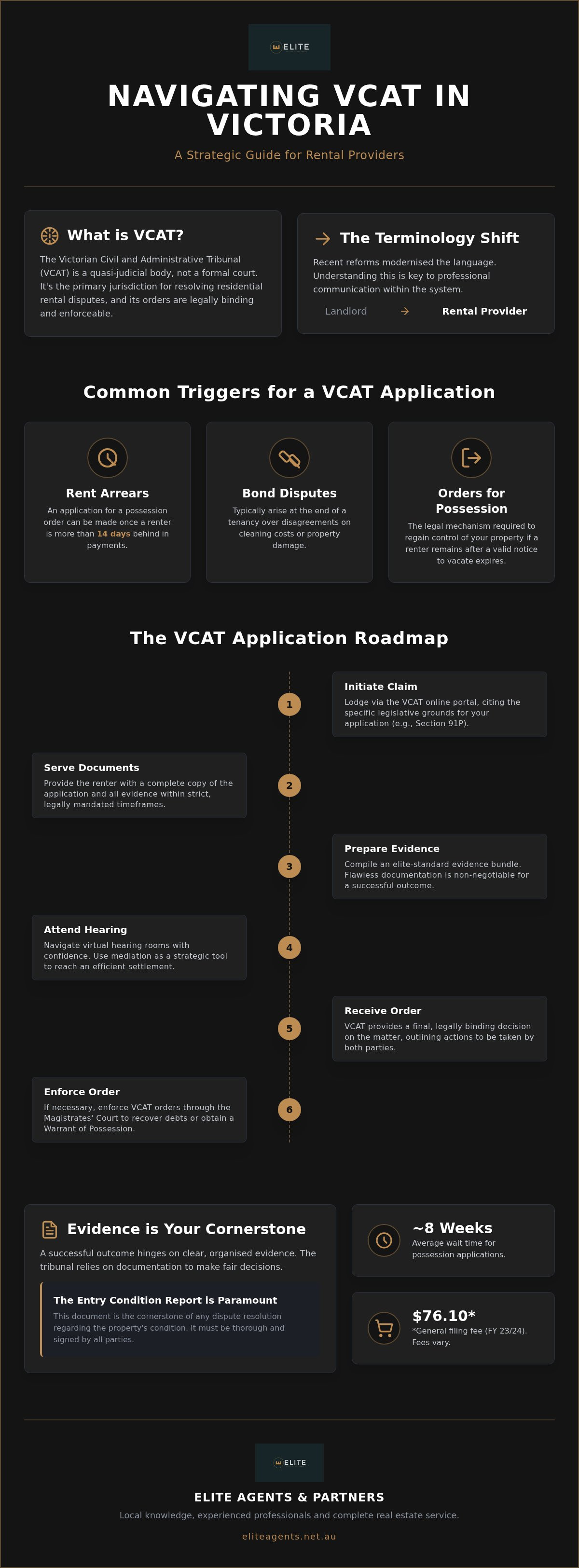
The Victorian Civil and Administrative Tribunal (VCAT) serves as the primary jurisdiction for resolving residential rental disputes across the state. It's essential to recognise that VCAT is a quasi-judicial body rather than a formal court. This distinction allows for a more accessible, less intimidating environment; however, the orders issued are legally binding and enforceable. For property investors, the VCAT process for landlords is the structured path to justice when private resolutions are no longer viable.
Recent legislative changes have refined how we approach these disputes. The 2021 reforms replaced traditional labels with "rental providers" and "renters." This shift underscores a modernised relationship between property owners and occupants. In high-growth areas like Berwick and Narre Warren, where investment yields are significant, understanding these nuances is vital. VCAT acts as a neutral arbiter, ensuring that both parties adhere to their contractual and statutory obligations under the Residential Tenancies Act 1997.
The Role of VCAT in Victorian Property Investment
Maintaining a high-performing portfolio requires a balance between renter rights and owner protections. VCAT provides the framework for this equilibrium. To succeed, you must follow the law to the letter, especially the 2021 amendments which introduced stricter disclosure and maintenance standards. Professionalism is your greatest asset here. Adopting an elite standard of record-keeping is not just good practice; it's a requirement for successful property management Berwick investors rely on. When your documentation is beyond reproach, the tribunal can make swift, fair decisions that protect your capital.
Common Triggers for a VCAT Application
Most applications in the residential list stem from a few critical scenarios where the rental agreement has been compromised. These include:
- Rent Arrears: You can apply for a possession order once a renter is more than 14 days behind in their payments.
- Bond Disputes: These typically occur at the conclusion of a tenancy when there is a disagreement regarding cleaning costs or property damage.
- Orders for Possession: This is the legal mechanism required to regain control of your property if a renter remains in the premises after a valid notice to vacate has expired.
Success in the VCAT process for landlords depends on your ability to present a clear, evidence-backed narrative. Whether you're dealing with a minor bond claim or a complex possession case, your approach must be clinical and well-prepared.
Initiating Your Claim: The VCAT Application Process
The VCAT process for landlords begins with a strategic digital application. Most claims are now lodged exclusively through the VCAT online portal, a system designed to streamline the intake of dispute details. When you initiate a claim, you must specify the exact legislative grounds. For instance, an application for a possession order usually requires citing Section 91P of the Residential Tenancies Act. Before committing to the tribunal, many savvy investors review Consumer Affairs Victoria dispute resolution guidelines to see if the matter can be settled via the free Rental Dispute Resolution Victoria (RDRV) service.
Financial precision is equally vital during the filing stage. As of 1 July 2026, the value of a fee unit in Victoria is $17.27. While the general filing fee for residential list matters was $76.10 in the previous financial year, the total cost depends on the number of fee units assigned to your specific application type. Fee waivers exist for those in genuine financial distress, though these are typically not applicable to commercial investment scenarios. Once filed, the requirement of 'Service' becomes your next priority. You must provide the renter with a complete copy of the application and all attached evidence within the strict timeframes dictated by the Act.
Choosing the Right Application Type
You must clearly differentiate between monetary claims and possession claims. Monetary claims focus on recovering unpaid rent or compensation for property damage. Possession claims are more serious, seeking a legal order to end the tenancy. In the City of Casey, urgent applications involving danger or significant damage are fast-tracked, often being heard within two business days. A Certificate of Service is the formal declaration you must sign to confirm the renter was legally notified of the proceedings.
Timelines and Expectations for 2026
For investors in the South East Melbourne corridor, hearings are typically allocated to venues in Dandenong or Frankston. Current data indicates an average wait time of approximately eight weeks for standard residential tenancy disputes. However, matters involving non-urgent repairs are often resolved in about seven business days. You can track the status of your case through the VCAT digital dashboard, which offers real-time updates on hearing dates and Member assignments. Managing these administrative hurdles requires significant attention to detail. Many local owners find that engaging a professional property manager to oversee the application ensures the highest standards of legal compliance are met from day one.
Preparing Your Evidence: The Elite Standard for Success
A successful outcome at the tribunal is rarely the result of luck; it's the product of meticulous preparation. The VCAT process for landlords relies heavily on the quality of your "Evidence Bundle," a curated collection of documents that tells a clear, indisputable story of the tenancy. While photos provide a visual aid, the Member prioritises a chronological narrative supported by hard data. You must present your case with clinical precision to ensure your investment interests remain protected. This begins with understanding the official VCAT process for documenting claims, where the burden of proof rests firmly on the applicant.
The Entry Condition Report stands as the most critical document in any bond dispute. It functions as the legal baseline for the property's state at the commencement of the lease. If this report lacks detail, even high-resolution photos may be dismissed as insufficient. Beyond the initial report, your digital communication logs serve as a vital timeline. Emails and SMS messages provide an objective record of when issues were raised and how you responded. To support financial claims for repairs, always include itemised quotes or invoices from professional tradespeople. These documents carry far more weight than personal estimates, as they provide an independent verification of market costs.
The Essential Landlord Evidence Checklist
Organise your bundle into a logical sequence that a Member can review quickly. Ensure you include these foundational items:
- Valid Residential Tenancy Agreement: The current, signed lease identifying all parties.
- Comprehensive Rent Ledger: A clear, up-to-date breakdown showing exactly when payments were missed and the total arrears.
- Notices Served: Copies of all 'Notices to Vacate' or 'Breach of Duty' notices, including proof of how they were delivered.
- Comparative Photography: High-resolution, date-stamped images from both the start and the conclusion of the tenancy to highlight specific changes.
Witness Statements and Expert Reports
In complex cases, a written statement from your property manager can provide essential context regarding the renter's conduct or the history of the dispute. If the damage is structural or specialised, an expert report from a qualified tradesperson is indispensable. You must serve this entire evidence bundle to the renter at least seven days before the hearing date. Failure to meet this deadline can result in your evidence being excluded or the hearing being adjourned. For investors concerned about the broader impact of a dispute on their asset, accurate house valuations in Berwick can offer a professional benchmark for property value loss, providing a sophisticated layer of evidence that reinforces the financial stakes involved.
The Hearing Day: Mediation, Conferences, and Decisions
The VCAT process for landlords has been significantly modernised with the opening of the new tribunal headquarters in March 2026. This state-of-the-art facility features 41 hearing and mediation rooms, prioritising virtual and hybrid access to reduce travel time for all parties. Whether you are appearing via a digital hearing room or in person, the environment requires a high level of professional discipline. You should address the presiding official as "Member" and wait for your turn to speak. If the renter does not show up despite being legally served, the Member can grant an ex-parte order. This allows the hearing to proceed in their absence, provided your evidence is clear and your documentation is flawless.
Success on the day depends on your ability to remain calm under pressure. Emotions can run high in rental disputes, but the Member is only interested in facts and legislative compliance. If a renter attempts to distract from the core issue with personal grievances, steer the conversation back to your evidence bundle. Your goal is to be seen as a diligent, sophisticated rental provider who has met every legal obligation. This composed approach often carries more weight than the most passionate argument. By focusing on the data rather than the dispute, you position yourself as a credible witness whose testimony is reliable.
Navigating Mediation and Compulsory Conferences
Mediation is a strategic opportunity to resolve the dispute with speed and certainty. Unlike a contested hearing where the Member decides the outcome, mediation allows you to negotiate a settlement that you can live with. You should enter this stage with a clear "bottom line" regarding rent repayment plans or bond deductions. If an agreement is reached, the Member will formalise it as an Order by Consent. This makes the private agreement legally binding and enforceable. Settling via mediation is often the most efficient way to minimise financial loss and move forward with your investment without the risk of a reserved decision.
Presenting Your Case to the Member
When presenting your case, focus on the timeline of events you've already established in your preparation. Renters often raise counter-claims as a tactical move, such as claiming non-urgent repairs were neglected to justify rent arrears. You must respond to these claims clinically by referencing your maintenance logs or professional trade quotes. The Member will typically make a ruling on the spot; however, they may reserve the decision in complex cases to review the law. If the administrative burden of the VCAT process for landlords feels overwhelming, Elite Agents & Partners provides expert representation to handle these hearings on your behalf, protecting your interests with professional authority and local expertise.
Post-Hearing: Orders, Warrants, and Professional Management
Securing a decision in your favour is a significant milestone, yet the VCAT process for landlords only concludes once that order is fully satisfied. A VCAT Order is a legally binding directive that outlines the Member’s final ruling. You must serve this document to the renter promptly to ensure compliance timeframes begin. If the renter fails to adhere to the terms, the matter moves beyond the tribunal’s administrative halls and into the jurisdiction of enforcement. Understanding how to transition from a piece of paper to a tangible result is what separates a successful investor from a frustrated one.
Enforcing Orders and Recovering Debts
A monetary order for unpaid rent or property damage doesn't guarantee cash in your hand. You must first register your VCAT order as a court judgment with the Magistrates' Court to unlock formal enforcement tools. This conversion allows you to engage the Sheriff’s Office for debt recovery through a Warrant of Execution, which currently carries a fee of approximately $115. If a renter ignores a 'Notice to Repair' or continues to breach their duty, these registered judgments provide the necessary legal leverage to protect your financial interests. This multi-tiered enforcement system ensures that the law has teeth, protecting rental providers from persistent non-compliance.
When a possession order is granted but the renter refuses to vacate, you must apply for a Warrant of Possession. This warrant, costing approximately $100 in 2026, remains valid for 14 days and is the only legal mechanism for eviction. It authorises the Victorian Police to attend the property and ensure you regain control of your investment. It's a decisive, structured process that removes the uncertainty of a non-compliant tenancy, allowing you to prepare the property for a more reliable occupant.
Minimising Risk with Elite Agents & Partners
Elite property management is the ultimate preventative measure against the stress of tribunal appearances. Rigorous tenant screening and proactive communication in the Berwick real estate market create a foundation of stability for your portfolio. Professional oversight ensures that every interaction is documented and every legal notice is flawless. By partnering with experts who handle the VCAT process for landlords daily, you ensure your evidence is beyond reproach and your investment remains a source of pride rather than a source of anxiety.
The most sophisticated investors view VCAT outcomes as a strategic learning tool to refine their future property investment strategies. By analysing why a dispute occurred, you can adjust your tenant screening criteria or improve your property’s maintenance schedule. High-performing portfolios in the South East are built on this cycle of continuous improvement. Professional representation doesn't just improve your success rate; it provides a buffer between you and the emotional toll of a dispute. Partnering with a dedicated agency allows you to focus on growing your wealth while experts manage the complexities of the Residential Tenancies Act.
Elevating Your Investment Through Professional Governance
Mastering the VCAT process for landlords requires more than just administrative compliance; it demands a clinical approach to documentation and a strategic mindset. By prioritising elite-standard evidence and understanding the enforcement mechanisms available through the Magistrates' Court, you transform a potentially volatile dispute into a manageable business outcome. Success at the tribunal is won long before the hearing date, beginning with the very first condition report and every digital log maintained throughout the tenancy.
Whether you're enforcing a warrant of possession or negotiating a settlement in the new digital hearing rooms, your success depends on the strength of your professional governance. We invite you to secure your investment with Elite Agents & Partners today. Our team provides expert VCAT representation for all managed clients, backed by a sophisticated tenant screening process designed to minimise tribunal risks across the Berwick and Casey rental markets. Enjoy the rewards of your property portfolio with the absolute confidence that your interests are protected by the region's leading specialists.
Frequently Asked Questions
How much does it cost for a landlord to apply to VCAT in 2026?
The application cost is calculated based on fee units set by the Victorian Government. From 1 July 2026, the value of a single fee unit is $17.27. While the general filing fee for the residential list was $76.10 in the previous financial year, the total amount depends on the specific section of the Act you are applying under. It's best to check the current fee schedule on the digital portal before lodging your claim.
Can my property manager represent me at a VCAT hearing?
Yes, your property manager can represent you in the majority of residential tenancy disputes. This is a core benefit of elite property management, as it ensures a specialist handles the VCAT process for landlords with professional authority. An experienced agent understands the legislative requirements and can present your evidence bundle with the technical precision needed to secure a favourable outcome without you needing to attend in person.
How long does the VCAT process take for an eviction in Victoria?
Standard possession applications for evictions typically take between six and eight weeks to reach a hearing. While the new VCAT headquarters opened in March 2026 to improve efficiency, wait times can vary based on the complexity of the case. Urgent applications involving danger or serious damage are prioritised and are often scheduled much faster, sometimes within two business days, to protect the safety of the property and the community.
What happens if a tenant ignores a VCAT order to pay rent?
If a renter ignores a monetary order, you must register the order with the Magistrates' Court to begin formal enforcement. Once registered as a court judgment, you can engage the Sheriff’s Office to recover the debt through a Warrant of Execution. This process allows for the seizure of assets or the redirection of earnings to satisfy the debt. It's a necessary step to ensure the tribunal's decision results in actual financial recovery.
Do I need a lawyer for the VCAT process for landlords?
You don't strictly need a lawyer for residential rental disputes, as VCAT is designed to be a self-represented jurisdiction. Most rental providers find that the expertise of a high-performing property manager is more than sufficient to navigate the VCAT process for landlords effectively. If a case involves exceptionally complex legal arguments or significant commercial implications, you may choose to seek legal counsel, though this is rare for standard tenancy matters.
Can I claim the VCAT application fee back from the tenant?
Yes, you can request that the VCAT Member order the renter to reimburse your application fee if your claim is successful. While the decision to award costs is at the Member’s discretion, it's a standard request in most successful possession or bond claims. You must ensure you ask for this reimbursement during the hearing so it can be formally included in the final written order issued by the tribunal.
What is the difference between a mediation and a hearing at VCAT?
Mediation is a confidential session where an independent mediator helps both parties reach a voluntary agreement. It's a less formal approach that offers you more control over the final settlement. A hearing is a formal proceeding where a VCAT Member hears the evidence from both sides and makes a legally binding decision. If mediation fails to produce a result, the matter will proceed to a hearing for a final ruling.
What evidence do I need to win a bond claim at VCAT?
The most critical evidence for a bond claim is a comprehensive Entry Condition Report compared against a detailed Exit Condition Report. You must support these documents with high-resolution, date-stamped photos and professional tradesperson quotes for any required cleaning or repairs. This creates a clear, factual timeline that proves the property's condition has deteriorated beyond fair wear and tear, providing the Member with the objective data needed to rule in your favour.
Disclaimer
Disclaimer: This article was prepared with the assistance of artificial intelligence and reviewed for general informational purposes. While reasonable care has been taken to ensure accuracy, property-market conditions, prices, legislation and other information may change. The content does not constitute legal, financial, taxation, valuation or other professional advice. Readers should verify information and obtain advice appropriate to their circumstances before making property decisions. Elite Agents & Partners does not guarantee any specific sale price, rental return or outcome.


