

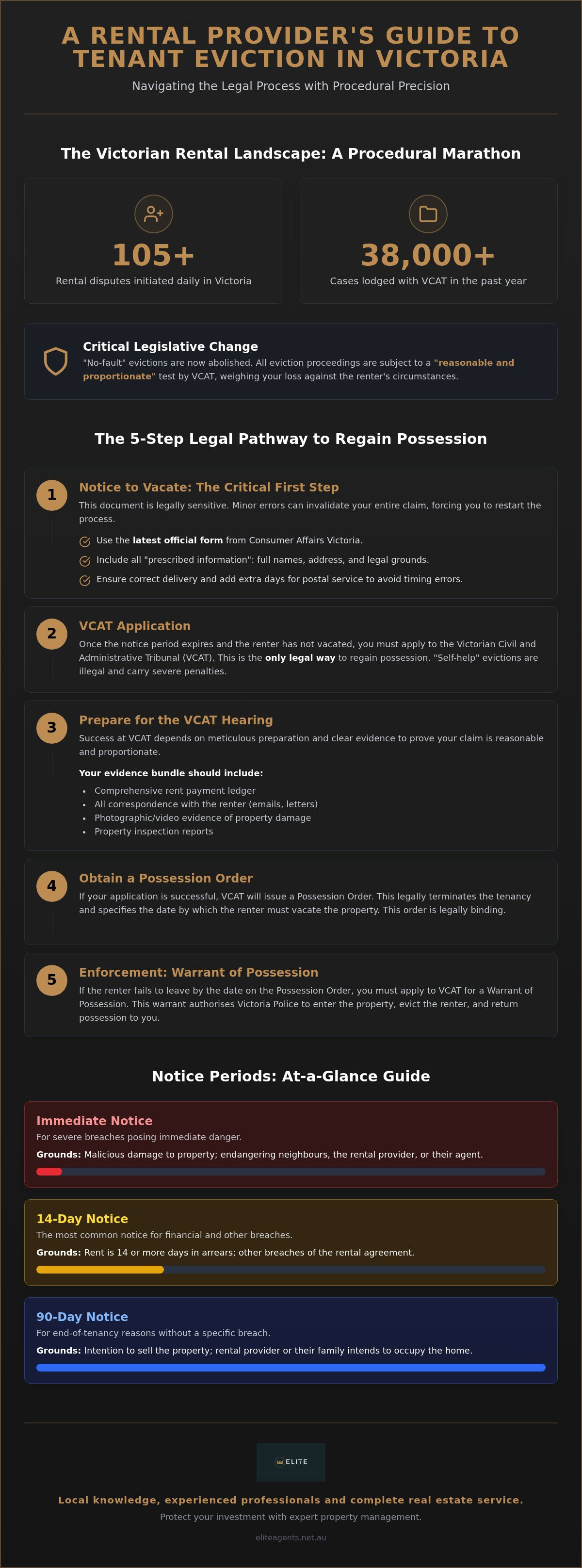
Did you know that over 105 Victorian rental providers initiate formal dispute resolution processes every single day? With more than 38,000 cases lodged in the past year alone, it’s clear that managing a rental property in Victoria has become a complex procedural marathon. You likely feel the weight of these statistics when dealing with unpaid rent or property damage, especially while facing the notorious VCAT backlogs and the ban on no-fault evictions.
This evicting a tenant VIC guide ensures you don't become another cautionary tale of administrative error. We promise to help you master the strict legal requirements and specific procedural steps necessary to lawfully regain possession of your investment. By following this curated roadmap, you'll learn how to handle the 90-day notice periods, the current VCAT fee structures, and the mandatory documentation required to minimise financial loss and ensure 100% compliance with the latest 2026 reforms.
Key Takeaways
- Master the art of procedural precision by selecting the correct official forms and accounting for postal service delays to ensure your application remains valid.
- Consult this evicting a tenant VIC guide to stay ahead of the latest 2026 legislative shifts, including extended notice requirements for owner-occupation or property sales.
- Prepare a comprehensive evidence bundle, featuring rent ledgers and photographic records, to present a sophisticated case during your VCAT hearing.
- Navigate the final enforcement phase with confidence by understanding the transition from a possession order to a police-enforced Warrant of Possession.
- Minimise future risks through exclusive tenant screening and expert management designed to protect the long-term value of your Victorian investment.
Understanding the Victorian Rental Landscape in 2026
Success in Victorian property investment requires more than just securing a high-yield asset. It demands a sophisticated understanding of a legal framework that has become increasingly protective of occupant rights. In Victoria, the relationship between a "rental provider" and a "renter" is no longer just a private contract. It is a highly regulated partnership governed by the Residential Tenancies Act. This legislation provides the rigid blueprint for every interaction, from the initial bond lodgement to the final possession order. While other jurisdictions might follow different models, such as the Residential Tenancies Authority in Queensland, Victoria relies on a specific set of reforms that were significantly bolstered in late 2025.
The days of informal "handshake" agreements or unilateral lockouts are long gone. "Self-help" evictions are strictly illegal and carry severe criminal penalties, including substantial fines that can dwarf years of rental income. The Victorian Civil and Administrative Tribunal (VCAT) remains the only legal avenue for regaining possession of your property. This evicting a tenant VIC guide emphasises that VCAT acts as the sole arbiter in these disputes. They ensure that all proceedings remain transparent, ethical, and strictly compliant with the letter of the law. As a rental provider, your role is to provide the evidence; VCAT's role is to provide the authority.
Key Legislative Changes for Rental Providers
The landscape shifted dramatically on 25 November 2025, when "no-fault" evictions were officially abolished across the state. You now need a specific, legally valid reason to end a tenancy. Perhaps the most significant hurdle in 2026 is the "reasonable and proportionate" test. When you apply for a possession order, VCAT members must now consider whether evicting the renter is a fair outcome. They weigh your financial loss against the renter's personal circumstances, such as health or family stability. In this environment, meticulous documentation is your most valuable asset. Every email, property inspection report, and payment ledger serves as vital evidence to prove that your request for possession is both necessary and justified.
Common Grounds for Eviction in Victoria
Most possession claims in the City of Casey and broader Melbourne fall into three primary categories. Non-payment of rent remains the most frequent trigger. Under the 14-day rule, you can issue a notice to vacate once the rent is 14 days in arrears, provided you follow the correct notice sequence. Serious damage to the property or instances where the renter poses a danger to neighbours or your agent also provide grounds for immediate action. Finally, you can end a tenancy at the conclusion of the first fixed-term agreement. However, for most other scenarios, such as when you intend to sell or move back into the home, the standard notice period has been extended to 90 days. Using this evicting a tenant VIC guide helps you navigate these timelines to avoid costly procedural restarts.
The Notice to Vacate: Your First Critical Step
Regaining possession of your property begins with a single document: the Notice to Vacate. This is the most legally sensitive phase of the process. If your notice contains even a minor technical flaw, VCAT will likely strike out your application, forcing you to restart the entire timeline. You must use the official "Notice to vacate to renter/s of rented premises" form issued by Consumer Affairs Victoria. As of early 2026, using any outdated or generic template will invalidate your claim immediately. This evicting a tenant VIC guide reminds you that the form was updated recently, so always download the latest version directly from the official source.
Every notice must include specific "prescribed information" to be legally enforceable. This includes the full names of all renters listed on the lease, the precise address of the premises, and the specific grounds for the notice. Under the Residential Tenancies Act 1997, you're also required to cite the specific section of the Act that supports your reason for eviction. Delivering this document requires equal precision. While electronic service is efficient, it's only valid if the renter explicitly agreed to receive legal notices via email in the original rental agreement. If you choose registered post, you must add extra "service days" to account for Australia Post delivery times. Failing to calculate these additional days is a common error that ruins many possession applications.
Notice Periods for Common Breaches
The timeframe for a notice depends entirely on the nature of the breach. For rent arrears, you may issue a 14-day notice once the renter is at least 14 days behind in payments. If the renter causes malicious damage or endangers the safety of neighbours, you can issue an immediate notice. However, for more common scenarios like selling the property or moving back in, the 2026 regulations now require a 90-day notice period. This evicting a tenant VIC guide highlights that these longer windows are designed to give renters ample time to find alternative housing, so you'll need to plan your timelines accordingly.
Avoiding Technical Errors That Void Your Notice
Precision is your best defence. Ensure the spelling of names matches the lease exactly and that the termination date is calculated correctly. You must also provide clear evidence of the breach alongside the notice, such as a formal rent ledger or photographic evidence of damage. A valid notice is one that meets all statutory requirements, includes all prescribed information, and strictly adheres to the mandated service timeframes. To ensure your documentation is bulletproof from day one, consider a free rental appraisal and management review to identify potential risks in your current agreements.
Navigating VCAT: Securing a Possession Order
Once the Notice to Vacate period expires and the renter remains in the property, you must move swiftly to the Victorian Civil and Administrative Tribunal (VCAT). Delaying your application only extends your period of financial risk. As of June 2026, the application fee for residential tenancy disputes is $65.60, a small price to pay for the legal authority to reclaim your investment. This evicting a tenant VIC guide advises you to lodge your application the very next business day after the notice period ends to ensure you're placed in the hearing queue as early as possible.
Your success at VCAT depends entirely on your "Bundle of Evidence." This collection of documents must be sophisticated, organised, and undeniable. You'll need to provide the original signed lease agreement, a clear and up-to-date rent ledger, copies of all correspondence, and dated photographs if the eviction is due to property damage. If your evidence is incomplete, you risk an adjournment, which can delay your possession by several weeks or even months. Meticulous preparation is what separates a successful possession order from a frustrating legal stalemate.
During the hearing, the VCAT member will apply the "Reasonable and Proportionate" test. This means they won't just look at whether a breach occurred; they'll evaluate if evicting the renter is a fair outcome given the circumstances. They consider factors like the renter's health, whether they have children, and the nature of the breach. You must be prepared to demonstrate that the impact of the renter staying in the property outweighs the hardship they might face by leaving. Many owners find that engaging expert property management Berwick specialists is the most effective way to navigate these nuanced legal arguments.
The VCAT Hearing Process
In 2026, most hearings in the City of Casey and surrounding regions are conducted via high-definition video link or telephone. You should treat these digital sessions with the same professional decorum as an in-person court appearance. State your facts concisely and avoid emotional language. To prevent common adjournments, ensure you've already provided a copy of your evidence bundle to both VCAT and the renter at least seven days before the hearing date.
Possession Orders vs. Compliance Orders
VCAT has the discretion to issue a compliance order instead of a possession order. This often happens in rent arrears cases where a renter demonstrates a genuine ability to catch up via a payment plan. While a possession order sets a firm date for the renter to move out, a compliance order gives them a "second chance" to stay, provided they meet specific conditions. It's also important to distinguish these from monetary orders, which are separate rulings that legally require the renter to pay back any outstanding debt or compensation for damages.
Enforcement: The Warrant of Possession and Police Role
Securing a possession order is a significant milestone, yet it doesn't always result in a vacant property on the day. If a renter ignores the VCAT-mandated date and remains in the home, you must apply for a Warrant of Possession immediately. This evicting a tenant VIC guide clarifies that this warrant is the final legal instrument required to regain physical control of your investment. It authorises Victoria Police to enter the premises, by force if necessary, to remove any occupants. While the application to VCAT is instant, the actual execution depends on the scheduling capacity of your local police station. Expect a wait time of approximately seven to fourteen days during peak periods in the metropolitan area.
The transition from a legal order to a physical lockout requires meticulous coordination. You cannot take the law into your own hands by changing locks before the police arrive. Doing so exposes you to severe penalties and potential compensation claims from the renter. The police role is purely to ensure the peace is kept and the premises are vacated. Once they have cleared the house, the responsibility for securing the property returns to you. Having a professional team manage this high-pressure moment ensures that the eviction is executed with the sophisticated authority your asset deserves.
Working with the Victoria Police
Booking the eviction requires direct coordination with the local station, typically Berwick or Narre Warren for properties within the City of Casey. You or your authorised representative must be present at the site, but you should allow the officers to take the lead during the initial entry. They will ensure the premises are safe and empty before handing the keys back to you. You must also arrange for a professional locksmith to be on-site at the exact same time as the police. Once the officers have completed the lockout, the locksmith will secure the property by changing all external barrels. To avoid the stress of these final confrontations, contact our property management team for comprehensive support throughout the enforcement phase.
Dealing with Abandoned Goods
A physical lockout often reveals a house full of left-behind belongings. You have a legal obligation to manage these items with care, regardless of the circumstances of the eviction. Perishable goods or items of no monetary value can be disposed of right away. However, for "goods of value," you must follow a strict storage and notification procedure. You are required to provide the renter with a formal notice of abandoned goods and store them safely for the prescribed period. Abandoned goods must be handled according to Part 9 of the Act to avoid compensation claims. This ensures your transition back to full ownership remains legally sound and ethically transparent.
Protecting Your Investment: The Elite Advantage
While the legalities of the eviction process are necessary to understand, the most successful investors focus on prevention. This evicting a tenant VIC guide has detailed the procedural hurdles you may face, but the real elite advantage lies in avoiding the tribunal altogether. Sophisticated tenant screening is your first line of defence. By vetting applicants against rigorous financial and history-based criteria, we ensure that only the most reliable individuals occupy your home. A high-quality renter respects the property and the lease, significantly reducing the likelihood of ever needing a possession order.
Attracting these premium renters begins with how your property is positioned in the local market. A proactive property appraisal Berwick allows you to set a competitive price that reflects the home’s true value while appealing to a sophisticated demographic. Properties that are well-maintained and correctly priced attract a higher calibre of applicant, which naturally filters out high-risk tenancies. Professional management also provides a level of VCAT expertise that self-managed owners often lack. We understand the specific nuances of the 2026 reforms and know how to present evidence that meets the tribunal's strict requirements.
Even with the best management, unforeseen circumstances can impact a tenancy. This is where comprehensive landlord insurance becomes essential for your peace of mind. A robust policy covers not just lost rental income but also the legal costs associated with VCAT hearings and warrant enforcement. Combining expert management with a solid insurance policy creates a dual layer of protection for your asset, ensuring your yields remain protected even during difficult transitions.
Proactive Management vs. Reactive Eviction
Effective management in the City of Casey requires a watchful eye and a commitment to early intervention. We prioritise strategies that address rent arrears the moment a payment is missed rather than waiting for the 14-day mark. Regular routine inspections also play a vital role. They allow us to spot minor issues before they escalate into major property damage or safety concerns. By maintaining a professional yet approachable relationship with renters, we can often negotiate solutions that avoid the stress and expense of a formal eviction process.
Next Steps for Berwick Landlords
Navigating the Victorian rental market doesn't have to be a solo journey. If you're currently facing a difficult tenancy or simply want to ensure your property is managed to the highest standard, our team is ready to assist. Requesting a free rental appraisal is a great first step to ensure your investment is performing as it should. We provide the specialised VCAT support and local expertise needed to keep your portfolio secure and your stress levels low. Protect your investment with Elite Agents & Partners today.
Reclaiming Your Property with Confidence
Successfully navigating the Victorian rental system requires a sophisticated blend of patience and procedural precision. You've seen that regaining possession of your asset is no longer a simple transaction; it's a legal process that demands 100% compliance with the latest 2026 reforms. By following this evicting a tenant VIC guide, you can approach VCAT hearings and police-enforced lockouts with the authority needed to protect your investment's long-term yield.
Don't let the stress of a difficult tenancy compromise your portfolio's performance. As local Berwick market specialists, we provide the expert VCAT representation and rigorous tenant screening processes required to keep your investment on track. Secure your investment with Elite Agents & Partners and experience the peace of mind that comes with professional, local expertise. Your property is a significant achievement, and with the right partner, you can ensure it remains a source of success rather than a source of stress.
Frequently Asked Questions
Can I evict a tenant in Victoria if I want to sell my house?
Yes, you can issue a notice to vacate if you intend to sell the property, but you must provide a 90-day notice period under the latest 2026 regulations. You're required to use the official Consumer Affairs Victoria form and provide evidence of your intent to sell, such as a signed sales authority with an agent, to ensure the notice is legally valid.
How long does the eviction process take in VIC in 2026?
The total timeframe depends on the specific grounds for the notice and current VCAT wait times. A rent arrears eviction typically takes eight to twelve weeks from the initial notice to physical possession, while a sale-related eviction requires at least 90 days for the notice period alone. This evicting a tenant VIC guide notes that VCAT hearing schedules and police availability for warrant execution are the primary variables in these timelines.
What happens if a tenant refuses to leave after the notice expires?
If a renter remains in the property after the notice period ends, you must lodge an application with VCAT for a possession order. You cannot personally remove the renter or their belongings. Once VCAT grants the order and sets a possession date, you can then proceed to the enforcement phase by applying for a Warrant of Possession if they still fail to vacate.
Can I change the locks if my tenant hasn’t paid rent for a month?
No, you cannot change the locks or interfere with the renter's access to the property, regardless of how much rent is owed. Unauthorised lockouts are criminal offences in Victoria and carry severe penalties and potential compensation claims. You must follow the formal VCAT process to regain possession of your investment property lawfully.
Does VCAT always side with the renter?
VCAT members are required to make decisions based on the Residential Tenancies Act and the "reasonable and proportionate" test. While the legislation is protective of renters, the tribunal sides with the party that provides the most compelling, legally compliant evidence. Meticulous documentation and professional representation are your best tools for ensuring a fair and successful outcome at a hearing.
How much does it cost to apply for a possession order at VCAT?
As of June 2026, the application fee for a residential tenancy dispute at VCAT is $65.60. This fee is tied to the value of a fee unit, which is set at $16.81 as of 27 June 2026 and is scheduled to increase to $17.27 on 1 July 2026. This relatively small cost is a necessary investment to secure the legal authority needed to reclaim your property.
What is a Warrant of Possession and how do I get one?
A Warrant of Possession is the final legal instrument that authorises Victoria Police to physically remove occupants from a property. You can only apply for this warrant through VCAT after a possession order has been granted and the renter has failed to leave by the specified date. Once issued, you must coordinate with local police to execute the lockout.
Can a tenant stop an eviction at the last minute?
Renters can sometimes halt the process by proving extreme hardship or by agreeing to a VCAT-mandated payment plan in cases of rent arrears. This is known as a compliance order, which gives the renter a final opportunity to stay provided they meet specific conditions. Using a comprehensive evicting a tenant VIC guide helps you anticipate these challenges and prepare a sophisticated response to keep your eviction on track.
Disclaimer
Disclaimer: This article was prepared with the assistance of artificial intelligence and reviewed for general informational purposes. While reasonable care has been taken to ensure accuracy, property-market conditions, prices, legislation and other information may change. The content does not constitute legal, financial, taxation, valuation or other professional advice. Readers should verify information and obtain advice appropriate to their circumstances before making property decisions. Elite Agents & Partners does not guarantee any specific sale price, rental return or outcome.


