

In 2026, the most expensive repair is the one you didn't see coming, especially when a renter can legally spend up to A$2,500 of your money on an emergency fix without your prior consent. Knowing exactly who pays for urgent repairs in a rental property Victoria is no longer a casual concern; it's a vital legal safeguard for your wealth. With the Rental Dispute Resolution Victoria (RDRV) streamlining tenant claims, the cost of a delay now far outweighs the price of a plumber.
You've likely noticed the rising costs of local trades in Melbourne's South East and felt the pressure of the latest energy efficiency mandates. It's natural to worry about how these shifting regulations affect your bottom line. This guide will help you master Victorian repair laws, understand your financial obligations, and discover how strategic maintenance protects your Berwick investment ROI. We'll explore the critical difference between urgent and general repairs, the mandatory response timeframes, and a professional workflow designed to keep you out of VCAT while maximising your property's capital growth.
Key Takeaways
- Master the legal distinction between urgent and non-urgent repairs to maintain your property's "good repair" status under the latest 2026 Victorian legislation.
- Clarify exactly who pays for urgent repairs in a rental property Victoria and the mandatory seven-day window for reimbursing renter-authorised maintenance costs.
- Discover how the Rental Dispute Resolution Victoria (RDRV) functions as a sophisticated mediation layer to protect your interests and bypass lengthy VCAT backlogs.
- Leverage a vetted local network of trades across Berwick and the City of Casey to ensure high-quality, compliant outcomes that preserve your investment's premium standing.
- Implement proactive maintenance protocols that act as a "legal firewall," transforming routine upkeep into a strategic driver of superior capital growth and rental yield.
Understanding Victoria’s Rental Repair Laws in 2026
The legal landscape for Victorian property owners has shifted from passive management to active compliance. In 2026, the question of who pays for urgent repairs in a rental property Victoria is answered by a strict framework that prioritises renter safety and property integrity. Maintaining a property in "good repair" isn't a suggestion; it's an objective legal standard that applies whether your investment is a brand-new build or a character home in Berwick's established pockets. Age and wear are no longer valid excuses for failing to meet these benchmarks.
Non-compliance carries heavy financial weight. Beyond the immediate cost of a fix, rental providers risk rent abatements, where a portion of the rent is returned to the tenant for the period the property was substandard. With the Rental Dispute Resolution Victoria (RDRV) now providing a faster track for compensation, the cost of delaying a repair often exceeds the price of the maintenance itself. Protecting your asset requires a shift in mindset: viewing maintenance as a strategic investment rather than a mounting expense.
The Rental Provider’s Duty of Care
Your duty of care is a continuous legal obligation to provide a residence that is safe, secure, and functional for the duration of the tenancy. This duty remains absolute regardless of the weekly rent or the age of the dwelling. Under the Residential Tenancies Act, the rental provider is legally responsible for ensuring the property remains in a state of good repair and is fit for occupation. If a dispute arises over maintenance, the Victorian Civil and Administrative Tribunal (VCAT) evaluates whether the provider acted with reasonable haste. Failing this duty doesn't just lead to frustrated tenants; it creates a liability that can diminish your long-term yields.
Minimum Standards: The 2026 Baseline
By 2026, minimum standards have expanded to include stringent energy efficiency and safety requirements. Every rental must now feature functioning kitchen facilities, secure door locks, and heating that meets specific performance ratings. These aren't just "nice-to-haves" anymore. If a property fails these benchmarks, the issue is immediately classified as an urgent repair, meaning you must act without delay. Determining who pays for urgent repairs in a rental property Victoria is straightforward here: the responsibility sits squarely with the rental provider.
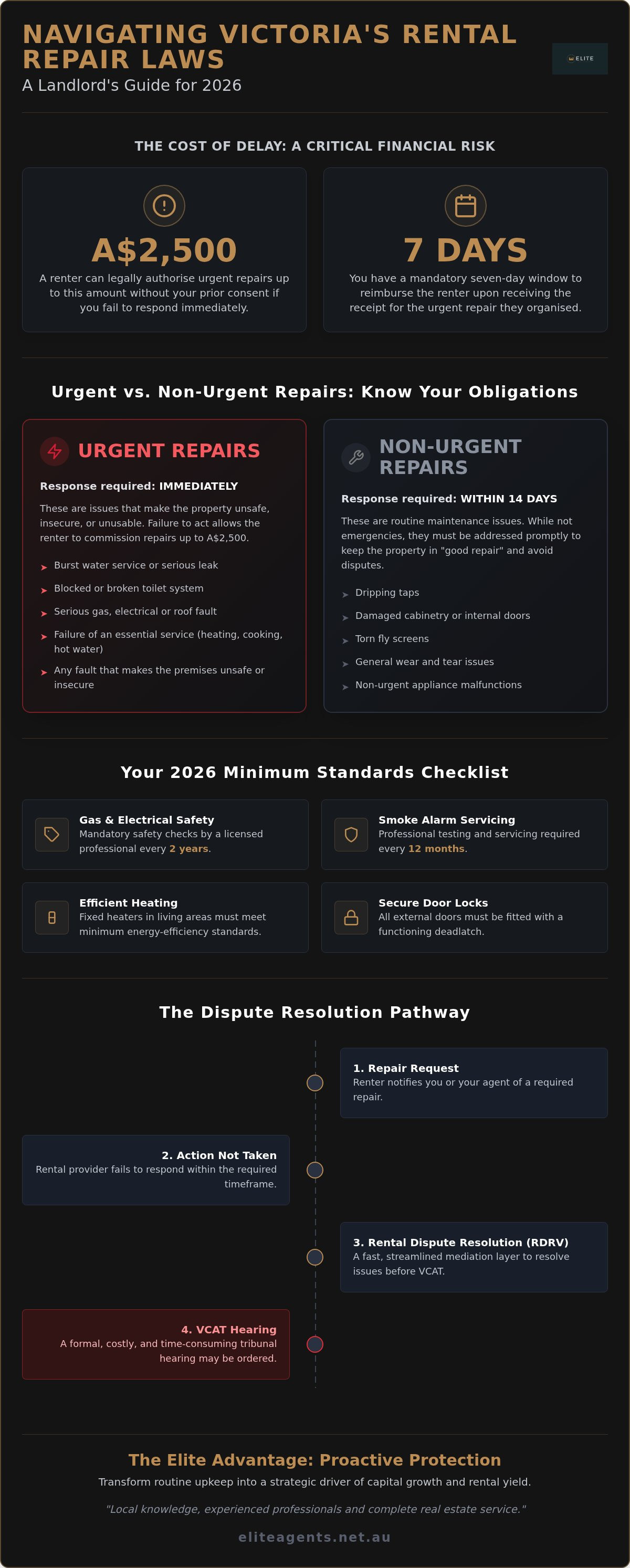
Strategic investors use these standards to safeguard their Berwick real estate market value. Regular audits ensure your asset remains a premium offering, attracting high-calibre tenants who value quality. Remember, under current laws, a renter can authorise urgent repairs up to A$2,500 if you don't respond immediately. This makes proactive management a financial imperative rather than a choice.
- Gas and electrical safety checks must be completed every two years by licensed professionals.
- Smoke alarm servicing and testing are required every 12 months.
- Heating systems must meet minimum energy-efficiency standards to reduce renter utility costs.
- All external doors must be fitted with a deadbolt or a lock that can be opened from the inside without a key.
Urgent vs Non-Urgent Repairs: The Compliance Checklist
Deciphering the hierarchy of maintenance requests is a critical skill for the modern investor. In 2026, the question of who pays for urgent repairs in a rental property Victoria is determined by the nature of the fault and the speed of your response. When a fault is classified as "urgent," the law expects you to act immediately. This doesn't mean within 48 hours; it means taking action as soon as you are notified. If you fail to respond, the renter has the legal right to authorise repairs up to the value of A$2,500 and must be reimbursed within seven days of providing the receipts.
Managing these high-stakes scenarios requires a clear understanding of Victoria’s rental repair laws. While the rental provider is almost always responsible for the cost, the risk lies in the loss of control over which trades enter your property and the premium rates they might charge for after-hours service. Sophisticated investors avoid these "blank cheque" scenarios by having pre-approved trade protocols in place.
The 2026 Urgent Repairs List
The legal definition of an urgent repair has expanded significantly to reflect modern living standards. Beyond the traditional emergencies like gas leaks, burst water services, and dangerous electrical faults, the 2026 list now includes:
- Security Breaches: Any fault or damage that makes the property unsafe, such as broken windows or external door locks that won't secure.
- Mould and Damp: Any mould caused by the building structure or a failure in the property's drainage and ventilation.
- Cooling Systems: The failure of an air conditioner or cooling system provided with the property is now often treated with the same urgency as a heating failure during peak months.
- Essential Services: A total loss of water, power, or gas, or the failure of the primary cooking or laundry facilities.
Handling Non-Urgent Maintenance Requests
For issues that don't pose an immediate risk to safety or essential services, such as a leaking tap or a stiff cupboard hinge, you have a 14-day statutory window to complete the fix. However, don't mistake this timeframe for a low-priority pass. If a non-urgent request is ignored, the renter can apply to Consumer Affairs Victoria for an official inspection or escalate the matter to the RDRV for mediation. Consistent, written communication is your best defence here. Clear timelines prevent a minor annoyance from escalating into a formal dispute.
Navigating these timelines while sourcing reliable trades in Melbourne's South East can be a logistical challenge. If you want to ensure your investment remains compliant without the midnight phone calls, consider how a professional property management partner can streamline your maintenance workflow. We maintain a vetted network of specialists across Berwick and the City of Casey to ensure every repair is handled with professional precision.
The Strategic Repair Process: From Request to Resolution
Moving from legal theory to practical execution requires a workflow that protects your time and your asset. While the law clearly dictates who pays for urgent repairs in a rental property Victoria, the strategic investor focuses on how those repairs are managed. Implementing a digital-first reporting system is your first line of defence. This creates an immutable paper trail of every request and response, serving as a "legal firewall" should a dispute ever reach a mediator. When an urgent issue arises, such as a burst pipe or a dangerous electrical fault, the Residential Tenancies Act allows for immediate entry to the property to carry out the fix, bypassing the usual notice periods required for general inspections.
A critical shift in 2026 is the "Efficient Replacement" mandate. If an appliance like a hot water system or a fixed heater fails and is deemed an urgent repair, you cannot simply replace it with a like-for-like older model. New regulations require these replacements to meet high energy-efficiency ratings. While the upfront cost for a high-efficiency heat pump or a 7-star gas heater may be higher, these upgrades are mandatory. Following Consumer Affairs Victoria's guidelines on urgent repairs ensures you don't just fix the problem, but you also future-proof your property against further legislative changes.
Communication Protocols with Renters
Acknowledging a repair request within 24 hours is the simplest way to prevent an escalation to the RDRV. Even if a trade isn't immediately available due to local parts shortages, a professional response demonstrates you are meeting your duty of care. Clear communication manages renter expectations and prevents them from exercising their right to spend up to A$2,500 on their own trades. Using a professional property manager provides a necessary buffer, ensuring that emotional disputes over trade timing don't damage the long-term relationship with your tenant.
Organising Trades and Quality Control
Sourcing reliable contractors in the City of Casey growth corridor requires more than a quick search online. The "cheapest quote" often results in substandard work that fails to meet minimum standards, potentially leading to a costly VCAT hearing later. We vet every specialist across Berwick, Narre Warren, and Pakenham to ensure they understand the 2026 compliance requirements. High-quality maintenance is a primary driver of Berwick property investment longevity. By investing in professional trades today, you secure record-breaking yields and maintain the premium status of your investment in Melbourne's South East.
Avoiding VCAT and RDRV Disputes in the City of Casey
The introduction of Rental Dispute Resolution Victoria (RDRV) in early 2026 has transformed how maintenance conflicts are resolved. This mediation tier acts as a mandatory filter, designed to settle disagreements before they clog the Victorian Civil and Administrative Tribunal (VCAT) system. When a dispute arises over who pays for urgent repairs in a rental property Victoria, the RDRV Resolution Coordinator evaluates whether the repair met the legal "urgent" criteria and if the response was handled with reasonable speed. Settling at this stage is always the superior outcome; it avoids the public record of a VCAT order and the potential for hefty RDRV penalties.
Repair flashpoints in the Berwick and Narre Warren markets often centre on heating failures during winter or structural dampness after heavy rain. In these high-growth corridors, renters are increasingly aware of their rights, especially the A$2,500 threshold for self-authorised urgent fixes. By maintaining a clear "legal firewall" through professional management, you ensure that every interaction is documented. This level of thoroughness doesn't just prevent disputes; it directly influences your property's market standing. Proactive maintenance is a key metric used in high-end property appraisals, as a well-documented service history signals a lower risk profile to future buyers and premium tenants.
Navigating the RDRV Process
If a renter initiates an RDRV claim, the process moves quickly. You'll be required to provide evidence of your "Duty of Care" almost immediately. This includes date-stamped communication logs, trade quotes, and photos of the completed work. The Resolution Coordinator aims for a mediated agreement, which might include a small rent abatement or a structured reimbursement plan. Having a professional property manager represent you during these sessions is vital. We provide the technical industry terminology and compliance checklists needed to protect your financial interests and reach a swift, private resolution.
Preventative Maintenance as an Asset Strategy
Sophisticated investors in the Melbourne South East corridor view maintenance as a wealth-protection strategy rather than a chore. Scheduling annual gutter cleans, smoke alarm checks, and bi-annual electrical safety audits effectively eliminates the risk of an "Urgent" status repair. This "Elite" standard of care attracts high-calibre, long-term renters who are less likely to pursue litigious pathways. It reduces the "stress-tax" of property ownership and ensures your investment continues to deliver record-breaking yields without the threat of unexpected RDRV intervention.
To ensure your investment is fully compliant and protected against the latest 2026 legislative shifts, request a comprehensive rental appraisal from our specialised property management team today.
The Elite Advantage: Professional Management for Stress-Free Investing
DIY management in 2026 has transitioned from a cost-saving measure to a high-risk gamble. The intricate layers of the Residential Tenancies Act, combined with the immediate financial pressure of RDRV mediation, require a specialist's touch to navigate successfully. While the law clearly defines who pays for urgent repairs in a rental property Victoria, a professional manager ensures you aren't paying a premium for unvetted trades or suffering through avoidable legal disputes. Sophisticated investors understand that their time is better spent growing their portfolio while a dedicated partner handles the daily complexities of compliance and renter relations.
Elite Agents & Partners functions as your legal and operational firewall. We don't just facilitate repairs; we manage the entire lifecycle of your investment to ensure it remains a high-performing asset. By maintaining a rigorous digital audit trail and a vetted network of specialists across the Melbourne South East corridor, we protect your yield from the "stress-tax" of non-compliance. In a market where a renter can authorise a A$2,500 repair if you fail to act, having a professional property manager is the only way to maintain absolute control over your property's maintenance standards and financial outcomes.
Local Expertise in Berwick and the City of Casey
Generic, CBD-based agencies often lack the localized knowledge required to manage properties in high-growth areas like Clyde North, Officer, and Berwick. Our team possesses a deep understanding of local council regulations and the specific geographic maintenance needs of the South East. Whether it's managing the drainage requirements of a new build in a growth corridor or maintaining the heritage integrity of an established Berwick estate, our local presence ensures a rapid response. We are neighborhood specialists who have our finger on the pulse of the market, ensuring your property remains a premium offering that attracts the region's best tenants.
Maximising Returns Through Sophisticated Service
There is a direct, undeniable link between property condition and capital growth. A well-maintained home doesn't just avoid RDRV intervention; it commands record-breaking rental yields and secures long-term capital appreciation. We treat every repair request as an opportunity to reinforce the value of your asset. By adhering to Elite maintenance standards, we ensure your property stays ahead of 2026 energy efficiency mandates and safety requirements. This proactive approach transforms routine upkeep into a strategic driver of wealth, providing you with the confidence that your investment is being managed to the highest possible standard.
Ready to experience the difference that professional, local expertise can make for your portfolio? Book a free rental appraisal with Elite Agents & Partners today and discover how we can secure your investment's future.
Future-Proofing Your Victorian Property Portfolio
Navigating the 2026 rental landscape requires more than just reactive maintenance; it demands a sophisticated asset protection strategy. The "immediate" rule and the A$2,500 renter reimbursement threshold have fundamentally changed the stakes for local investors. Knowing exactly who pays for urgent repairs in a rental property Victoria is the first step in building a resilient "legal firewall" between your wealth and potential RDRV disputes. By prioritising proactive compliance and leveraging a vetted network of local trades, you transform routine chores into a strategic driver of capital growth.
Elite Agents & Partners offers the specialised Berwick and City of Casey expertise needed to manage these complexities with professional precision. Our dedicated compliance coordination team ensures your property meets every 2026 standard while securing record-breaking yields. Don't leave your investment's performance to chance in an increasingly litigious environment. Secure your investment with Elite Property Management and experience the peace of mind that comes with sophisticated local expertise. Your property is a significant asset, and it deserves a management partner committed to its long-term excellence.
Frequently Asked Questions
What is the official definition of an urgent repair in Victoria for 2026?
Urgent repairs are defined as faults that make a property unsafe or lack essential services. This includes burst water pipes, gas leaks, dangerous electrical faults, and serious roof leaks. For 2026, the list has been clarified to include broken cooling systems during extreme heat and any security failure that leaves the home vulnerable, such as a broken external door lock.
Can a renter legally stop paying rent if I haven’t fixed a non-urgent repair?
No, a renter cannot legally withhold rent in Victoria, regardless of the repair status. Doing so is a breach of the rental agreement and can lead to a notice to vacate. If a repair is delayed, the renter should instead apply to the RDRV or VCAT for a rent abatement or an order to pay rent into a special tribunal account until the work is completed.
How long does a rental provider have to fix a broken heater in Victoria?
You must respond to a broken heater immediately because it is classified as an urgent repair. In the Victorian winter, "immediately" means taking action to engage a tradie as soon as you are notified. While parts shortages can sometimes cause delays, you must demonstrate that you've made every reasonable effort to restore the service without delay.
What happens if I cannot find a tradesperson to attend an urgent repair immediately?
You must document every attempt you make to source a qualified professional. If you're unable to find a tradie, the renter has the legal right to organise their own urgent repair up to the value of A$2,500. Having a dedicated property manager with a vetted local network in Berwick and the City of Casey ensures you always have priority access to emergency trades.
Do I have to reimburse the renter if they paid for their own urgent repair?
Yes, you must reimburse the renter within seven days of receiving their written notice and receipts. When determining who pays for urgent repairs in a rental property Victoria, the law is clear that the rental provider is responsible for the cost, provided the repair was genuinely urgent and the renter didn't cause the damage through their own negligence.
How does Rental Dispute Resolution Victoria (RDRV) differ from a VCAT hearing?
RDRV is a mediation-led service that aims to resolve disputes quickly through a Resolution Coordinator. It is designed to be less formal and much faster than VCAT. While VCAT issues legally binding orders after a formal hearing, RDRV focuses on reaching a mutual agreement between the landlord and tenant to avoid the tribunal backlog.
What are the minimum standards for a rental property in Victoria in 2026?
Minimum standards require every rental to be weatherproof, structurally sound, and mould-free. Key requirements include functioning kitchen and laundry facilities, secure door locks, and energy-efficient heating. By 2026, these standards also include mandatory two-yearly gas and electrical safety checks and specific window coverings in all bedrooms and living areas for privacy and insulation.
Can I increase the rent after making significant repairs or improvements?
You can only increase the rent once every 12 months, and you must provide 60 days' notice using the correct official form. While significant improvements can justify a higher market rate, you cannot increase the rent mid-lease unless the agreement specifically allows for it. Most investors wait until a lease renewal to adjust the rent to reflect the property's improved condition and value.
Disclaimer
Disclaimer: This article was prepared with the assistance of artificial intelligence and reviewed for general informational purposes. While reasonable care has been taken to ensure accuracy, property-market conditions, prices, legislation and other information may change. The content does not constitute legal, financial, taxation, valuation or other professional advice. Readers should verify information and obtain advice appropriate to their circumstances before making property decisions. Elite Agents & Partners does not guarantee any specific sale price, rental return or outcome.


