

Did you know that Victorian investors are now paying an average of $2,248 annually for house insurance, yet many still face the crushing reality of a rejected claim due to simple technical oversights? It's a stressful position to be in, especially when you're already dealing with property damage or the fallout of a difficult tenancy. You've worked hard to build your Berwick portfolio, and the last thing you need is a mountain of paperwork or a denied notice because of a missing piece of evidence. Mastering the landlord insurance claim process is the only way to ensure your assets remain protected in this evolving regulatory landscape.
We've designed this 2026 guide to help you secure a successful, stress-free payout and get your property back to premium condition quickly. With new Victorian regulations like the Portable Rental Bond Scheme and stricter evidence requirements now in effect, staying ahead of the curve is essential for every sophisticated investor. We'll walk you through the meticulous documentation needed to minimise rental income loss and ensure your investment continues to perform at its peak. From gathering evidence to finalising the payout, this is your roadmap to protecting your wealth.
Key Takeaways
- Secure your investment by leveraging entry condition reports and routine inspections as your most powerful evidence in a property dispute.
- Navigate the landlord insurance claim process with precision, from performing immediate "make safe" actions to formal insurer notification.
- Identify and bypass common claim rejection pitfalls, including the "fair wear and tear" trap and the legal requirement to mitigate rental losses.
- Understand why a standard residential bond is insufficient for major damages and how elite insurance coverage protects your long-term returns.
- Gain a competitive advantage through professional property management that handles complex VCAT hearings and streamlines the entire recovery phase.
Understanding the Landlord Insurance Claim Process in Victoria
The landlord insurance claim process is a sophisticated financial strategy designed to restore your investment to its premium state. At its core, an insurance claim process represents a formal request for reimbursement after a covered loss occurs. Whether you're dealing with a sudden pipe burst or a tenant who has defaulted on their payments, this process ensures your capital remains protected. It's a structured journey from incident to payout that requires precision and professional oversight.
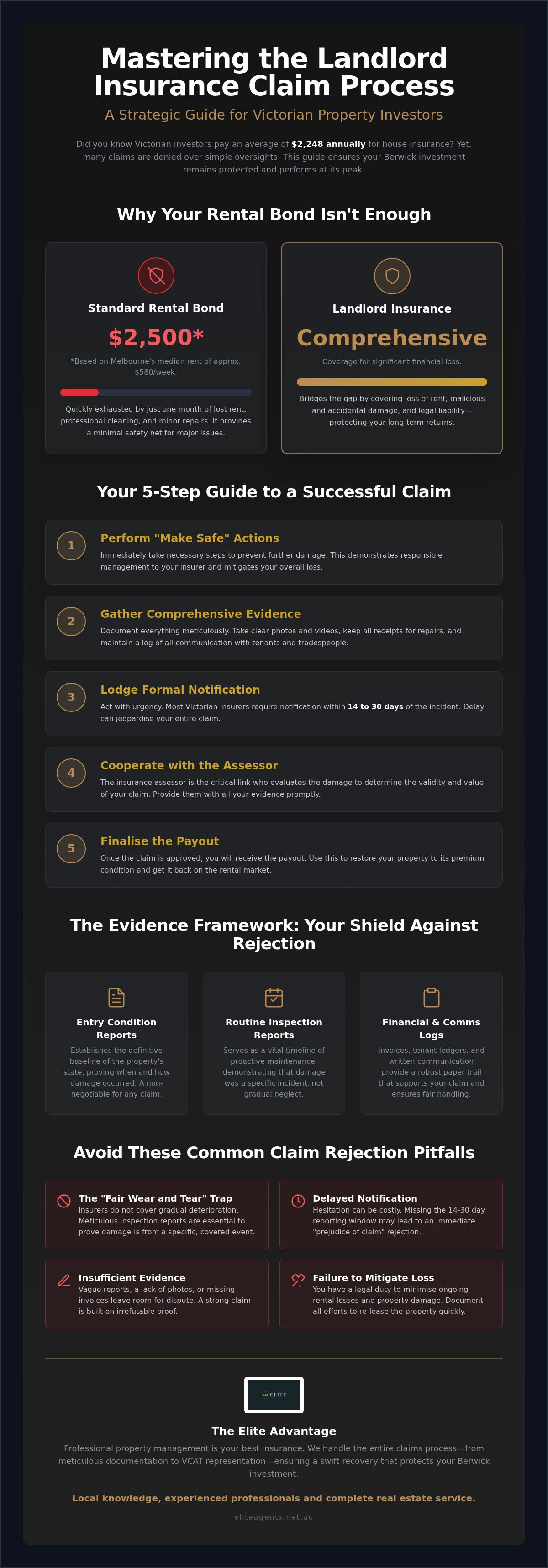
Many Berwick investors mistakenly believe the residential bond provides enough of a safety net. With the median rent in Melbourne sitting at approximately $580 per week, a standard four-week bond of $2,500 is quickly exhausted. A single month of lost rent combined with professional cleaning costs and minor repairs will easily exceed this amount. Insurance bridges that gap. It provides a level of security that a bond simply cannot match, especially when dealing with high-value Victorian assets.
Victorian policies typically distinguish between "defined events" and "tenant-related events." Defined events include natural disasters like the extreme weather that caused $1.8 billion in insured costs across Australia recently. These are often outside of anyone's control. Tenant-related events focus on the human element, covering malicious damage or rent default. The insurance assessor acts as the critical link here. They evaluate the damage on behalf of the insurer to determine the validity and value of your claim within the local property market context.
Key Coverage Areas for Victorian Landlords
Loss of rent is perhaps the most vital component; it protects your cash flow when a property is uninhabitable or a tenant defaults. You must also understand the nuance between malicious and accidental damage. Malicious damage implies intent, which often requires a police report to satisfy the landlord insurance claim process requirements. Accidental damage covers genuine mishaps. Legal liability is equally essential, shielding you if a visitor is injured on your Berwick premises and chooses to pursue a claim.
Why Timing is Critical for Your Claim
Speed is your greatest ally. Most Victorian insurers enforce an "immediate notification" rule, typically requiring you to start the claim within 14 to 30 days of the incident. Delaying this can lead to a "prejudice of claim" rejection. This occurs when the insurer argues that your hesitation made the damage worse or harder to investigate. Act while the evidence is fresh and the tenant's details are current. Prompt action ensures your property is restored to its premium condition without unnecessary delays.
The Evidence Framework: Documenting Your Berwick Investment
A successful landlord insurance claim process relies on more than just a policy number. It requires a robust evidence framework that leaves no room for ambiguity. Since October 13, 2026, Victorian landlords have been legally required to provide comprehensive evidence to support any bond claims. This regulatory shift has raised the bar for insurance documentation as well. Your Entry Condition Report is your primary weapon in any dispute. It establishes a definitive baseline of your property’s state, allowing you to prove exactly when and how damage occurred. Without a detailed report signed by both parties, your claim faces an uphill battle against "pre-existing condition" clauses.
Routine inspection reports serve as a vital timeline of property maintenance. They demonstrate that you are a proactive investor who hasn't allowed the property to fall into disrepair. Insurers often scrutinise claims for signs of neglect or wear and tear to avoid payouts. By providing a paper trail of regular check-ins, you prove the damage was a specific incident rather than gradual deterioration. If you want to ensure your documentation meets these elite standards, our property management professionals can maintain these records for you, protecting your Berwick asset around the clock.
When navigating these technicalities, remember that insurers must adhere to the Insurance Code of Practice. This code sets the standard for how claims are handled, ensuring transparency and fairness. A meticulous paper trail including invoices, tenant ledgers, and communication logs ensures you are treated fairly under these guidelines.
Capturing Professional-Grade Evidence
In 2026, blurry phone snaps are no longer sufficient for high-value claims. Use date-stamped, high-resolution photography to prove the exact moment damage was discovered. Video walkthroughs offer a sophisticated way to document the flow of damage through a home, providing a sense of scale that photos often miss. Focus your efforts on high-value areas common in Berwick homes, such as premium stone benchtops, designer bathrooms, and high-end timber flooring. These areas often represent the largest financial losses and require the most detailed proof.
Financial Record Keeping for Loss of Rent
Proving financial loss requires an impeccable tenant ledger. This document must clearly show the date of the first default and every subsequent missed payment. You must also document the "Notice to Vacate" process to show you followed Victorian law to the letter. To secure a payout for rent loss, you must prove you have "mitigated your loss." This involves keeping records of re-letting efforts, such as marketing receipts and application logs, to show the insurer you've actively tried to find a new tenant and minimise their liability.
Step-by-Step Guide to Lodging Your Claim
Executing a successful landlord insurance claim process requires a disciplined and methodical approach. Once you discover damage or a default, your first priority is to perform "make safe" repairs. If a severe storm impacts your Berwick investment, tarping a damaged roof or boarding up a broken window is essential to prevent secondary issues like mould or theft. Insurers expect you to act as a prudent owner would, and failing to mitigate further damage can jeopardise your final payout.
After the property is secure, formalise the notification with your insurer or broker immediately. Have your policy number ready and provide a concise summary of the event. You then need to assemble a comprehensive "Claim Pack." This curated collection of documents should include your bond claim evidence, the latest routine inspection reports, and any relevant VCAT orders. Presenting this pack in a logical, professional format signals to the insurer that you are a sophisticated investor who understands the requirements of the 2026 Victorian rental market.
The assessor meeting is the next critical phase. Approach this with professional poise. Walk the assessor through the property, pointing out specific damages while referencing your entry condition report. Once they provide a settlement offer, you face a strategic choice. A cash settlement offers maximum flexibility for your capital, while managed repairs through the insurer can remove the stress of coordinating trades. Evaluate which path best serves your long-term investment goals.
Reporting Crimes and Malicious Damage
Intentional vandalism or theft isn't merely a tenancy dispute; it's a criminal matter. If you discover burglary or malicious damage, you must involve Victoria Police immediately. Obtaining a Police Report Number is a non-negotiable requirement for the landlord insurance claim process when criminal activity is involved. Insurers use these reports to distinguish between civil disagreements and criminal acts, so ensuring the correct legal channel is used is vital for your claim's validity.
Navigating the VCAT Component
For claims involving tenant default or significant bond disputes, most insurers require a formal VCAT order before releasing funds. Preparing your case for a hearing in the City of Casey requires meticulous attention to detail and a deep understanding of the Residential Tenancies Act. You must ensure your property management Berwick team has correctly served all legal notices and maintained a flawless communication log. This high level of preparation ensures you stand before the member with confidence and the evidence needed to win.
Common Pitfalls That Lead to Claim Rejection
A rejected claim is the ultimate frustration for any investor, yet many setbacks in the landlord insurance claim process are entirely avoidable. Rejections rarely stem from a lack of coverage; instead, they often arise from a failure to meet the insurer’s strict procedural expectations. Understanding these nuances is the difference between a successful payout and an expensive out-of-pocket repair. Insurers look for any evidence that a landlord has been negligent in their duties, which makes professional oversight and meticulous record-keeping non-negotiable for the elite investor.
Failure to mitigate loss is a frequent deal-breaker in Victorian claims. If a tenant vacates unexpectedly, you cannot simply leave the property empty and expect the insurer to subsidise the lost income indefinitely. You must demonstrate commercial urgency by advertising the property at a market-appropriate rate immediately. Similarly, inadequate tenant screening can void specific policy features. If you haven't conducted thorough reference checks or utilised national tenancy databases, your insurer may argue that you didn't take reasonable steps to prevent a high-risk tenancy.
The transition from a fixed-term lease to a periodic tenancy also carries hidden risks. Some policies change their coverage limits or increase excess amounts once a lease expires. Staying on top of lease renewals ensures your protection remains at its most robust level. Secure your investment's future by partnering with experts who understand these sophisticated nuances; book a consultation with our property management team today to safeguard your Berwick portfolio.
Distinguishing Wear and Tear from Damage
Insurers expect you to maintain your property to a high standard, which means they won't pay for natural aging. Faded paint from sunlight is considered fair wear and tear, whereas scuff marks or holes in the wall are classified as damage. Carpet life cycles are a common point of contention; a ten-year-old carpet is often considered to have zero depreciated value, meaning a claim for its replacement will likely be rejected. Utilising a regular property appraisal Berwick helps you track these depreciation cycles and maintain an elite standard of presentation that discourages tenant neglect.
Policy Exclusions You Need to Know
Distinguishing between gradual damage and sudden events is vital. A slow-leaking pipe behind a wall that causes rot over several months is often excluded as a maintenance issue. Conversely, a pipe that bursts suddenly is usually covered. Building defects and pre-existing maintenance issues remain the landlord’s financial responsibility. You should also verify your coverage regarding unauthorised pets. If a tenant keeps an animal without permission and causes damage, your ability to claim may depend on whether you discovered the pet during a routine inspection and took appropriate action to rectify the breach.
The Elite Advantage: Why Professional Management is Your Best Insurance
While the technicalities of the landlord insurance claim process can seem daunting, they don't have to be your burden. Elite Agents & Partners transforms this complex legal journey into a seamless administrative exercise. We act as your authoritative representative, ensuring that every box is ticked and every piece of evidence is presented with professional precision. By positioning ourselves as the primary contact for insurers and assessors, we protect your time and your capital. Our team understands the nuances of the 2026 Victorian landscape, ensuring your claim isn't just filed, but successfully won.
Our "Gold Standard" trade network is a critical asset during the initial "make safe" phase. When a storm hits the South East, our trusted contractors prioritise our clients, arriving quickly to prevent minor damage from becoming a total loss. This rapid response is paired with a sophisticated approach to tenant selection. By utilising rigorous vetting processes and national databases, we aim to prevent claims before they ever happen. High-quality tenants treat your home with respect, significantly reducing the likelihood of malicious damage or rent default. We don't just manage properties; we curate tenancies that perform.
End-to-End Claim Management
We take full responsibility for the landlord insurance claim process, from the initial incident report to the final settlement review. Our team handles the tedious documentation, coordinates with insurance assessors on-site, and manages all necessary follow-ups. This comprehensive service drastically reduces the mental load for busy property investors, allowing you to focus on growing your portfolio while we handle the logistics. We ensure every repair meets our exacting standards. Our ultimate goal is ensuring your asset returns to the rental market in premier real estate Berwick VIC condition, maintaining its capital value and premium appeal.
Maximising Your Investment Security
Expertise in VCAT hearings is another pillar of the Elite advantage. We represent your interests at the tribunal, presenting a meticulously prepared case that stands up to the most rigorous scrutiny. Our deep understanding of local Casey region regulations ensures your rights are protected during bond disputes or compensation claims. We know how to speak the language of the tribunal members. Through regular, thorough inspections, we catch potential maintenance issues before they escalate into claimable events. Join the ranks of Berwick property investment experts who trust Elite Agents & Partners to provide the highest level of security for their Victorian assets.
Elevate Your Investment Strategy for 2026
Your success as a Victorian investor depends on your ability to adapt to a shifting regulatory landscape. We've explored how a meticulous evidence framework and prompt "make safe" actions form the backbone of a successful landlord insurance claim process. By avoiding common pitfalls like the "fair wear and tear" trap and ensuring your documentation meets elite standards, you protect your capital and your peace of mind. Every detail matters when it's time to restore your asset to its premium condition.
You don't have to navigate these complexities alone. Elite Agents & Partners offers specialised local knowledge of the Berwick and Casey property markets, providing comprehensive digital documentation for every tenancy we manage. We provide expert VCAT representation for all our managed clients, ensuring your interests are defended by professionals who understand the law. Secure your investment with Elite Property Management and experience the confidence that comes with a high-performance partnership. Your property deserves the elite standard of care that turns potential risks into long-term rewards.
Frequently Asked Questions
Do I need to wait for VCAT before making an insurance claim?
You should notify your insurer immediately after an incident, but finalising a claim for tenant default or malicious damage usually requires a VCAT order. Insurers typically wait for the tribunal to determine the final debt and bond distribution before paying out the balance. For non-tenant events like storm damage, you don't need VCAT and should proceed with the landlord insurance claim process as soon as the property is safe.
What is the average time it takes to process a landlord insurance claim in Victoria?
Simple claims for sudden physical damage are often settled within two to four weeks if the documentation is complete. However, complex cases involving tenant disputes or VCAT hearings can take several months to reach a final resolution. Providing high-resolution digital evidence and a clear paper trail from the start is the most effective way to accelerate this timeline and secure your payout.
Can I claim for "fair wear and tear" on my rental property?
No, landlord insurance strictly excludes fair wear and tear, as this is considered a standard cost of owning an investment. Insurers define this as the gradual deterioration that occurs through normal use, such as the natural fading of curtains or minor scuffs on high-traffic flooring. Claims must relate to a specific, identifiable event or a deliberate act of malicious damage rather than general maintenance issues.
What happens if my tenant leaves and the bond doesn’t cover the damage?
This is the primary reason for maintaining a sophisticated insurance policy. With the median Melbourne bond sitting at approximately $2,500, significant repairs or long-term rent defaults will quickly exceed the available funds. Once the bond is exhausted through the RTBA, you claim the remaining eligible costs from your insurer. This ensures your capital remains protected even when the tenant's security deposit falls short.
Does landlord insurance cover damage caused by pets?
Coverage for pet damage varies significantly between Victorian insurance providers and often requires a specific policy add-on. Some elite policies include protection for damage caused by authorised pets, while others may exclude it entirely or increase the excess. It's vital to check your specific Product Disclosure Statement (PDS) to understand how your policy treats both authorised and unauthorised animals on your Berwick property.
Will my insurance premium increase if I make a claim for tenant damage?
It's likely that your premium will increase at the next renewal following a claim. Insurers adjust their rates based on risk profiles and claim history, and as of March 2026, the average Victorian house premium already sits at $2,248. While a single claim might not cause a massive spike, a history of multiple claims can lead to higher costs or more restrictive policy conditions in the future.
How much evidence do I really need for a loss of rent claim?
You need a comprehensive evidence pack to satisfy the landlord insurance claim process for lost income. This must include a complete tenant ledger showing the date of first default, copies of all legally served "Notice to Vacate" forms, and proof of your efforts to re-let the property. Since the October 2026 regulatory changes, Victorian insurers have become even more stringent regarding the quality and transparency of this financial documentation.
Can I perform my own "make safe" repairs after a storm in Berwick?
You can perform temporary "make safe" actions, such as tarping a roof or boarding a window, to prevent further damage to your investment. However, you must not commence permanent repairs or dispose of damaged items until an insurance assessor has inspected the property. Always take clear, date-stamped photos before and after any emergency work to ensure your actions are correctly documented for the insurer.
Disclaimer
Disclaimer: This article was prepared with the assistance of artificial intelligence and reviewed for general informational purposes. While reasonable care has been taken to ensure accuracy, property-market conditions, prices, legislation and other information may change. The content does not constitute legal, financial, taxation, valuation or other professional advice. Readers should verify information and obtain advice appropriate to their circumstances before making property decisions. Elite Agents & Partners does not guarantee any specific sale price, rental return or outcome.


