

With the Melbourne CBD office vacancy rate sitting at 19.0% in the first quarter of 2026, the leverage in the commercial leasing process has shifted firmly into the hands of the well-informed tenant. Securing a premium space in the Eastern Core or a creative hub like Cremorne requires more than just a keen eye for aesthetics; it demands a clinical understanding of Victorian legislation. You likely recognise that a lease is less of a standard contract and more of a strategic partnership where the finest details of the Head of Agreement dictate your long-term success.
It's true that deciphering the Retail Leases Act 2003 or calculating complex outgoings can feel like a significant hurdle to your next investment. Our expert breakdown provides the clarity you need to navigate these complexities with the poise of a market veteran, ensuring you meet every disclosure requirement while maximising your fit-out incentives. We explore the essential steps from the mandatory 14-day disclosure period to the final execution, giving you a transparent roadmap to secure your next Victorian address with absolute confidence.
Key Takeaways
- Learn how to distinguish between retail and commercial tenancies to ensure your business remains compliant with the Victorian Retail Leases Act 2003.
- Master every stage of the commercial leasing process to move from an initial search to a signed agreement with complete transparency.
- Identify the hidden costs within Gross and Net lease structures to maintain a clear picture of your financial obligations and outgoings.
- Protect your investment by evaluating "Permitted Use" and end-of-lease "Make Good" requirements during the critical due diligence phase.
- Gain a competitive edge in South East Melbourne by aligning your property goals with localised market insights and elite management expertise.
What is the Commercial Leasing Process in Victoria?
The commercial leasing process is fundamentally a strategic business commitment rather than a simple rental arrangement. It involves a binding contract specifically designed for premises used for business purposes, ranging from sleek CBD office suites to expansive industrial warehouses in Berwick. Unlike residential tenancies in Melbourne, where consumer protection is the primary focus, commercial agreements operate on the principle of commercial utility. The expectations are higher; the stakes involve your brand's physical footprint and long-term financial health.
A successful lease relies on the oversight of the Victorian Small Business Commission (VSBC). This regulatory body ensures fair play, particularly for retail tenants, and provides a mandatory mediation service before any disputes can escalate to the Victorian Civil and Administrative Tribunal (VCAT). Our elite approach to management prioritises transparency from the very first walkthrough. We believe that early-stage negotiation is where the most value is won, ensuring that every term in the Head of Agreement reflects your specific operational needs before the final documents are drafted.
The Legal Framework: Retail vs. Non-Retail Leases
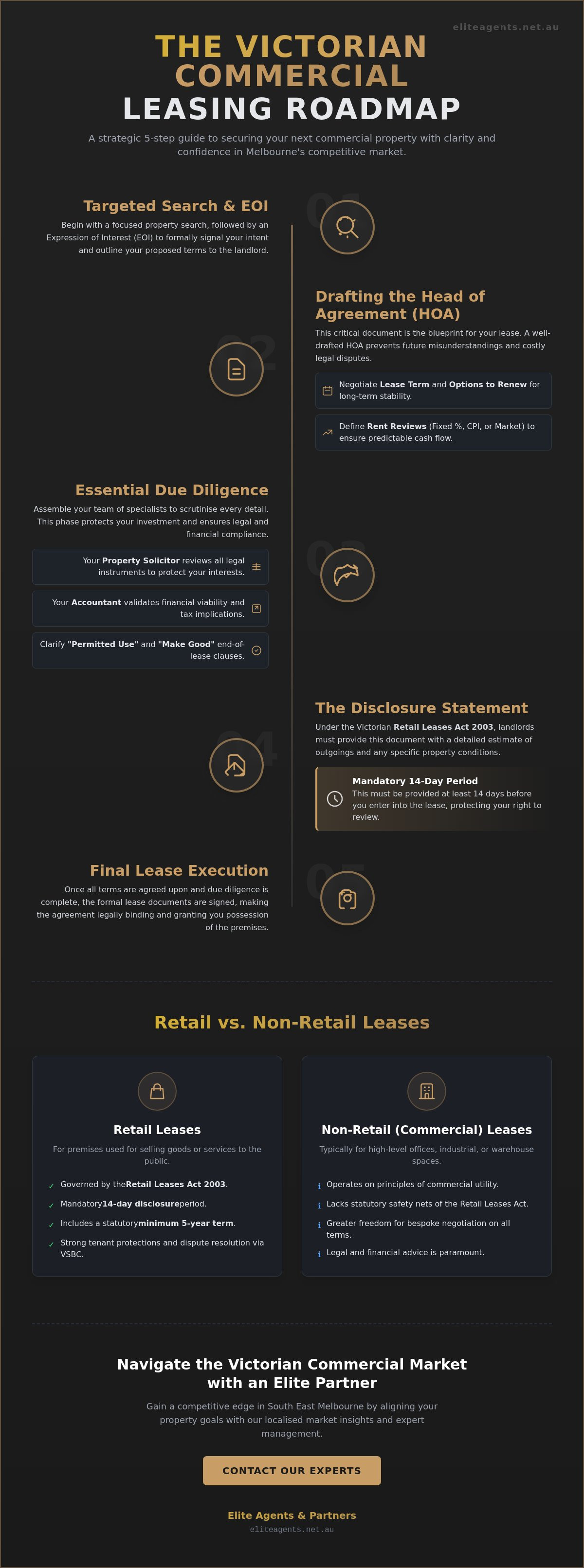
Understanding the Retail Leases Act 2003 (VIC) is essential for any Victorian investor or business owner. This legislation applies if the premises are used wholly or predominantly for the sale of goods or services to the public. It offers significant tenant protections, including a mandatory 14-day disclosure period before a lease is signed and a minimum five-year term, unless the tenant chooses to waive this right. Non-retail leases, often involving high-level office or industrial spaces, provide more room for bespoke negotiation but lack the same statutory safety nets. Recognising which category your property falls into is the first step in a secure commercial leasing process.
Key Parties and Professional Advisors
Securing a premium commercial space in South East Melbourne requires a coordinated team of specialists. Your commercial leasing agent acts as the local expert, identifying opportunities in growth corridors like Berwick, Narre Warren, and Officer that align with your business profile. However, the agent is only one part of the equation. You'll need a property solicitor well-versed in Victorian commercial law to scrutinise the fine print and ensure your interests are legally protected. Simultaneously, your accountant plays a pivotal role in reviewing the financial viability of the lease, assessing how outgoings and the new Commercial and Industrial Property Tax (CIPT) might impact your bottom line over the coming decade.
- Leasing Agent: Curates the match between landlord and tenant based on market demand.
- Property Solicitor: Drafts and reviews the legal instruments to prevent future litigation.
- Accountant: Validates the tax implications and cash flow requirements of the agreement.
The 5-Step Commercial Leasing Roadmap
The commercial leasing process transforms from a broad search into a precise negotiation once you find a space that fits your business profile. It begins with a targeted search followed by an Expression of Interest (EOI), which signals your intent to the landlord and outlines your proposed terms. This leads directly into the creation of a Head of Agreement (HOA), a document that serves as the blueprint for your future lease and prevents misunderstandings before formal contracts are drawn.
From Handshake to Head of Agreement (HOA)
Drafting a sophisticated HOA is a critical milestone for any Victorian investor. It must clearly define the initial rent and the specific structure of future rent reviews. With the RBA cash rate currently at 4.35%, many local businesses prefer fixed percentage reviews to maintain predictable cash flow, though CPI or market reviews remain common. You'll also need to negotiate the lease term and "Options to Renew" to ensure your business has a stable home for years to come. Getting these details right at the HOA stage saves significant legal costs during the final lease review.
The Disclosure Statement: A Victorian Requirement
In Victoria, the Disclosure Statement is a non-negotiable legal requirement under the Retail Leases Act 2003. Landlords must provide this document at least 14 days before you enter the lease. It provides a detailed estimate of outgoings, including insurance and maintenance costs, and highlights any specific property conditions. If this timeframe isn't met, or the information provided is inaccurate, your rights are protected by the Victorian Small Business Commission. They offer guidance to ensure the information you receive is transparent and legally sound.
Security Bonds and Bank Guarantees
Securing the premises involves a significant financial commitment through a bank guarantee or cash bond. In South East Melbourne, landlords typically require a security amount equal to three to six months' rent, depending on the asset's quality and the tenant's history. Cash bonds for retail leases must be lodged with the VSBC, while bank guarantees remain a popular choice for their efficiency and ease of management. If you're unsure if your proposed terms are competitive, our team can provide a free rental appraisal to give you the data you need.
Once the lease is executed and the bond is lodged, the fit-out period begins. This is your opportunity to customise the space to your brand's standards before the official lease commencement and handover. Clear communication during this phase ensures that your business can open its doors on schedule without any unexpected delays or compliance hurdles.
Calculating the Real Cost: Rent, Outgoings, and Incentives
Determining your total occupancy cost is a pivotal phase in the commercial leasing process. While the base rent often takes centre stage, the structure of your outgoings and incentives determines your ultimate return on investment. In markets like Berwick, you'll typically encounter two primary lease structures. A Gross Lease provides a simplified, all-inclusive figure where the landlord covers the outgoings. Conversely, a Net Lease requires the tenant to pay a base rent plus a proportionate share of the building's operating expenses. Most sophisticated industrial and retail agreements in South East Melbourne favour the Net Lease model for its transparency and scalability.
One of the most critical Victorian regulations involves Land Tax. Under the Retail Leases Act 2003, landlords are strictly prohibited from passing Land Tax on to retail tenants. This is a significant protection that does not apply to non-retail commercial or industrial leases. Ensure your solicitor reviews your outgoings schedule to confirm you aren't being charged for costs that are legally the landlord's responsibility. Beyond tax, standard outgoings include council and water rates, building insurance, and general repairs. It's vital to clarify which maintenance items fall under your remit and which remain with the owner.
Navigating Commercial Outgoings in Casey
Industrial spaces in Dandenong and Pakenham often carry unique outgoing profiles. These typically include Essential Safety Measures (ESM), such as fire extinguisher testing and sprinkler system maintenance. While the landlord is responsible for ensuring the building meets these safety standards, the costs of annual inspections are often recoverable from the tenant. We recommend requesting an annual audit of outgoing expenses. This practice verifies that you are only paying for services actually rendered and ensures the building's maintenance remains at a premium standard.
Incentives: The Art of the Deal
Landlords often offer incentives to secure high-calibre tenants and maintain the property's face rent. These usually take the form of rent-free periods or fit-out contributions. A rent-free period allows you to establish your operations without the immediate pressure of lease payments. Alternatively, a fit-out contribution provides cash or a rent abatement to help fund the customisation of your space. Be mindful of the "Clawback" clause. This provision requires you to repay a pro-rata portion of the incentive if the lease is terminated before the term expires. Successful negotiation ensures these incentives support your growth rather than creating a future liability.
- Rent-Free Period: A set duration at the start of the lease with no rent payable.
- Fit-out Contribution: Financial assistance from the landlord to build your internal space.
- Rent Abatement: A reduction in rent spread across a specific portion of the lease term.
Essential Due Diligence for Commercial Tenants
The commercial leasing process reaches its most critical juncture during the due diligence phase. This is the period where you verify that the property’s legal status matches its physical promise. A sophisticated tenant looks beyond the floorplan to scrutinise the Victorian Planning Scheme and the specific requirements of local authorities like the City of Casey. You're effectively auditing the property to ensure your business can operate without regulatory interference or unexpected capital outlays.
Zoning and Council Approvals
Zoning and "Permitted Use" are the foundations of your operational legality. You must ensure the property is zoned correctly for your specific business activity before committing to a long-term agreement. Even a minor shift in your business model, such as moving from a pure retail shop to a space that includes food preparation, can trigger the need for a Change of Use permit from your local Melbourne council. Never sign a binding agreement without a "subject to permit" clause if your operation requires these approvals. This strategic safeguard ensures you aren't locked into a financial commitment for a space you cannot legally occupy.
The "Make Good" and Redecoration Clauses
Your obligations at the end of the lease are just as important as the terms at the beginning. The "Make Good" clause defines how you must return the premises to the landlord when the term expires. While some agreements only require a "broom-clean" handover, others mandate a full strip-out. This involves removing all partitions, signage, and fit-outs to restore the building to its original base-building condition. This can be a significant expense that needs to be factored into your long-term budget from day one.
Standard five-year leases in South East Melbourne also frequently include redecoration cycles. These clauses typically require the tenant to repaint and refresh the interior finishes at specific intervals or in the final six months of the term. To protect yourself from unfair claims, insist on a comprehensive Condition Report at the start of the commercial leasing process. This document, complete with high-resolution photography, serves as the definitive record of the property's state at handover and prevents disputes when it's time to move on.
Finally, ensure your insurance portfolio meets the landlord's specific requirements. This almost always includes public liability insurance, plate glass replacement, and your own contents and equipment cover. If you are navigating these requirements for the first time, our specialists provide tailored commercial leasing and management services to help you secure your next Victorian business address with absolute confidence.
The Elite Advantage: Commercial Leasing in South East Melbourne
Success in the Victorian market requires more than a transactional mindset; it demands a partner who views the commercial leasing process as the foundation of long-term wealth creation. At Elite Agents & Partners, we move beyond simply filling vacancies. We curate the perfect match between landlord and tenant by aligning business aspirations with premium commercial assets. Our approach is built on a foundation of local pride and professional authority, ensuring that every lease we manage in Berwick, Narre Warren, and Officer reflects the high standards of our brand.
Localised Market Insights
The commercial landscape in South East Melbourne is evolving rapidly, driven by significant infrastructure investment and population growth. In the Berwick commercial precinct, we're seeing a sustained flight to quality as businesses seek modern, well-appointed spaces that mirror their own brand's sophistication. Meanwhile, the industrial corridor in Pakenham and new developments in Clyde are reshaping regional demand. With the Melbourne South East industrial vacancy rate sitting at approximately 3.5% in early 2026, the competition for prime space is intense. We leverage our deep local network to identify off-market opportunities, giving our clients exclusive access to properties before they reach the broader market.
Professional Management for Peace of Mind
Securing a tenant is only the beginning of a successful investment journey. The true value of our commercial leasing and management service lies in our meticulous attention to detail during the life of the lease. We handle complex rent reviews and annual outgoing reconciliations with clinical precision, ensuring that your returns are optimised and your legal obligations are met. By fostering professional, transparent relationships with tenants, we encourage long-term stability and reduce the risks associated with frequent turnover. Our commitment to ethical transparency means every interaction is backed by comprehensive documentation and expert advice.
Navigating the complexities of the Victorian market doesn't have to be a solitary endeavour. Whether you're an investor looking to secure a high-performing tenant or a business owner searching for your next flagship location, our team provides the sophisticated guidance you need. Take the first step toward a more secure commercial future by contacting us for a free sales and rental appraisal. Let us show you how a partnership with a local expert can transform your experience of the commercial leasing process into a seamless, successful journey.
- Strategic Matching: We align high-quality tenants with premium commercial properties.
- Market Authority: Expert insights into Berwick, Officer, and the Casey growth corridor.
- End-to-End Service: From initial marketing to professional outgoing reconciliations.
- Exclusive Access: Leveraging off-market networks to find the perfect commercial fit.
Secure Your Commercial Future in South East Melbourne
Mastering the commercial leasing process in Victoria is about transforming complex regulations into strategic advantages. You now understand the vital distinction between retail and commercial frameworks, the nuances of net lease outgoings, and the critical importance of a "subject to permit" clause. These elements form the bedrock of a secure and profitable business environment. By prioritising transparency and thoroughness, you protect your capital and ensure your physical footprint supports your brand's growth.
Led by Director Javid Zada, our team combines expert local knowledge of the City of Casey with a commitment to sophisticated results. We provide comprehensive procedural checklists to ensure every detail is meticulously managed, offering you total transparency from the first inspection to the final handover. Don't leave your next commercial move to chance when you can leverage the expertise of neighbourhood specialists who understand the local pulse.
Book an Elite Commercial Leasing Consultation today to discuss your property goals. We look forward to helping you secure a premium space that reflects your business's success and long-term vision.
Frequently Asked Questions
How long does the commercial leasing process usually take in Victoria?
The commercial leasing process typically takes between four and eight weeks from the initial Expression of Interest to the official handover. This timeframe allows for the mandatory 14-day disclosure period required for retail tenancies and the subsequent legal review by both parties' solicitors. If the premises require a significant fit-out or specific council permits in the City of Casey, you should anticipate a longer lead time before your business is fully operational.
What is the difference between a retail lease and a commercial lease in VIC?
A retail lease is defined by the nature of the business; specifically, whether you sell goods or services to the public. These agreements fall under the Retail Leases Act 2003, which provides tenants with specific protections regarding outgoings and lease terms. General commercial leases usually apply to industrial warehouses or private office spaces where no public trade occurs, offering more flexibility but fewer statutory safeguards for the tenant.
Can a landlord refuse a lease transfer if I sell my business?
A landlord generally cannot unreasonably refuse a request to transfer a lease if you sell your business, provided the new tenant is financially sound. Under Victorian law, you must provide the landlord with the details of the proposed assignee and their business experience. The landlord then has a specific timeframe to review the application. They can only withhold consent if the new tenant lacks the financial resources or relevant skills to maintain the tenancy.
Who pays for the legal costs of preparing a commercial lease in Victoria?
In Victoria, landlords are legally prohibited from charging retail tenants for the preparation of the lease or the disclosure statement. This is a significant protection that ensures the initial entry costs remain manageable for small business owners. However, for non-retail commercial or industrial leases, the responsibility for legal fees is a negotiable item. It's common for tenants to pay the landlord's reasonable legal costs in these instances.
What is a "Director Guarantee" and do I need one for a commercial lease?
A Director Guarantee is a personal commitment from the company's directors to meet the lease obligations if the business itself cannot pay. Landlords frequently require these guarantees for proprietary limited companies to ensure they have a secondary path for recovering rent or damages. While common, the scope of these guarantees can often be negotiated; for example, by limiting the liability to a specific dollar amount or a fixed period.
How do rent reviews work in a standard Victorian commercial lease?
Rent reviews in a standard Victorian lease usually occur annually to ensure the property's yield keeps pace with the market. You'll typically see a fixed percentage increase, often between 3% and 4%, or an adjustment linked to the Consumer Price Index (CPI). Market reviews are generally reserved for the commencement of a new option period, allowing the rent to be recalibrated to current local values in areas like Berwick or Narre Warren.
What happens if a commercial tenant defaults on rent in Melbourne?
If a tenant defaults on rent, the landlord must issue a formal notice of breach giving the tenant a specific period to rectify the debt. If the payment isn't made, the landlord may have the right to re-enter the premises and terminate the lease. For retail tenancies, parties are encouraged to attempt mediation through the Victorian Small Business Commission before taking the matter to VCAT, ensuring a transparent and ethical resolution process.
Is a 3x3 lease common for small businesses in Berwick?
A "3x3" lease, consisting of a three-year initial term with a three-year option to renew, is exceptionally common for small businesses in the Berwick precinct. This structure provides the tenant with the security of a six-year horizon while allowing for a review of the business's viability after the first three years. It's an ideal balance for emerging enterprises in growth corridors like Officer and Clyde that require stability without an indefinite commitment.
Disclaimer
Disclaimer: This article was prepared with the assistance of artificial intelligence and reviewed for general informational purposes. While reasonable care has been taken to ensure accuracy, property-market conditions, prices, legislation and other information may change. The content does not constitute legal, financial, taxation, valuation or other professional advice. Readers should verify information and obtain advice appropriate to their circumstances before making property decisions. Elite Agents & Partners does not guarantee any specific sale price, rental return or outcome.


