

What if the difference between a substantial payout and a total claim rejection isn't the extent of the damage, but a single missing date-stamped photo in your property manager's routine report? We understand that for Victorian investors, the landlord insurance claim process often feels like a high-stakes gamble against complex fine print and lengthy VCAT wait times. You've worked hard to build your portfolio in Berwick or the City of Casey, and the thought of losing rental income while navigating bureaucratic hurdles is genuinely stressful.
You deserve a management partner who treats your investment with the same meticulous care you do. This elite guide ensures you master every stage of the claim journey, from initial evidence collection to the final successful payout. We'll show you how to minimise out-of-pocket expenses and return your property to the rental market with record speed. By following our proven framework, you'll gain the confidence to handle tenant disputes and insurance adjusters with the authority of a seasoned professional. We'll explore the critical documentation required to satisfy insurers and the exact steps to take when a tenancy doesn't go to plan.
Key Takeaways
- Act immediately within the first 24 hours to secure your property and mitigate further loss, ensuring you involve the police for any malicious damage or theft.
- Streamline your landlord insurance claim process by maintaining meticulous, date-stamped evidence from the initial entry condition report through to the final inspection.
- Learn to navigate complex Victorian regulations, including the 14-day arrears threshold for rent default and the critical distinction between accidental and malicious damage.
- Leverage expert property management representation to handle insurer enquiries and manage on-site assessor inspections for a faster, more successful payout.
- Understand the final logistical steps required for settlement, from obtaining VCAT orders to executing a Warrant of Possession when necessary.
Immediate Actions: What to Do When Disaster Strikes Your Investment
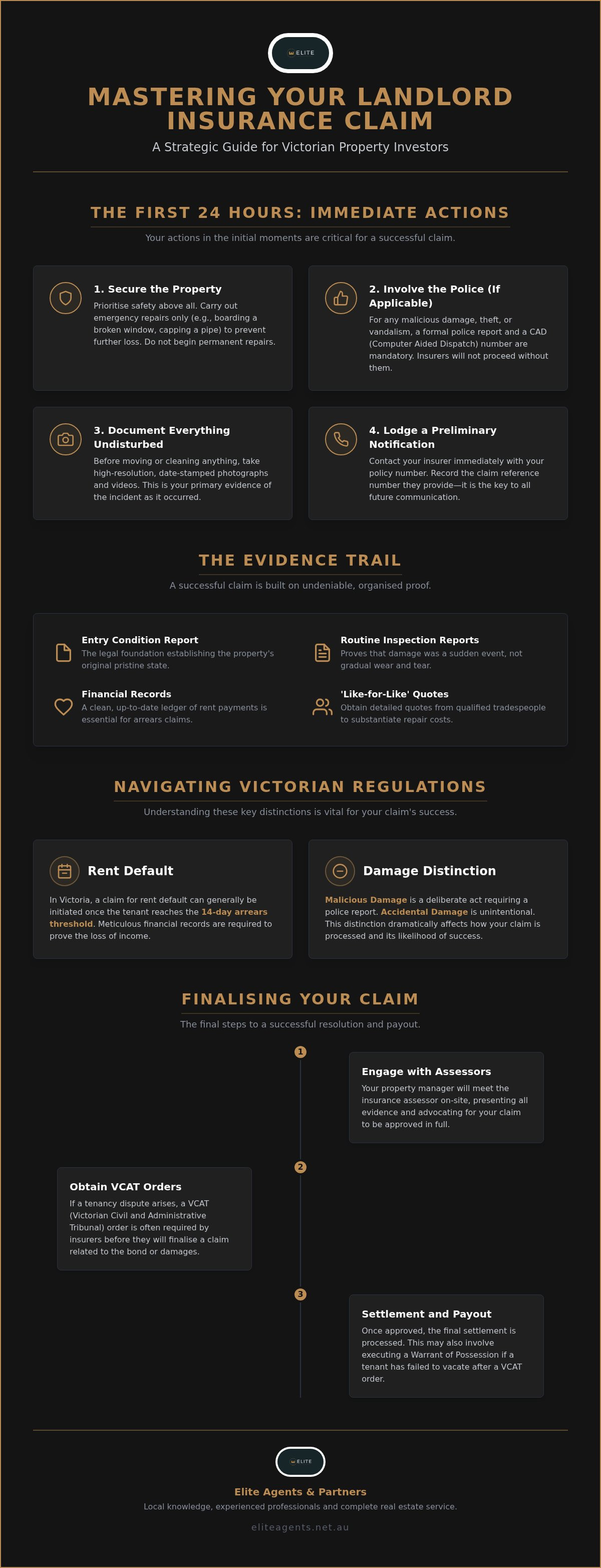
The moment you discover damage to your Victorian investment, your priorities must shift from growth to preservation. The first 24 hours are a high-stakes window where your actions directly dictate the success of your eventual payout. While your instinct might be to rush in with a toolkit, the landlord insurance claim process requires a more calculated, strategic approach. You must first ensure the property is safe and then meticulously document every detail before a single item is moved or cleaned.
If the damage involves theft, vandalism, or malicious acts, involving the police is a mandatory legal step. You cannot bypass this; insurers will almost certainly reject a claim for malicious damage without a formal police report and a corresponding CAD (Computer Aided Dispatch) number. Contact your property manager immediately. As your first responder, we take the lead in coordinating these interactions, ensuring the right information is captured from the outset. This early intervention is vital because Rent Insurance Explained resources often highlight how loss of income can be mitigated through swift, professional management.
One of the most common mistakes investors make is violating the 'No Repair' rule. Apart from emergency work required to prevent further loss, you should never undertake permanent repairs before an assessor has inspected the site. If you replace the carpet or repaint the walls before they arrive, you've essentially erased the evidence they need to approve your claim. Keep the scene exactly as it is until you receive the green light from your provider.
Securing the Property Safely
Safety is paramount, particularly if your tenants are still in residence. You are permitted to carry out emergency repairs, such as boarding up a broken window or capping a leaking pipe, to prevent secondary damage. However, these must be temporary measures only. Before any work begins, capture high-resolution, date-stamped imagery of the scene. These photos serve as the "before" in your evidence trail, providing the insurer with an unedited view of the incident. Coordinate closely with your tenants to ensure their safety and cooperation, as their testimony can often support your claim.
Lodging the Preliminary Notification
Once the site is secure, lodge a preliminary notification with your insurer. You'll need your policy number and the current Product Disclosure Statement (PDS) to confirm your specific coverage limits. Always record the claim reference number provided during this call; it is the key to all future correspondence. Immediate notification prevents 'prejudice' to the insurer's position, ensuring they cannot claim your delay hindered their ability to investigate the loss. This proactive step keeps the landlord insurance claim process moving forward without unnecessary friction.
The Evidence Trail: Documenting Damage for a Successful Claim
A successful outcome in the landlord insurance claim process hinges on one thing: undeniable proof. The Entry Condition Report serves as the legal foundation for every claim you'll ever make. This document isn't just a formality. It's your primary defence against a tenant claiming that a hole in the wall or a stained carpet was "already there." We ensure these reports are exhaustive, capturing the pristine state of your Berwick or Narre Warren property before the keys are handed over, leaving no room for ambiguity.
High-resolution, date-stamped imagery is non-negotiable. While a blurry photo might show damage, a crisp, professional-grade image provides the clarity an assessor needs to approve a payout. You must also maintain a clean ledger of all financial transactions, particularly rent arrears and outgoings. This financial trail is essential for rent default claims, where every cent must be accounted for. When seeking repairs in the City of Casey, always obtain 'like-for-like' quotes from qualified tradespeople. These estimates should reflect the cost of returning the property to its original state, not upgrading it. For a deeper look at the requirements, consult the Official Victorian Claim Guide to ensure your documentation meets state standards.
The Power of Routine Inspections
Regular inspections are your best tool for proving that damage was a sudden event rather than gradual deterioration. By conducting thorough checks as frequently as Victorian law permits, we create a chronological record of the property's condition. This timeline is vital because insurers often reject claims for "wear and tear" or "gradual damage." We use professional property management software to store these date-stamped records securely. Remember that Victorian legislation requires specific notice periods before entering, ensuring you remain compliant while protecting your asset.
Organising Your Substantiating Documents
Substantiation is the legal burden of proof resting entirely on the landlord. To meet this, you should compile a comprehensive 'Claim Pack' that includes the signed tenancy agreement, bond lodgement forms, and a complete communication log. Tracking every email, text, and phone call regarding the incident provides a narrative that insurers find difficult to dispute. If you find the paperwork overwhelming, consider how a professional property appraisal and management service can take the lead on your documentation. Having all these records organised and ready to go can shave weeks off your settlement time.
Common Claim Scenarios: Rent Default vs. Malicious Damage
Not all setbacks to your investment portfolio are equal. Understanding the nuance between a tenant who misses rent and one who intentionally damages the property is vital for a smooth landlord insurance claim process. While accidental damage might be a simple wine spill on the carpet, malicious damage involves a deliberate act of destruction. The distinction is not merely semantic; it dictates the excess you pay and the evidence required to secure a payout.
In Victoria, rent default claims usually trigger once the 14-day arrears threshold is met. You cannot simply claim because a tenant is two days late. You need a paper trail that proves you have followed the Residential Tenancies Act to the letter. This includes issuing the correct notices at the precise legal intervals. Situations involving tenant hardship or death require a delicate balance of empathy and procedural rigour. These sensitive claims often fall under specific policy inclusions that differ from standard default scenarios.
If damage renders your City of Casey property "untenantable," you can often claim for the loss of rent during the repair period. This ensures your yield remains protected even while the property sits vacant for restoration. It's a critical safety net that prevents a physical disaster from becoming a total financial collapse. We work to ensure every day of lost income is documented and presented clearly to your insurer.
Navigating Rent Default Claims
Serving a 'Notice to Vacate' correctly is the non-negotiable first step in the Victorian market. If the notice is invalid due to a technical error, your insurance claim will likely fail before it even reaches an assessor. Most insurers also require the bond to be fully exhausted or legally allocated through VCAT before the policy payout commences. For a deeper dive into managing these complex tenant relationships and protecting your returns, see The Elite Guide to Property Management in Berwick.
Identifying Malicious Damage
Proving intent is the primary hurdle in the landlord insurance claim process for property damage. Insurers distinguish between a child drawing on a wall, which is often classified as accidental, and a tenant smashing mirrors or intentional flooding, which is malicious. A police report number is your strongest validation in these instances. Without a formal police record, the insurer may default the classification to accidental, which often results in a significantly higher excess for the landlord to absorb.
Why Professional Property Management is Your Best Insurance Policy
Most investors view property management as an operational expense; however, during the landlord insurance claim process, it functions as a high-yield investment. Insurers often pose complex, technical questions designed to identify policy exclusions. An expert team like Elite Agents & Partners acts as your professional advocate, answering these enquiries with precision and backed by the date-stamped evidence we've already established. We don't just facilitate the claim; we navigate the bureaucracy to ensure your interests remain protected at every turn.
The 'Assessor Liaison' is perhaps the most undervalued part of a successful claim. When the insurance assessor arrives at your property, having an agent on-site is vital. We don't merely hand over the keys. We walk the assessor through the damage, provide historical context from previous routine inspections, and ensure no detail is overlooked. This proactive stance prevents the assessor from making conservative assumptions that could result in a lower payout. By being present, we ensure the evidence trail is presented with absolute clarity.
Our team keeps the landlord insurance claim process efficient by coordinating with a curated network of Berwick tradespeople. We see that repairs are prioritised and completed to a high standard, which minimises the vacancy period and caps your loss of rent claim. Our deep understanding of Victorian legislative compliance ensures that every Notice to Vacate or arrears letter is served perfectly. One technical error in a notice can provide an insurer with the grounds they need to reject a rent default claim entirely.
The Elite Advantage in Berwick
Our rigorous tenant screening process is your first line of defence, designed to prevent claims before they even happen. By selecting high-calibre renters for properties in Narre Warren and Cranbourne, we mitigate the risk of malicious damage from the outset. It's also critical to ensure your property isn't under-insured in a rising market. Utilise our House Valuation Berwick resource to confirm your sum insured reflects the current market value of your asset.
Reducing the Stress of the Process
We act as the essential buffer between you and a defaulting tenant, removing the emotional friction from difficult situations. Our team also manages your 'Duty of Disclosure' during policy renewals, ensuring the insurer is notified of any material changes to the tenancy. A professional manager's fee is often offset by the higher claim success rate and the prevention of costly VCAT errors. If you want to secure your investment with a team that understands the stakes, enquire about our property management services today. We handle the complexity so you can focus on your broader portfolio goals.
Finalising Your Claim: VCAT Orders and Settlement Logistics
Obtaining a formal VCAT Order is the definitive final step for any rent default claim in Victoria. While earlier stages of the landlord insurance claim process focus on documentation, this phase is about legal closure. Most insurers will not release the final payout for lost rent until you provide a VCAT Order for possession or a compensation order. This document proves that the tenancy has legally ended and quantifies the exact debt owed by the renter. We manage this transition with precision, ensuring that the transition from a non-paying tenant to a settled claim is as seamless as possible.
When a tenant refuses to vacate despite a possession order, we must move to obtain a Warrant of Possession. This is a critical legal instrument that authorises the Victorian Police to assist with the eviction. It is a high-pressure situation that requires calm, professional oversight to ensure the safety of the property and the surrounding Berwick community. Once the property is vacant, you face a choice between a cash settlement or managed repairs. A cash settlement offers immediate liquidity, but managed repairs through our network ensure the work meets the high standards required to attract premium tenants in the City of Casey.
Before re-listing, conduct a thorough post-claim review of your policy. For investors seeking to refine their coverage, a specialist boutique advisory like Putney Insurance Group can help you identify if your sum insured or specific sub-limits, such as the $12,000 limit for accommodation and storage costs, need adjusting for the next tenancy. This proactive approach ensures your portfolio remains resilient against future market shifts.
Navigating the VCAT Process
Success at a VCAT hearing requires a meticulously prepared 'Evidence Folder'. This includes the chronological communication log, date-stamped inspection photos, and proof that all notices were served within the strict Victorian timelines. From the moment the 'Notice to Vacate' is issued, the clock starts ticking toward the hearing date. A professional agent is significantly more effective at VCAT than a self-managing landlord because we understand the specific precedents and evidentiary standards the Tribunal members expect. If the insurer declines your claim, remember you have exactly 28 days to apply to VCAT for a review of that decision.
Closing the Claim and Re-listing
The final administrative hurdle involves finalising the bond claim through the Residential Tenancies Bond Authority (RTBA). We ensure the bond is correctly allocated to cover the initial arrears or damage before the insurance payout covers the balance. Before the next Berwick family moves in, the property must meet all Victorian 'minimum standards'. This includes ensuring your mandatory gas and electrical safety checks are current, as these must be conducted every two years by qualified tradespeople. To discuss how we can provide this level of rigorous, stress-free oversight for your investment, Contact Elite Agents & Partners today. We specialise in turning complex claims into successful outcomes, protecting your yield and your peace of mind.
Protecting Your Victorian Property Portfolio
Mastering the landlord insurance claim process requires a blend of foresight, meticulous documentation, and decisive action. You've now seen how the foundation of a successful payout is laid long before an incident occurs, starting with comprehensive digital condition reporting and regular, date-stamped inspections. By understanding the nuances of Victorian law and the specific requirements of the City of Casey market, you can protect your portfolio from the financial impact of rent default or malicious damage.
You deserve a partner who understands the local landscape and has the expertise to represent your interests at VCAT with authority. Our team serves as your dedicated advocate, ensuring every procedural step is followed to the letter. Don't leave your rental yield to chance or struggle with the stress of complex insurance paperwork alone. As local Berwick market experts, we provide the sophisticated oversight your investment deserves.
Secure your investment with Elite Property Management and experience the peace of mind that comes with expert, local representation. We're here to ensure your investment continues to thrive.
Frequently Asked Questions
How long does a landlord insurance claim usually take to process in Victoria?
A landlord insurance claim process typically takes between two and eight weeks to reach a settlement once all substantiating documentation is submitted. Delays often occur if the insurer requires additional evidence or if there is a backlog following a major weather event. Providing a complete 'Claim Pack' with date-stamped photos and a clean rental ledger from the outset is the most effective way to accelerate this timeline.
Can I make a claim if the tenant hasn't moved out yet?
You can lodge a claim for physical damage while a tenant still resides in the property to prevent further loss. However, for rent default claims, most Victorian insurers require the tenancy to have officially ended via a VCAT Order or a signed surrender of lease. This ensures the total loss of rent is accurately calculated and the bond has been correctly allocated before the final payout is issued.
What is the difference between a 'Notice to Vacate' and an eviction?
A 'Notice to Vacate' is the formal legal document that starts the process of ending a tenancy, whereas an eviction is the physical removal of a renter. Under Victorian law, an eviction only occurs after a VCAT possession order is granted and a Warrant of Possession is executed by the police. You must follow the specific notice periods required by the Residential Tenancies Act to ensure your insurance remains valid.
Do I have to pay the insurance excess for every single item damaged?
You typically pay one excess per 'event' rather than per individual item. If a tenant maliciously damages multiple walls during a single incident, it is usually treated as one claim with one excess. However, if damage occurred during two separate, unrelated incidents, the insurer may apply two separate excesses. Always check your Product Disclosure Statement to see how your specific provider defines an 'event'.
Will my landlord insurance cover the cost of a VCAT hearing?
Many premium policies cover the VCAT application fee as part of a rent default or malicious damage claim. While they rarely cover the cost of legal representation, the landlord insurance claim process often allows for the reimbursement of tribunal-related outgoings. Having an expert property manager handle the hearing ensures your evidence is presented professionally, which significantly increases your chances of a successful compensation order.
What happens if my insurance claim is rejected?
If your claim is rejected, you have exactly 28 days to apply to VCAT for a formal review of the insurer's decision. Before taking this step, you should request a detailed written explanation from the insurer's internal dispute resolution department. Often, a rejection is simply due to a lack of evidence, which a professional agent can help rectify by providing missed inspection reports or communication logs.
Does landlord insurance cover damage caused by the tenant's pets?
Coverage for pet damage is frequently an optional add-on or a specific inclusion with its own sub-limits rather than being part of standard accidental cover. It is essential to check your policy wording, as some insurers exclude pet damage entirely unless a specific 'pet' premium is paid. Given the current Victorian rental reforms regarding pets, ensuring this cover is active is a vital safeguard for your investment.
How much rent default can I typically claim back?
Most policies allow you to claim between 6 and 15 weeks of lost rent, though this is often capped at a specific dollar amount or the end of the fixed-term lease. The claim amount is calculated after the tenant's bond has been fully exhausted or legally allocated to other debts. We focus on meticulous ledger management to ensure every day of arrears is accounted for in your final settlement.
Disclaimer
Disclaimer: This article was prepared with the assistance of artificial intelligence and reviewed for general informational purposes. While reasonable care has been taken to ensure accuracy, property-market conditions, prices, legislation and other information may change. The content does not constitute legal, financial, taxation, valuation or other professional advice. Readers should verify information and obtain advice appropriate to their circumstances before making property decisions. Elite Agents & Partners does not guarantee any specific sale price, rental return or outcome.


