

Is your current approach to upkeep a protective shield for your wealth, or is it a ticking clock of hidden liabilities? With the National Construction Code 2025 now in effect and the May 2026 mandate for lead-free plumbing officially active across Victoria, the standards for commercial property maintenance have shifted. It’s no longer just about fixing leaks; it’s about navigating a high-stakes environment where compliance and asset value are inextricably linked.
You’ve likely felt the pressure of rising material costs and the confusion that often surrounds tenant outgoings in Melbourne’s South East. It's frustrating when unexpected repairs eat into your yield, especially as the 2026-27 Federal Budget introduces a new inflation-indexed model for capital gains. We're here to help you regain control. This article reveals how to strategically manage your maintenance to protect your capital growth, satisfy strict Essential Safety Measures, and attract the kind of premium tenants who value a well-curated space. We will break down the latest regulatory changes and provide a clear framework for lowering your long-term costs while staying fully compliant.
Key Takeaways
- Learn why shifting your perspective from maintenance as an expense to a strategic investment is the key to protecting your capital growth in 2026.
- Master the nuances of commercial property maintenance to ensure your asset meets the latest Victorian safety standards and National Construction Code requirements.
- Understand the critical distinctions within the Retail Leases Act 2003 (VIC) to correctly manage outgoings and avoid costly disputes regarding landlord works.
- Discover how a comprehensive baseline audit allows you to categorise assets by service frequency and predict repair cycles with absolute precision.
- Gain exclusive insights into how sophisticated commercial management in the City of Casey secures high-calibre tenants through a rigorous contractor vetting process.
Understanding Commercial Property Maintenance in the Australian Market
Strategic Property maintenance is the foundation of a high-performing investment portfolio. Unlike residential assets, commercial holdings operate under longer lease cycles and significantly stricter legislative frameworks. Neglecting a single compliance check in a Dandenong warehouse or a Berwick office suite doesn't just risk a fine; it threatens the security of your long-term income stream. High-calibre tenants expect a seamless environment where their business can thrive without the disruption of failing infrastructure. When you prioritise commercial property maintenance, you aren't just fixing issues; you're actively protecting your asset's cap rate and ensuring it remains a premium choice in a competitive market.
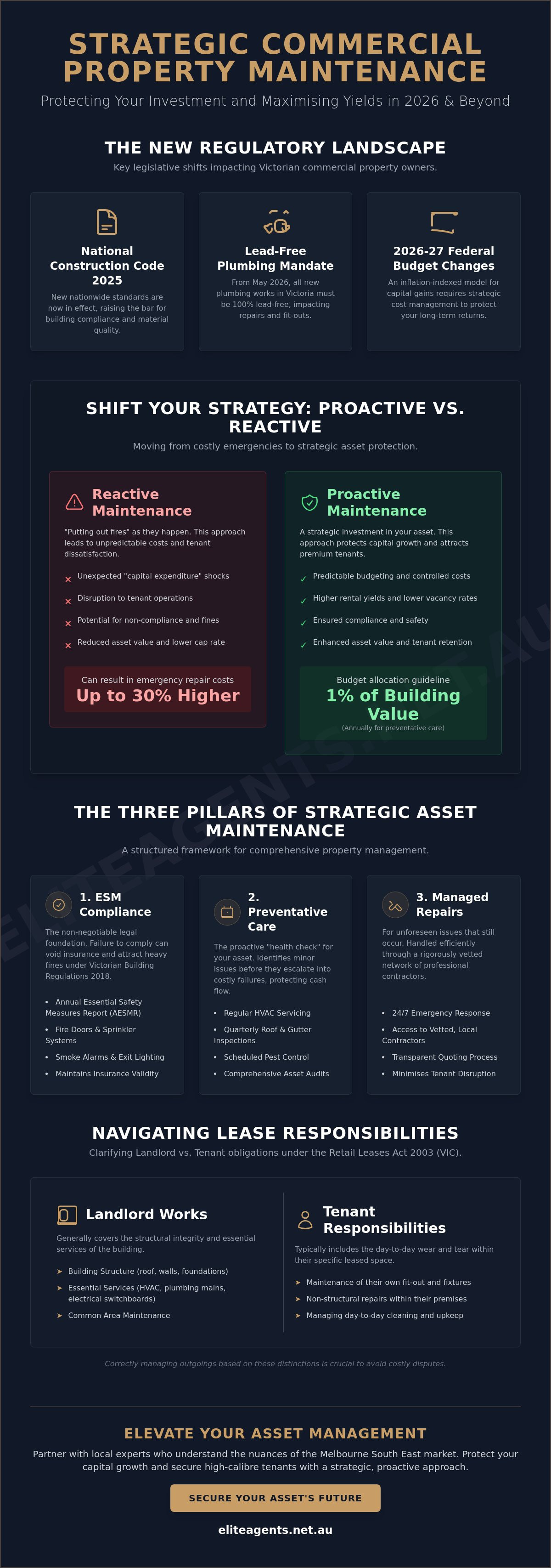
In the Victorian market, the distinction between "Landlord Works" and "Tenant Fit-out" is often where disputes arise. Most commercial leases allow for the recovery of maintenance costs through outgoings; however, the Retail Leases Act 2003 (VIC) places specific limits on what can be passed to the tenant. Landlords are generally responsible for the structural integrity and the maintenance of essential services, while tenants handle the day-to-day wear of their specific space. Getting this balance right is essential for maintaining a transparent, professional relationship with your occupants.
The Financial Case for Proactive Upkeep
Proactive management is the most effective way to avoid "capital expenditure" shocks that can derail your annual cash flow. By identifying minor issues before they escalate, you maintain the building's presentation, which directly correlates with higher rental yields and lower vacancy rates. Industry data suggests that a disciplined approach to preventative care can reduce emergency repair costs by up to 30%. This shift from reactive to strategic management ensures that your funds are used to enhance the property rather than simply putting out fires.
Local Market Dynamics in Melbourne's South East
Properties in the City of Casey and Cardinia Shire face unique environmental challenges. The heavy rainfall patterns common to the South East demand rigorous guttering and drainage inspections to prevent water ingress, which can lead to expensive structural damage. For retail strips in Berwick and Narre Warren, kerb appeal is a primary driver of foot traffic. A pristine facade and well-maintained common areas signal quality to both customers and prospective high-value tenants. Leveraging local expertise is vital; you need contractors who understand the specific soil conditions and weather profiles of the region to ensure every repair is fit for purpose. This localised knowledge is what separates a standard service from a curated asset strategy that delivers long-term results.
The Three Pillars of Strategic Asset Maintenance
Achieving a sustainable yield in the 2026 market requires more than just collecting rent. It demands a sophisticated three-tiered framework that balances legal necessity with operational efficiency. By categorising your commercial property maintenance into three distinct pillars, you transform a chaotic list of repairs into a streamlined asset protection strategy. This structured approach ensures your building remains a premium choice for high-calibre tenants while safeguarding your long-term capital growth.
Essential Safety Measures (ESM) Compliance
Compliance is the non-negotiable foundation of your investment. In Victoria, the Building Regulations 2018 mandate that property owners maintain specific safety features to protect occupants. These Essential Safety Measures include fire doors, smoke alarms, exit lighting, and sprinkler systems. You're legally required to prepare an Annual Essential Safety Measures Report (AESMR) every year. Failing to produce this document doesn't just invite heavy fines; it can void your insurance coverage entirely. Maintaining a pristine compliance record is a hallmark of a professional landlord and a key factor in securing the trust of national-brand tenants.
Preventative vs. Reactive Strategies
Preventative maintenance acts as the proactive "health check" for your building. Regular HVAC servicing, quarterly roof inspections, and scheduled pest control prevent minor issues from becoming catastrophic failures. For 2026, Melbourne strata guidelines suggest a disciplined budgeting approach. You should ideally allocate 1% of the building's replacement value to an annual maintenance fund. Properties under 10 years old may only require 0.5% to 0.75%, while assets over 20 years old often need 1% to 2% to remain competitive. This foresight prevents the "capital expenditure shocks" that can suddenly erode your annual yield.
Reactive maintenance addresses the sudden, unpredictable failures that disrupt business operations. You must have established protocols for the "2 AM emergency". Whether it’s a burst pipe or a failed security gate, the speed of your response determines the longevity of your tenant relationships. High-performing investors don't wait for things to break; they have a vetted list of contractors ready to act. If you're looking to elevate your investment's performance, exploring a specialised commercial leasing and management strategy can provide the professional oversight your portfolio deserves.
Balancing these three pillars creates a resilient asset. When your commercial property maintenance is handled with this level of precision, you reduce long-term repair costs and enhance the property's valuation. It’s about moving away from a "fix it when it breaks" mentality toward a curated strategy that prioritises both safety and sophistication.
Navigating Outgoings and Tenant Responsibilities
Precision in your lease agreement is the strongest defence against unexpected costs. While the physical pillars of commercial property maintenance ensure your building stays standing, the legal distribution of these tasks determines who actually pays for them. Misunderstandings regarding outgoings don't just strain tenant relationships; they directly impact your net yield. A sophisticated landlord knows that a "set and forget" approach to lease terms is a recipe for financial leakage. You must clearly delineate between landlord works, which preserve the building’s structural integrity, and tenant fit-out maintenance, which covers the occupant’s specific operational needs.
Outgoings generally include council rates, water rates, land tax, and insurance. They also cover the recurring costs of keeping the property functional, such as gardening, cleaning, and fire safety checks. Ensuring these are explicitly outlined in the initial contract prevents friction during the term. At the end of a lease, the 'Make Good' provision becomes your primary tool for asset protection. This clause requires the tenant to return the premises to its original condition, minus fair wear and tear, ensuring the next high-calibre occupant can move in without you facing a massive refurbishment bill.
The Retail Leases Act and Maintenance
The Retail Leases Act 2003 (VIC) creates a specific boundary for landlords in Melbourne’s South East. Unlike industrial or pure commercial leases where "net leases" often pass almost all costs to the tenant, retail legislation is protective of the occupant. You cannot recover capital improvement costs or certain property management fees from a retail tenant. The Disclosure Statement is your most critical document here. It must accurately forecast all maintenance outgoings, as failing to disclose a cost can legally bar you from recovering it later. Our team at Elite Agents & Partners prioritises this level of transparency, ensuring lease compliance for Berwick landlords and protecting their long-term interests.
Negotiating Maintenance in the Lease
Clarity is paramount when negotiating service contracts. Don't use vague terms like "good repair and condition" without defining what that looks like for your specific asset. Be explicit about who is responsible for servicing high-wear items like air conditioning units or grease traps in Narre Warren hospitality spaces. Setting a regular schedule for property inspections allows you to enforce these tenant obligations before minor neglect turns into major damage. These walkthroughs aren't just about policing; they're an opportunity to demonstrate your commitment to a premium business environment, fostering the kind of long-term loyalty that keeps your vacancy rates low.
How to Create a Proactive Maintenance Schedule: A Step-by-Step Guide
Transitioning from a reactive "break-fix" cycle to a disciplined commercial property maintenance schedule is the most effective way to secure your yield. A well-constructed plan removes the guesswork from property ownership, allowing you to forecast expenses with precision. This proactive approach doesn't just save money; it signals to your tenants that their business environment is managed with professional authority. By following a structured framework, you ensure no element of your asset's health is left to chance.
Step 1: The Comprehensive Building Audit
Every successful strategy begins with a baseline. You must conduct a thorough audit of the building's "envelope", which includes the roof, external walls, and windows. Structural integrity is paramount; minor hairline cracks or failing window seals can lead to significant water ingress if ignored. Internally, focus on the mechanical heart of the property: the electrical switchboards, plumbing manifolds, and HVAC systems. A professional Property Appraisal helps identify hidden maintenance liabilities by providing a high-level overview of the asset's current market standing and physical condition. This audit provides the data required to categorise your assets by service frequency.
- Monthly: High-traffic cleaning, landscaping, and security system functionality checks.
- Quarterly: HVAC filter replacements, gutter clearing, and plumbing pressure tests.
- Annually: Structural facade reviews, roof membrane inspections, and full ESM certification.
Step 2: Building Your Contractor Network
The "Local Advantage" is a tangible asset in the City of Casey. Sourcing Berwick-based tradies ensures faster response times and lower travel costs, which is vital during urgent repairs. When vetting contractors, look beyond the quote. Ensure they hold commercial-grade insurance and specialised qualifications relevant to your building's specific systems. Consolidating your services under a few trusted, high-performing partners reduces "call-out fee" fatigue and ensures a consistent standard of work across the property. This curated network becomes an extension of your management team, providing the eyes and ears on the ground that you need.
In 2026, paper records are no longer sufficient. You must implement a digital tracking system for all service records and safety certificates. This creates an immutable trail of compliance that is essential for insurance renewals and potential property sales. Review your schedule every six months; as the building ages or tenant usage changes, your commercial property maintenance needs will evolve. Adjusting your plan in real-time ensures you are always one step ahead of the wear-and-tear cycle, keeping your investment in peak condition.
Elevating Your Asset: The Elite Agents Approach to Commercial Management
Elite Agents & Partners views commercial property maintenance as a primary driver of capital appreciation. We don't merely manage buildings; we curate high-performing investments. Our 'Elite' vetting process for contractors in the City of Casey ensures that every tradie on your site meets our exacting standards for technical skill and professional conduct. By leveraging our extensive local network, we secure priority service for our clients. This ensures your asset is never left waiting for essential repairs while competitors struggle with contractor delays. This proactive oversight is exactly what leads to higher valuations and superior sales outcomes when you decide to exit the market.
Sophisticated Management for Sophisticated Investors
Transparent reporting is the hallmark of our service. We provide detailed insights into your property's performance, keeping you informed without the day-to-day stress of micro-management. Our team maintains a focus on 'Aspirational Appeal' across all asset classes, including industrial and retail spaces. We believe every property should reflect the success of its owner. We also handle the difficult conversations. When tenants raise concerns or push back on repair obligations, we use our deep knowledge of Victorian legislation to resolve the issue while preserving the landlord-tenant relationship. Our goal is a seamless experience that prioritises your peace of mind.
Your Next Step toward a Worry-Free Investment
A free commercial rental appraisal is the most effective way to assess whether your current management is truly delivering maximum yield. If your asset feels under-managed or your repair costs are spiralling, it's time for a more proactive experience. Switching to Elite Agents & Partners is a streamlined process designed to protect your interests from day one. We take the burden of compliance and contractor coordination off your shoulders, allowing you to focus on your broader investment goals. We invite you to experience a partnership that values relationship-driven results over mere transactions.
Contact Elite Agents & Partners today for a comprehensive commercial management review
Secure Your Commercial Legacy through Strategic Oversight
Success in the 2026 commercial landscape requires a shift from reactive repairs to disciplined, data-driven management. By mastering the three pillars of maintenance and strictly adhering to Victorian safety regulations, you position your asset as a premium choice for high-calibre tenants. This strategic approach to commercial property maintenance allows you to forecast outgoings with certainty and avoid the capital expenditure shocks that often derail long-term growth. It's the difference between a property that merely exists and one that consistently outperforms the local market averages in Berwick and the City of Casey.
Our specialised commercial leasing and management team brings expert local knowledge and comprehensive procedural checklists to every portfolio we oversee. We provide the transparency and professional authority you need to invest with absolute confidence. Your property deserves a management partner as dedicated to its long-term success as you are.
Book Your Free Commercial Property Appraisal with Elite Agents and discover how a curated maintenance framework can elevate your asset’s value today. Let's ensure your investment remains a sophisticated pillar of your financial future.
Frequently Asked Questions
Who is responsible for air conditioning maintenance in a commercial lease?
Responsibility for air conditioning maintenance is typically determined by the specific terms of your lease agreement. In most Australian commercial leases, the tenant handles routine servicing and filter changes, while the landlord remains responsible for major structural repairs or full unit replacements. It's vital to define these boundaries clearly during negotiations to avoid disputes when a system fails during a Melbourne heatwave.
What are Essential Safety Measures (ESM) in Victoria?
Essential Safety Measures are the fire, life safety, and health items required in a building to ensure occupant safety. In Victoria, this includes fire doors, smoke alarms, emergency lighting, and sprinkler systems. Landlords must ensure these are maintained and produce an Annual Essential Safety Measures Report to remain compliant with the Building Regulations 2018.
Can I pass all maintenance costs onto my commercial tenant as outgoings?
You can pass on many maintenance costs as outgoings, provided they are clearly outlined in the lease and do not violate the Retail Leases Act 2003. While industrial and office leases often allow broad cost recovery, retail landlords are prohibited from passing on capital improvement costs or certain management fees. Always verify your disclosure statement reflects these intended recoveries to ensure they are legally enforceable.
How often should I conduct a commercial property inspection?
Conducting a formal inspection every six months is the industry standard for maintaining high-performing assets. These bi-annual walkthroughs allow you to identify minor wear before it escalates into a costly repair. Regular site visits also provide an opportunity to verify that the tenant is fulfilling their specific commercial property maintenance obligations as defined in their contract.
What happens if a landlord fails to maintain a commercial building in Victoria?
Neglecting maintenance in Victoria can lead to severe legal and financial repercussions. Tenants may have grounds to seek a rent reduction or terminate the lease if the building becomes unfit for their business operations. Additionally, failing to uphold structural integrity or safety standards can void your insurance policy and result in significant fines from local councils or the Victorian Building Authority.
How does the Retail Leases Act 2003 affect maintenance in Berwick?
The Retail Leases Act 2003 significantly restricts how landlords in Berwick and the wider City of Casey recover costs. It mandates that landlords cannot pass on land tax or capital expenditure to retail tenants. This legislation also requires a high level of transparency; if a maintenance cost wasn't accurately forecast in the Disclosure Statement, you may be legally unable to claim it from the occupant.
Is it better to use a single maintenance contractor or multiple specialists?
Using a curated mix of specialists is generally more effective for complex systems, while generalists suit routine tasks. Specialists ensure that high-stakes infrastructure like HVAC and fire systems are serviced by qualified experts. However, consolidating these services under a broader management strategy helps reduce call-out fees and ensures a consistent standard across your entire portfolio.
How do I calculate a maintenance budget for my commercial warehouse?
To calculate a maintenance budget, industry guidelines for 2026 suggest allocating 1% of the building’s replacement value annually. For a modern warehouse under 10 years old, you might only need 0.5% to 0.75%. If your facility is over 20 years old, increasing that allocation to 1% or 2% is a safer strategy to account for aging infrastructure and the rising costs of commercial property maintenance materials.
Disclaimer
Disclaimer: This article was prepared with the assistance of artificial intelligence and reviewed for general informational purposes. While reasonable care has been taken to ensure accuracy, property-market conditions, prices, legislation and other information may change. The content does not constitute legal, financial, taxation, valuation or other professional advice. Readers should verify information and obtain advice appropriate to their circumstances before making property decisions. Elite Agents & Partners does not guarantee any specific sale price, rental return or outcome.


