

A lease break doesn't have to be a financial disaster for your premium investment. While the sudden news of an early departure is often unsettling, it's a procedural transition that allows you to strategically reset your yield when managed with professional precision. You're likely asking what happens if a tenant breaks lease VIC under the 2026 regulations, particularly regarding your right to recover costs without triggering a lengthy VCAT dispute. It's natural to feel concerned about the potential for extended vacancies or the complexity of pro-rata re-letting fees, but these challenges are manageable with the right expertise.
We understand the pressure to maintain consistent cash flow while adhering to strict legislative requirements. This guide provides a clear roadmap for navigating the $65.60 VCAT application fee, calculating legitimate advertising recovery, and fulfilling your essential duty to mitigate loss. You'll gain the confidence to secure a new, high-quality tenant quickly while maintaining the professional standards your property deserves. We'll explore the nuances of the Residential Tenancies Act to ensure you recover your actual and reasonable costs without the stress of an avoidable legal battle.
Key Takeaways
- Master the art of pro-rata calculations to ensure you recover legitimate re-letting and advertising costs without exceeding legal limits.
- Fulfil your statutory duty to mitigate loss by initiating a strategic marketing campaign immediately to protect your investment's yield.
- Identify the specific legal exceptions, such as family violence provisions, where a tenant may terminate an agreement without financial penalty.
- Gain clarity on what happens if a tenant breaks lease VIC to distinguish between recoverable expenses and prohibited penalties under the latest 2026 regulations.
- Leverage exclusive local renter databases to achieve a zero-day vacancy transition and maintain your property’s performance in the Berwick and Narre Warren markets.
Understanding Lease Breaks under Victorian Tenancy Laws
A lease break represents a significant pivot in your property's lifecycle. It occurs when a tenant exits a fixed-term agreement before the specified end date, a process legally defined in Victoria as "ending a residential rental agreement early." The 2026 regulatory landscape demands a sophisticated approach to these transitions. Landlords must now adhere to strict pro-rata compensation rules that prioritise transparency and fairness. Understanding these nuances is the first step in protecting your asset's long-term performance.
The legal framework governing these interactions is robust. When you explore Understanding Lease and Tenancy Laws, it becomes clear that the rights of both parties are carefully balanced. To successfully manage your portfolio, you must know exactly what happens if a tenant breaks lease VIC. This knowledge allows you to transition from a period of uncertainty to a proactive strategy that secures a new, high-calibre renter without delay.
Fixed-Term vs. Periodic Agreements in VIC
Fixed-term agreements are the cornerstone of a stable investment. They provide a guaranteed term of rental income, making them highly desirable for sophisticated landlords. When a tenant breaks this specific type of contract, they are typically responsible for a portion of the costs associated with finding a successor. This is because the landlord has planned their financial trajectory based on that fixed duration. Breaking a fixed-term lease carries more financial weight for the tenant than a standard exit.
Periodic tenancies, often called month-to-month agreements, operate differently. They offer a level of flexibility that suits certain lifestyle choices but provide less long-term certainty for the property owner. In Victoria, a tenant on a periodic lease can vacate by providing a minimum of 28 days' notice. Because there is no fixed end date, the landlord cannot claim re-letting fees or advertising costs in these instances. Recognising which agreement type you have in place is essential for setting accurate expectations regarding compensation.
The Tenant’s Notice of Intention to Vacate
The transition begins formally when the tenant serves a Notice of Intention to Vacate. This document must be in writing and should ideally use the prescribed Consumer Affairs Victoria format. It sets the legal clock in motion. Once received, you can immediately begin to organise your marketing strategy. Quick action is the hallmark of a successful landlord. It allows you to tap into our database of pre-qualified renters in Berwick and Narre Warren before the current tenant even hands back the keys.
Occasionally, a tenant may "abandon" a property by leaving without any formal communication. This scenario requires immediate professional intervention. You must verify the abandonment and follow specific procedural steps to regain possession legally. Delaying this process only extends the vacancy period. By acting swiftly and following the established legal protocols, you can minimise financial exposure and prepare the property for its next premium occupant. Documenting every step ensures you are prepared should the matter require a VCAT hearing later.
Calculating Compensation: Pro-rata Fees and Lost Rent
Financial recovery in a lease-break scenario is governed by the principle of restoration. As a landlord, you're entitled to be "put back in the position" you would have enjoyed had the agreement reached its natural conclusion. This doesn't mean profiting from the situation; instead, it ensures your investment remains whole and your yield is protected. To achieve this, you must follow a structured four-step process to determine legitimate claims. Understanding Calculating Compensation is essential for any property owner aiming for a transparent and fair resolution that stands up to scrutiny.
The process begins with calculating the pro-rata re-letting fee. You must also determine pro-rata advertising costs and track lost rent from the vacate date until the new lease commences. Every claim you make is cross-referenced against your "duty to mitigate loss." If you're unsure about your current property's performance or potential during a transition, a free rental appraisal can help clarify your market position. Knowing exactly what happens if a tenant breaks lease VIC ensures you remain compliant while securing your financial interests.
The Pro-rata Calculation Explained
The math is precise. You can't charge a departing tenant the full cost of re-letting if they've already served a significant portion of their term. The formula is straightforward: (Total Fee / Lease Term) x Remaining Months = Allowable Claim. For instance, if a tenant exits at the 10-month mark of a 12-month lease, they're only liable for two months' worth of the re-letting fee. This represents the "lost value" of the initial placement. It's a fair system that VCAT upholds strictly.
Advertising costs follow the same logic. In the competitive Berwick market, premium photography and premier listings are standard. However, these costs must be reasonable. Claiming a high fee for a basic social media post might be viewed as excessive, whereas a standard professional marketing package is generally accepted. Being clear on what happens if a tenant breaks lease VIC helps you avoid these common pitfalls during the bond claim process. Accuracy here prevents unnecessary delays in funds being released from the RTBA.
Lost Rent and the 'Mitigation' Requirement
Rent remains the tenant's responsibility until a new, suitable renter is found. This liability continues until the original lease ends or a new agreement begins. It's a vital protection for your cash flow. However, this right isn't absolute. The Residential Tenancies Act requires you to take all reasonable steps to reduce the tenant's loss. You can't simply let the property sit empty while the former tenant pays the bill; you must actively seek a replacement.
VCAT considers "reasonable effort" to include advertising the property promptly and at a realistic market rent. If you attempt to increase the rent significantly during a lease break, you may forfeit your right to claim compensation for lost rent. Success lies in balancing your desire for a high yield with your legal obligation to find a replacement tenant without unnecessary delay. Our team prioritises this balance to ensure your investment continues to perform at its peak even during unexpected changes.
Landlord Obligations: The Duty to Mitigate Loss
The Residential Tenancies Act is explicit: mitigation is a mandatory legal obligation, not a recommendation. When a tenant decides to vacate early, you possess a statutory duty to take all reasonable steps to reduce their financial burden. This legal principle ensures that while you're protected from loss, the departing tenant isn't unfairly penalised for a transition that could be resolved quickly through diligent effort. Failing to meet this standard is the most common reason VCAT dismisses compensation claims for lost rent. Understanding what happens if a tenant breaks lease VIC requires a clear grasp of how your actions directly influence your right to recover costs.
Documenting every stage of the re-letting process is vital for any potential bond dispute. If a matter proceeds to a hearing, the Member will look for evidence that you acted with urgency and fairness. This includes proof of when the property was first advertised, the frequency of inspections, and the criteria used to assess applicants. Without a comprehensive record, your claim for lost rent becomes vulnerable. We treat this duty with the highest level of professional rigour to ensure your investment's performance is never compromised by procedural oversights.
Proactive Marketing and Open Inspections
Strategic pricing is the cornerstone of effective mitigation. Attempting to advertise the property at a rent significantly higher than what the departing tenant was paying may be viewed by VCAT as a failure to mitigate. If you seek a higher yield during a lease break, you're essentially looking for a new investment opportunity rather than simply replacing a lost contract. Promptly scheduled open-for-inspections are equally crucial. They provide tangible proof of "reasonable effort" to find a successor. At Elite Agents & Partners, we manage this transition seamlessly by synchronising marketing launches with the receipt of notice, often securing a new tenant before the keys are even returned.
Record Keeping for VCAT Success
A successful claim relies on a transparent digital audit trail. You should maintain a meticulous log of every enquiry, every person who attended an inspection, and every application received. This data serves as your primary defence if a tenant challenges your claim for lost rent. It's also essential to remember that you cannot reject a suitable applicant without a valid, non-discriminatory reason. If a qualified renter applies and is turned away, your right to claim rent from the previous tenant typically ends at that moment. Our professional property management systems provide the robust reporting needed to satisfy VCAT's requirements, ensuring your path to cost recovery remains clear and legally sound.
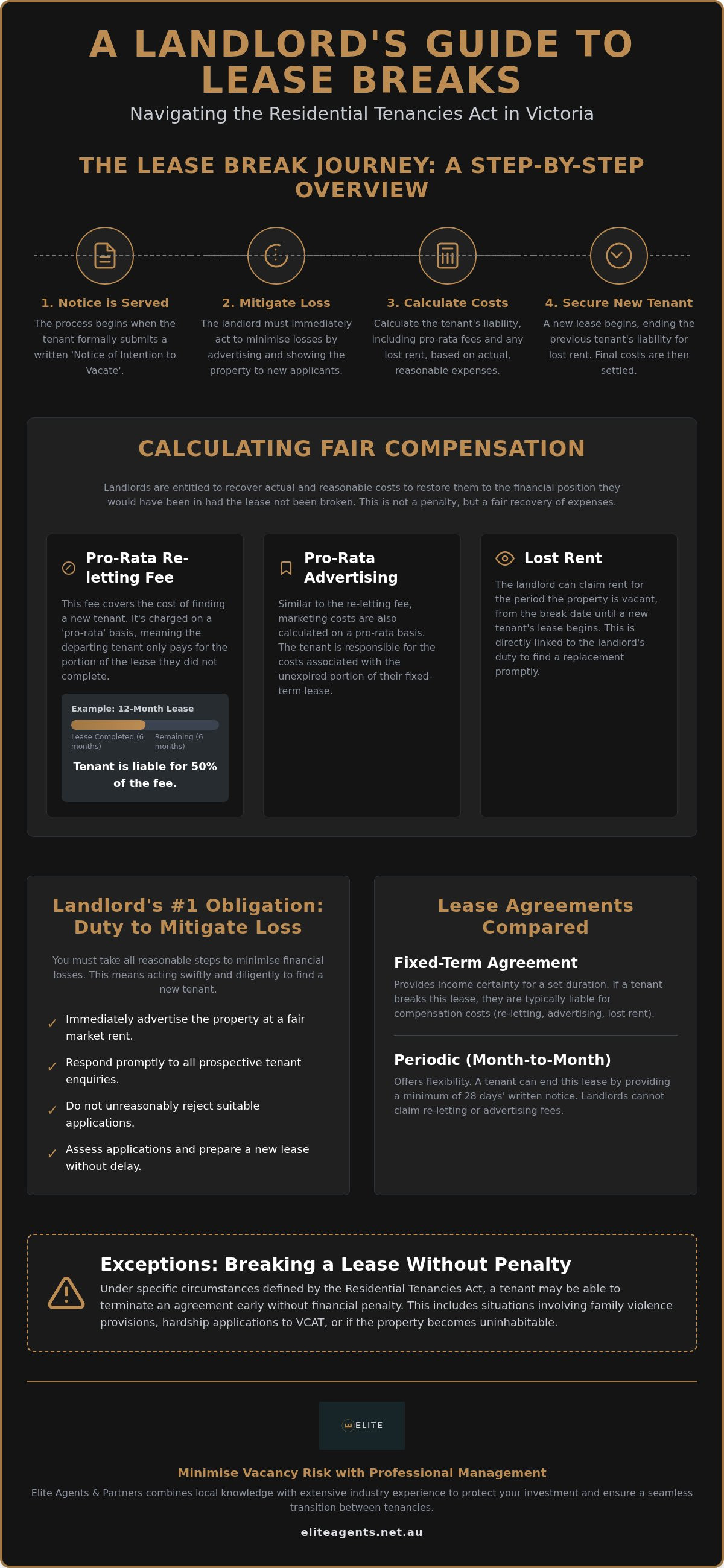
Exceptions: When a Tenant Can Break Lease Without Penalty
Legislation provides specific pathways where the usual compensation rules simply do not apply. While most departures follow the pro-rata recovery path discussed earlier, the 2026 regulatory environment recognises that certain life events require immediate flexibility. In these cases, your right to recover re-letting fees or lost rent is superseded by the tenant's legal protections. Understanding what happens if a tenant breaks lease VIC under these special circumstances is essential for maintaining an ethical and compliant portfolio. It allows you to respond with the necessary poise while protecting your long-term reputation as a provider of premium housing.
The 2021 reforms, which remain the cornerstone of today's market, introduced 'Special Circumstances' clauses. These allow for the termination of a residential rental agreement without the standard financial penalties if the tenant can prove specific grounds to VCAT. As a sophisticated property owner, you should view these not as hurdles, but as vital legal safety nets that require a nuanced, professional response. If you find yourself managing a delicate tenancy transition, our team offers a free rental appraisal and management consultation to guide your next steps.
Family Violence and Rental Agreements
Protections for tenants experiencing family violence are absolute and non-negotiable. Under Victorian law, a person who is a victim of family violence can apply to VCAT to terminate their agreement early or have their name removed from a joint lease. In many instances, they can vacate immediately. In these sensitive cases, you are legally prohibited from listing the tenant on a 'blacklist' or residential tenancy database. Confidentiality is paramount. Any breach of the tenant's privacy during this process can lead to significant legal repercussions. Bond handling also changes; VCAT may order that the bond be apportioned differently to protect the victim's financial interests while ensuring the landlord's property is still accounted for.
VCAT Hardship Applications
Severe financial hardship serves as another ground where VCAT may intervene. The Tribunal defines 'severe hardship' as a situation where the tenant would suffer more if the lease continued than the landlord would if it ended. This might include a total loss of income, a serious medical crisis, or a family tragedy. VCAT performs a delicate balancing act, weighing the tenant's immediate distress against your financial loss as a property owner. They have the power to reduce or even waive the compensation usually owed for a lease break.
Prevention is your strongest asset in this arena. Robust tenant screening Victoria remains the best defence against future hardship claims. By selecting applicants with stable financial histories and strong references, you minimise the risk of encountering these complex Tribunal battles. While you cannot predict every life event, a thorough vetting process ensures your property is occupied by those best positioned to fulfil their contractual obligations. When hardship does occur, having a professional partner to manage the VCAT application ensures your interests are represented with authority and clarity.
How Elite Property Management Minimises Vacancy Risk
A lease break presents a unique opportunity to reposition your asset in the current market. While the legalities of what happens if a tenant breaks lease VIC are fixed, the financial outcome depends entirely on the speed and quality of your response. Our "Elite" approach prioritises a zero-day vacancy transition. We don't wait for the keys to be returned to start the search for your next resident. Instead, we activate our exclusive database of pre-qualified renters in Berwick and Narre Warren the moment a notice is received. This proactive stance ensures your yield remains consistent even during unexpected changes.
Settling bond claims without the need for a VCAT battle requires expert negotiation and a deep understanding of current legislation. We manage this delicate balance by providing tenants with clear, documented calculations of their pro-rata obligations from the outset. This transparency reduces friction and encourages a swift resolution. By combining premium marketing strategies with a meticulous screening process, we ensure your property outshines the competition and attracts high-calibre applicants who value the quality of your investment.
The Elite Agents Advantage in the City of Casey
Local expertise is your greatest asset when navigating a lease break. Our deep roots in the City of Casey allow us to set competitive, data-driven prices in suburbs like Cranbourne, Officer, and Pakenham. We understand the specific lifestyle drivers that attract renters to these areas. By using property management Berwick experts, you gain access to a team that manages every communication with professional poise. We handle the final inspection with a critical eye, ensuring the property is returned in premium condition. Our streamlined bond claim process protects your yield by accounting for every legitimate expense before the funds are released.
Next Steps for Landlords Facing a Lease Break
If you've just received notice, speed is essential. Contact your property manager immediately to initiate a comprehensive mitigation plan. This is the time to review your landlord insurance policy to confirm your "loss of rent" coverage and understand any specific claim requirements. A lease break is also an ideal moment to reassess your property's market value. Requesting a free rental appraisal allows you to ensure your property is priced accurately for a quick re-let, preventing the long-term losses associated with over-pricing in a shifting market.
Managing what happens if a tenant breaks lease VIC doesn't have to be a source of stress. With a strategic partner by your side, this transition becomes a controlled procedural step in your investment journey. We provide the digital audit trails and professional representation needed to safeguard your interests at every turn. Let us turn a potential vacancy into a seamless transition that reinforces the strength of your property portfolio.
Securing Your Investment's Future Performance
A sudden vacancy is a pivotal moment that requires professional poise and local market expertise. By mastering the nuances of pro-rata cost recovery and fulfilling your statutory duty to mitigate loss, you ensure your portfolio remains resilient. Understanding what happens if a tenant breaks lease VIC is the first step toward a successful transition that prioritises your long-term yield. Success in the 2026 rental market depends on acting with urgency while maintaining a meticulous digital audit trail for any potential Tribunal review.
As specialists in Berwick and the wider City of Casey, we offer the expert knowledge of the Residential Tenancies Act 2026 required to navigate these complexities seamlessly. Our team delivers tailored marketing campaigns designed to outshine the competition and secure premium renters without delay. We focus on relationship-driven results that treat your property as the high-end asset it is, ensuring every transition is handled with elite precision.
Protect your investment and find a new tenant faster with Elite Agents & Partners. We're committed to empowering you with the tools and insights needed to thrive in an evolving market. Your investment journey deserves a partner who shares your vision for success.
Frequently Asked Questions
Can I keep the tenant's bond if they break the lease in VIC?
No, you cannot automatically keep the bond as a penalty. The bond is held securely by the Residential Tenancies Bond Authority (RTBA) and is only released via a mutual agreement or a VCAT order. You are entitled to claim for actual, documented losses such as lost rent and pro-rata re-letting fees. Understanding what happens if a tenant breaks lease VIC ensures you follow the correct legal path to recover these costs fairly and transparently.
How much notice does a tenant have to give to break a lease in Victoria?
Technically, there is no minimum notice period for ending a fixed-term agreement early, though tenants are encouraged to provide as much notice as possible. Providing early notice helps you start the re-letting process sooner, which reduces the tenant's liability for lost rent. For periodic tenancies, a standard 28-day written notice is required. Clear communication during this phase is vital for a smooth transition and protecting your investment's yield in the City of Casey.
What is a 'reasonable' re-letting fee in 2026?
A reasonable fee is strictly limited to the actual costs you incur, calculated on a pro-rata basis. If your agent charges a re-letting fee for a 12-month lease and the tenant leaves with six months remaining, the tenant is only liable for 50 per cent of that cost. You cannot charge a flat penalty or an amount that exceeds your actual out-of-pocket expenses. This ensures transparency and aligns with the latest Victorian rental reforms and VCAT expectations.
Do I have to accept the first tenant who applies after a lease break?
You are not required to accept the very first applicant, but you must not unreasonably reject a suitable candidate. To satisfy your duty to mitigate loss, you must assess all applications against your standard, non-discriminatory criteria. If you reject a high-quality applicant who meets all financial and reference requirements, VCAT may rule that your right to claim compensation for lost rent ended on the date that tenant could have moved in.
What happens if the tenant refuses to pay rent after they move out?
The tenant remains legally liable for rent until a new renter is found or the fixed-term agreement expires. If they stop payments, you should document the arrears carefully and prepare a claim against the bond. If the bond does not cover the total lost rent and re-letting costs, you can apply to VCAT for a compensation order. Promptly initiating your marketing plan is the best way to resolve this while fulfilling your legal obligations.
Can a tenant break a lease if the property needs repairs?
A tenant can only terminate the agreement without penalty if you have failed to meet your repair obligations after being formally notified. They must first serve a "Notice to Landlord of Breach of Duty." If the repairs are not completed within the required timeframe, the tenant may apply to VCAT for an order to end the tenancy. Maintaining your property to a premium standard is the most effective way to prevent these types of early terminations.
How long does it typically take to find a new tenant in Berwick?
In the active Berwick market, a well-presented property priced at market value often attracts high-quality applications within the first week of advertising. Our sophisticated marketing strategies and extensive local database aim to achieve a zero-day vacancy period. By starting the search the moment notice is received, we often secure a new, pre-qualified renter before the previous agreement has even concluded. This efficiency is a hallmark of our specialised local management service.
Disclaimer
Disclaimer: This article was prepared with the assistance of artificial intelligence and reviewed for general informational purposes. While reasonable care has been taken to ensure accuracy, property-market conditions, prices, legislation and other information may change. The content does not constitute legal, financial, taxation, valuation or other professional advice. Readers should verify information and obtain advice appropriate to their circumstances before making property decisions. Elite Agents & Partners does not guarantee any specific sale price, rental return or outcome.


