

Could a more regulated market actually offer more security for the sophisticated investor? With the full implementation of the Victorian rental laws 2026, the era of no-fault evictions has ended, replaced by a framework that demands precision and professional oversight. You might feel anxious about restricted screening processes or the complexity of the new portable bond scheme. These are valid concerns in a fast-evolving Melbourne market where the rules of engagement are being rewritten to prioritise transparency and long-term stability.
We understand that maintaining strong rental yields requires more than just luck; it requires deep, localised expertise and a proactive approach to compliance. This guide promises to help you master these reforms to ensure your investment remains compliant and your rights are protected. We'll explore the mandatory standard application form arriving in March, the extended 90-day notice period for rent increases, and the vital record-keeping standards required to avoid VCAT disputes and secure your property's future in the prestige rental market.
Key Takeaways
- Learn why the mandatory standard application form arriving in March 2026 prohibits specific questions about pets and children to ensure absolute privacy compliance.
- Understand the strategic shift required now that "no-reason" notices to vacate are banned, necessitating a valid, documented cause for every lease termination.
- Master the operational nuances of the Victorian rental laws 2026, specifically the "evidence first" rule that requires immediate proof for any bond claim.
- Discover how fixed-term agreements now transition automatically into periodic leases, requiring a more proactive approach to managing long-term occupancy.
- Identify why professional property management is essential for navigating this high-penalty environment and protecting your investment's long-term yield.
Navigating the 2026 Victorian Rental Law Reforms: A New Era for Owners
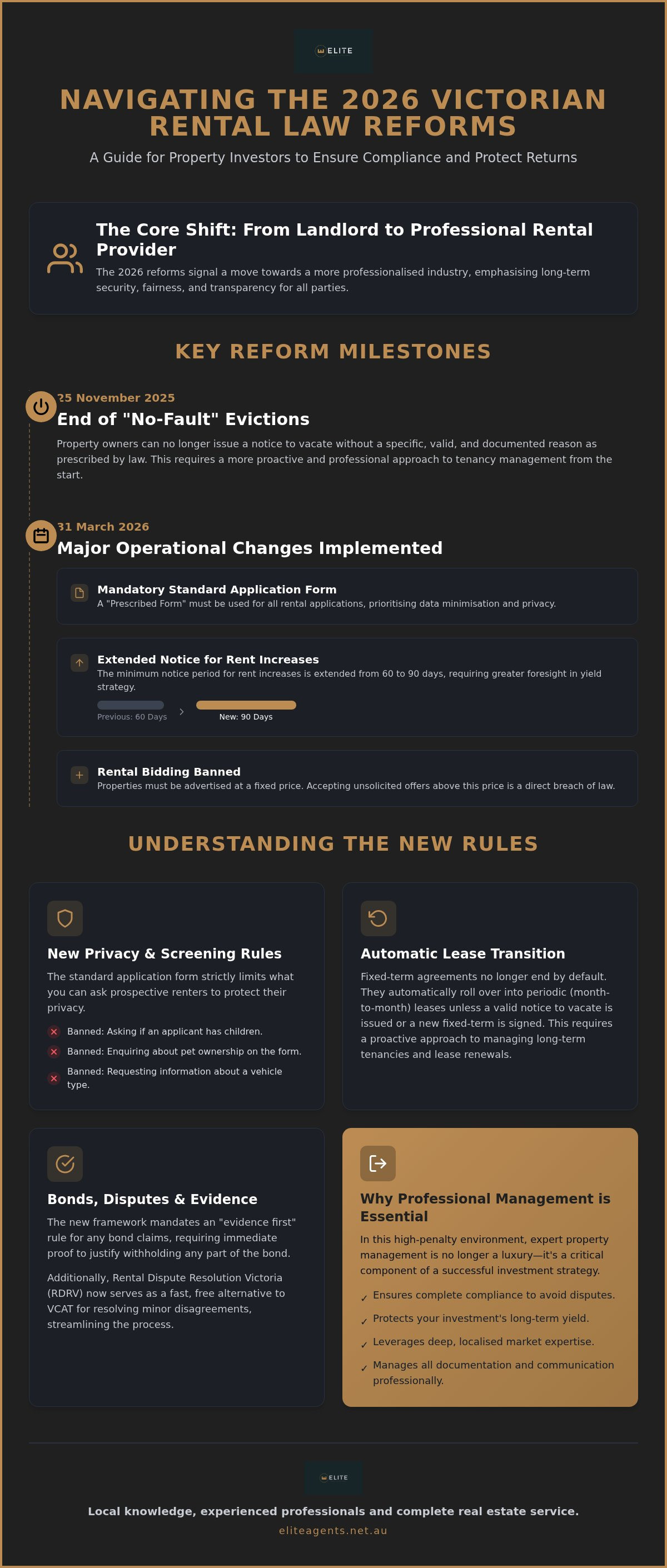
The Victorian rental laws 2026 represent more than just a legislative update; they signal a fundamental shift in the state's property ecosystem. The core objectives are clear: fairness, transparency, and a heightened level of privacy for renters. For property owners, this means moving away from the traditional "landlord" label toward a more professionalised "Rental Provider" identity. This change isn't just a matter of terminology. It's an invitation to view property management as a high-end service where compliance and excellence are the standard.
Understanding this shift requires looking at the broader Overview of Victorian Housing Market, where the demand for long-term stability is driving these reforms. In high-growth corridors like Berwick and Clyde North, where family-oriented investment properties are common, these laws ensure that both parties have a clear, predictable framework. For owners in these regions, staying ahead of these changes is vital for maintaining the prestige and performance of their assets. Mastering the Victorian rental laws 2026 requires a proactive mindset that prioritises relationship-driven results over mere transactions.
The Philosophical Shift in Victorian Tenancy
Victoria is moving toward a model that prioritises long-term rental security. This shift aims to make renting a viable life choice rather than just a temporary stepping stone. To support this, the state has introduced Rental Dispute Resolution Victoria (RDRV). This body provides a free, fast alternative to the often-congested VCAT system for resolving disagreements. RDRV acts as the primary gatekeeper for minor rental disputes in 2026, ensuring issues are resolved without lengthy legal battles.
Key 2026 Milestones for Property Owners
The road to full compliance involves several critical dates that every savvy investor must mark in their calendar. The foundation was laid on 25 November 2025, when no-fault evictions were officially banned. This means you can't issue a notice to vacate without a specific, valid reason. This change demands a more documented, professional approach to tenancy management from the very beginning.
Looking ahead, the 31 March 2026 deadline is the most significant milestone for your daily operations. From this date, every rental provider must use the mandatory standard application form, which limits the type of personal information you can request. Additionally, the minimum notice period for rent increases has been extended from 60 to 90 days. This change gives renters more time to adjust their finances while requiring owners to plan their yield strategies with greater foresight. By embracing these milestones, you position your property as a top-tier choice for high-quality renters.
The Mandatory Standard Rental Application (March 2026): Privacy and Screening
The 31 March 2026 deadline marks a definitive shift in how we initiate tenancies across the state. Under the Victorian rental laws 2026, every rental provider or agent must use a "Prescribed Form" for all new applications. Using a bespoke document, a legacy agency template, or even a modified PDF is no longer just a clerical oversight; it's a direct breach of the law. This reform prioritises data minimisation, ensuring that personal information is only collected when absolutely necessary for the assessment of a prospective resident.
Rental bidding is also firmly a thing of the past. Properties must be offered at a fixed price, and accepting an unsolicited offer above the advertised amount is now a major legal risk. These regulations aim to create a transparent marketplace, but they also require owners to be more strategic with their pricing from day one. To stay updated on the latest compliance forms, you can consult the Official Victorian Renting Guide. It's a vital resource for understanding your revised obligations in this more regulated environment.
What You Can and Cannot Ask Prospective Renters
The new privacy guidelines explicitly ban several questions that were once commonplace. You can no longer ask if an applicant has children, nor can you request information about the type of vehicle they drive. These details are considered irrelevant to a person's suitability as a renter. Pet ownership is another restricted topic during the initial screening phase. Renters now follow a formal, post-approval process to request a pet, meaning you cannot use pet ownership as a filter for selecting a successful applicant. Salary evidence and employment history collection are also subject to stricter "capacity to pay" assessment limits to prevent unnecessary privacy intrusion.
Elite Screening Strategies for the New Regulatory Environment
Maintaining a high-performing investment portfolio requires a more sophisticated approach to screening than ever before. Since traditional "filters" are now restricted, professional managers focus on deep-dive verifications of rental history and professional references. This process ensures we identify reliable residents who value the quality of your asset. Using expert property management Berwick is the most effective way to ensure your application process remains compliant while still protecting your yield. If you're concerned about your current screening protocols, you might book a comprehensive rental appraisal to see how professional oversight can mitigate these new regulatory risks.
Ending No-Fault Evictions and Managing Rent Increases Under the New Rules
The end of no-fault evictions marks the most significant cultural shift in Victorian property management history. Under the Victorian rental laws 2026, the traditional power to end a lease without reason at the conclusion of a fixed term has been permanently removed. This means that when a fixed-term agreement ends, it doesn't simply terminate; it transitions automatically into a periodic, month-by-month arrangement. To regain possession, rental providers must now provide a valid, legally recognised reason supported by documentary evidence. This change demands a higher level of professionalism and long-term planning from every owner.
Managing cash flow also requires greater foresight now that the notice period for rent increases has been extended to 90 days. While the frequency remains capped at once every 12 months, the longer lead time means you must be more precise with your market analysis. This framework is governed by the Residential Tenancies Act 1997, which provides the legal backbone for all notice requirements and dispute resolutions. It's no longer enough to be reactive; success in 2026 is built on a proactive, data-driven approach to tenancy management.
Valid Reasons to Vacate: Protecting Your Asset
While "no-fault" notices are gone, owners still retain the right to reclaim their property for specific, legitimate purposes. Valid reasons include the sale of the property with vacant possession, major renovations that require the premises to be empty, or the owner or a family member moving back in. However, the Victorian rental laws 2026 require strict evidence for these claims. For example, if you're renovating, you must provide building permits or contracts. Issuing a notice without genuine intent or proof can lead to significant VCAT penalties, making professional documentation essential for every transition.
Strategising Rent Reviews in the City of Casey
Success in high-demand areas like Narre Warren and Pakenham depends on a sophisticated understanding of local market data. You shouldn't just guess a figure; you need to justify any increase by comparing similar high-quality homes in the immediate neighbourhood. Given the 90-day notice requirement, we recommend starting your market review at least four months before the 12-month anniversary of the last increase. This proactive approach allows for clear, professional communication with your renters. Maintaining a positive relationship often leads to better retention, which is far more cost-effective than a vacancy in today's market. Sophisticated investors know that a stable, long-term renter is often the key to a quietly successful portfolio.
Operational Compliance in Berwick: Bonds, Repairs, and Portable Schemes
Precision in property management is no longer optional; it's the foundation of a successful investment. The Victorian rental laws 2026 introduce a rigorous "Evidence First" rule for bond claims that takes effect on 13 October 2026. You can no longer make a claim against a renter's bond based on a general assessment of "wear and tear." Instead, you must provide concrete evidence, such as photos, invoices, or condition reports, at the exact moment the claim is lodged. This requirement ensures transparency but demands that owners and managers maintain meticulous digital records throughout the entire tenancy lifecycle.
Access to your property is also strictly governed by the "No Fees for Keys" rule. You cannot charge a renter for their initial set of keys or any device required to access the premises. Additionally, the legislation now places a firm cap on lease-break costs. While you can still recover specific losses, such as pro-rata advertising costs or re-letting fees, these must be calculated using a standardised formula that reflects the remaining term of the lease. These changes aim to reduce friction, yet they require a sophisticated understanding of operational math to protect your bottom line.
The Portable Rental Bond Scheme Explained
The introduction of the Portable Rental Bond Scheme is a game-changer for the high-activity corridors of the South East. This system allows renters to carry their existing bond from one property to another, significantly reducing the upfront financial burden of moving. Bond transfers are now managed through a centralised digital portal to streamline moves and ensure security for all parties. For owners in suburbs like Berwick or Clyde North, this means your property stays competitive for high-quality residents who are upgrading within the local area. However, you must ensure the bond is fully topped up to match the current market rate if the new rent is higher than the previous agreement.
Safety Standards and Urgent Repairs
Compliance in 2026 involves a strict 24-month cycle of gas and electrical safety checks. These must be performed by licensed tradespeople who provide formal certificates of compliance. Failure to keep these records is a major breach that can lead to significant penalties at VCAT. Urgent repairs, such as burst water services or broken cooling systems, now have even tighter resolution windows, often requiring action within 24 hours. Sourcing reliable, qualified trades on short notice is a common pain point for self-managed owners. This is where local real estate Berwick VIC expertise becomes invaluable, providing you with priority access to a curated network of compliant contractors. To ensure your property meets every safety benchmark before the next inspection, request a free rental appraisal today and let our team audit your compliance status.
Securing Your Investment: Why Elite Property Management Matters in 2026
The complexity of the Victorian rental laws 2026 has transformed property ownership from a passive investment into a high-stakes professional service. Attempting to self-manage in this high-penalty environment is a significant risk that few sophisticated investors are willing to take. One minor clerical error on the mandatory standard application form or a missed deadline for a 90-day rent increase notice can lead to costly VCAT disputes. Choosing Elite Agents & Partners means you're partnering with a team that has its finger on the pulse of every legislative nuance.
Our role extends beyond simple administration; we provide expert negotiation and representation when dealing with bodies like Rental Dispute Resolution Victoria (RDRV). We act as a professional buffer, ensuring your rights are protected while maintaining the aspirational elegance of your property's brand. With deep-rooted local knowledge across Berwick, Officer, and Pakenham, we understand the specific demographic shifts and market demands that drive long-term success in the City of Casey and beyond. This localized expertise allows us to anticipate changes before they impact your yield.
Mitigating Risk Through Professional Oversight
The value of a premium management fee is quickly realised when compared to the potential cost of non-compliance. Our team handles the entire "Standard Application" process, ensuring every privacy boundary is respected while still securing top-tier residents. We manage the "Evidence First" bond claim requirements and safety check schedules so you don't have to. This professional oversight provides peace of mind, allowing you to enjoy the rewards of your investment without the burden of legislative complexity. We treat your asset with the same care and attention to detail that you would, backed by industrial-strength compliance systems.
Maximising Returns in a Regulated Market
Success in a more regulated market requires a data-driven strategy that prioritises both yield and retention. We use a comprehensive property appraisal Berwick to ensure your asset is priced with precision from the very first day it hits the market. Our retention strategies are designed to work within the 2026 laws, fostering stable, long-term relationships that minimise vacancy periods. Don't leave your portfolio's performance to chance in this new era of tenancy. Request a Free Rental Appraisal with Elite Agents & Partners today to discover how our specialised advice can empower your investment journey.
Future-Proofing Your Property Portfolio
The landscape of property ownership in Victoria has changed forever. Mastering the Victorian rental laws 2026 requires a shift from traditional landlord mindsets to a professionalised service model. Success now hinges on your ability to manage the "Evidence First" bond claim rules and the strict privacy requirements of the mandatory application forms. These reforms are complex, but they also offer a path toward more stable, higher-quality tenancies for those who prepare correctly.
You don't need to navigate these regulatory waters alone. As local experts in Berwick and the City of Casey, Elite Agents & Partners provides sophisticated compliance systems designed specifically for the 2026 reforms. Our Director-led agency prioritises premium results and relationship-driven outcomes over mere transactions. We ensure your rights are protected while your yields remain competitive in a fast-paced market. Protect your investment with Elite Property Management and secure the expert oversight your asset deserves. You've worked hard to build your portfolio; let's work together to keep it thriving.
Frequently Asked Questions
Can I still evict a renter in Victoria if I want to sell my property in 2026?
Yes, selling your property with vacant possession remains a valid reason for ending a rental agreement. You must have a signed contract of sale and provide the renter with a 90-day notice to vacate. This process requires specific documentary evidence to ensure compliance with the latest regulations and to protect the rights of all parties involved.
What is the mandatory standard rental application form for 2026?
The mandatory form is a government-prescribed document that all rental providers and agents must use starting 31 March 2026. It's designed to protect renter privacy by prohibiting questions about children, pets, or vehicle types during the initial screening. Using any other bespoke or legacy application form is now a breach of the Victorian rental laws 2026.
How often can I increase the rent for my Berwick investment property?
Rent increases are restricted to once every 12 months for any residential tenancy. You're also required to provide a minimum of 90 days' notice before the increase can take effect, up from the previous 60-day requirement. This longer lead time allows residents in high-demand areas like Berwick to adjust their financial planning with greater certainty.
Can I ask a prospective renter if they have pets during the application process?
No, you cannot ask about pets as part of the initial application or screening phase. Pet ownership is now managed through a formal, post-approval request process once a renter has been selected. This shift ensures that pet ownership isn't used as an unfair filter during the selection of high-quality residents for your property.
What happens if a renter wants to use the Portable Rental Bond Scheme?
Renters can now transfer their existing bond from one property to another via a centralised digital portal. This scheme streamlines the moving process by removing the need for renters to pay a second bond while waiting for their previous one to be released. If your property commands a higher rent, you'll simply coordinate a bond top-up through the system.
Are there limits on how much I can charge for a lease break in Victoria?
Yes, lease-break costs are now capped and must be calculated using a standardised pro-rata formula. You can only recover actual losses, such as advertising costs and re-letting fees, based on the time remaining in the fixed-term agreement. This prevents excessive charges and ensures that the costs associated with a lease break remain fair and transparent.
Do I need to provide extra keys to my renters for free under the new laws?
You must provide each person signed onto the rental agreement with a set of keys or any necessary access devices, like fobs, at no cost. The "No Fees for Keys" rule ensures that renters don't face hidden entry costs. Any replacement keys required due to fair wear and tear must also be provided by the rental provider without charge.
How does Rental Dispute Resolution Victoria (RDRV) affect me as a landlord?
RDRV serves as a free, streamlined gatekeeper designed to resolve minor rental disputes before they escalate to VCAT. This body handles issues like bond claims and repair disagreements through a faster, less formal process. For sophisticated rental providers, it offers a more efficient path to resolution, reducing the time and stress often associated with traditional tribunal hearings.
Disclaimer
Disclaimer: This article was prepared with the assistance of artificial intelligence and reviewed for general informational purposes. While reasonable care has been taken to ensure accuracy, property-market conditions, prices, legislation and other information may change. The content does not constitute legal, financial, taxation, valuation or other professional advice. Readers should verify information and obtain advice appropriate to their circumstances before making property decisions. Elite Agents & Partners does not guarantee any specific sale price, rental return or outcome.


