

A rental property can earn income and rise in value, yet rent may not cover the mortgage and ongoing costs. That tension sits at the heart of the pros and cons of buying an investment property: the decision depends on whether potential returns and tax deductions justify the cash-flow demands and risks. In Australia, according to the Australian Taxation Office, an owner who sells a property for a profit after owning it for over one year is taxed on half of the net capital gain.
It’s easy to focus on rental income and long-term growth, but the purchase price is only one part of the calculation. Rates, insurance, repairs, vacancies and loan repayments can all affect your overall return.
This guide covers potential rental income and value growth, the costs and tax considerations, and the trade-offs to weigh before buying. It also explains how a property’s appeal to renters can shape its prospects, helping you assess both its potential and its demands.
Key Takeaways
- Weigh purchase and ongoing costs against your budget to see how much cash the property may require.
- Assess rental demand and potential value growth together; rent alone may not cover the mortgage and expenses.
- Understand how eligible deductions and negative gearing can affect your tax position and cash flow.
- Compare local rental appeal, property condition and tenant demand before choosing an investment.
1. Is It Worth Buying An Investment Property?
Buying an investment property can generate rental income and expose you to potential property growth, but it also ties up capital and brings ongoing costs. Property is a tangible asset and may be less volatile than some other investments. Shares and ETFs offer different ways to invest, while property returns depend on rent, changes in value, expenses and when you sell. Selling a property can take months, depending on the area, so accessing your capital may be slower.
For an Australian purchase, budget for the deposit, purchase costs, loan repayments and ongoing expenses. Your costs will depend on the property, loan and ownership expenses.
Lenders typically ask investment property buyers for a deposit of between 10% and 20%. Borrowing more than 80% of the property’s value can mean paying Lender Mortgage Insurance. Interest rates and repayments depend on the loan and lender. Compare the deposit and loan costs with your available capital before committing.
Allow for council and water rates, insurance, strata fees, repairs, maintenance, management fees, vacancy costs and land tax. Vacancies can interrupt rental income while repayments continue, and selling costs reduce your proceeds. According to the Australian Taxation Office, an owner who sells for a profit after owning the property for over one year is taxed on half of the net capital gain.
A timeshare is different: it gives the holder use of holiday accommodation for a set period each year. Consider its purchase and ongoing costs, limits on when you can use it, and the possibility that resale or recovering your money may be difficult. The pros and cons of buying an investment property depend on whether potential rent and growth justify the costs, risks and reduced liquidity.
2. Potential rental income and property value growth
Rental income can provide regular cash flow, while property growth may increase the asset’s value over time. These are separate return drivers: rent depends on achievable weekly rent and occupancy, while capital growth depends on the property’s market value when you sell. Shares can also generate income and growth, but direct property links your returns to one asset and its local rental market. Neither approach offers the same income pattern or liquidity.
Start with a cash-flow estimate. Compare expected rent with loan repayments and ongoing expenses, allowing for periods without a renter. If rent does not cover the outgoings, consider whether your other income could cover the shortfall if rent pauses or repayments rise.
Positive cash flow occurs when rental income exceeds the property’s running costs and loan repayments. The reverse can still support a growth strategy, but it requires available cash to fund the difference. For comparison, an Australian example with A$20,000 in annual rent and A$30,000 in annual interest and running costs produces a A$10,000 annual property loss. Treat that as a cash-flow calculation, not a forecast for another property.
Value growth may improve your overall return, but it won’t pay monthly bills unless you sell or borrow against your equity. Selling can take time, and stamp duty and other purchase costs affect the capital invested from the outset. Rental-property expenses, including interest on a loan used to buy the property, can generally be offset against rental income. Eligible deductions can change the after-tax result, but they don’t remove a cash-flow shortfall. Assess likely rent, vacancies, expenses and growth together, then compare the full property strategy with alternatives such as shares.
3. Investment property tax deductions and negative gearing
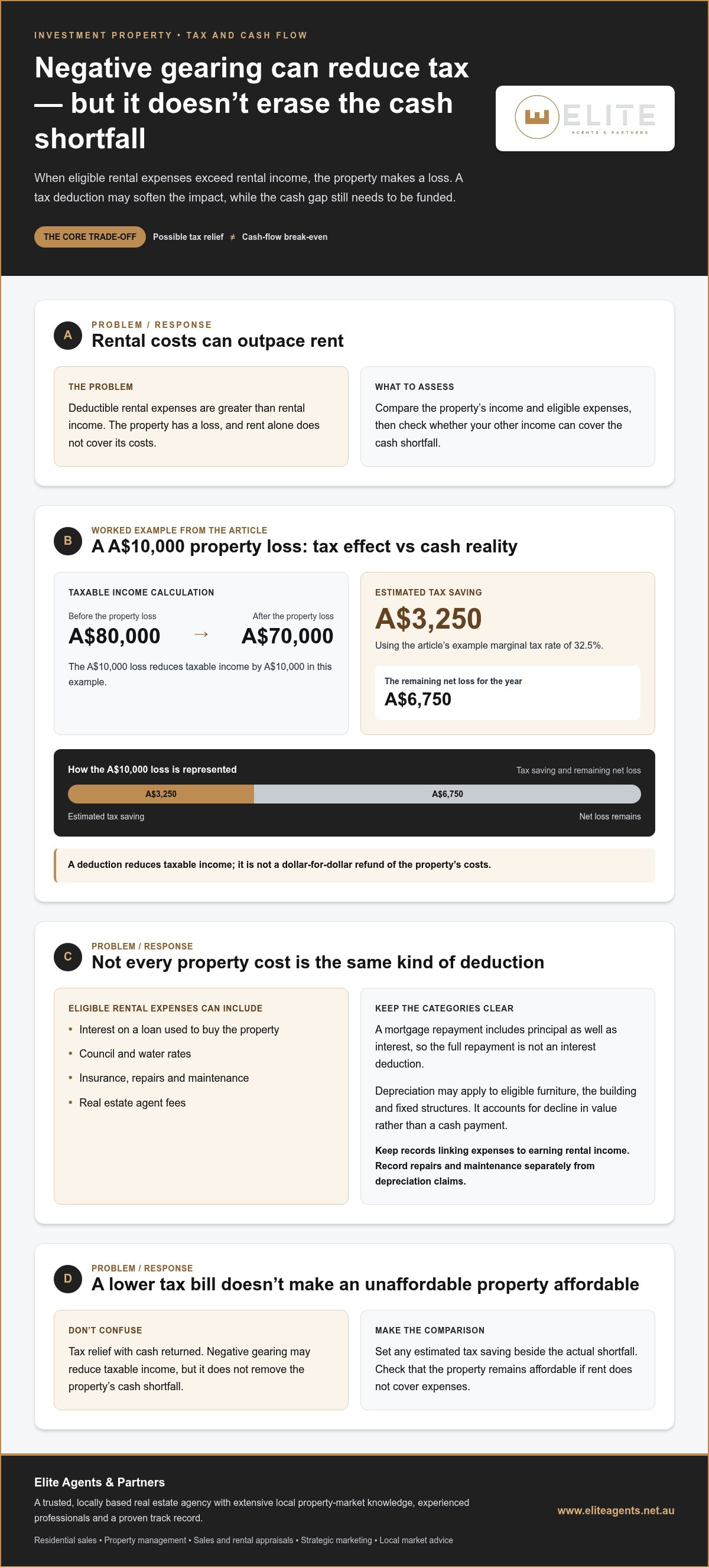
Negative gearing applies when deductible rental expenses exceed the property’s rental income. The resulting loss may be deducted against other income, reducing taxable income, but it doesn’t remove the cash shortfall. For example, a A$10,000 property loss reduces taxable income from A$80,000 to A$70,000. At a 32.5% marginal tax rate, the estimated tax saving is A$3,250, leaving a net loss of A$6,750 for the year.
Eligible rental expenses can include interest on a loan used to buy the property, council and water rates, insurance, repairs, maintenance and real estate agent fees. Keep records showing that each expense relates to earning rental income. A mortgage repayment includes principal as well as interest, so the full repayment is not an interest deduction. A home loan for a private residence is also distinct from borrowing to acquire a rental property.
Depreciation is another deduction to consider. Australian investors may claim depreciation for eligible furniture, the building and fixed structures. These deductions account for the decline in value of eligible assets, rather than a cash payment to renters or a repairer. A five-year-old property may still provide depreciation benefits, depending on its eligible assets and building components. Record repairs and maintenance separately from depreciation claims.
To assess the tax effect, list rental income, interest and other eligible expenses, then calculate the resulting property loss or profit. Apply the loss to the relevant income calculation, as in the A$80,000 example, and compare any estimated tax saving with the actual cash shortfall. A deduction reduces taxable income; it isn’t a dollar-for-dollar refund of maintenance costs or mortgage repayments. The property must still be affordable if rent doesn’t cover its expenses, even when negative gearing lowers the tax bill.
4. Choosing an investment property for rental growth
In Australia, a sound investment choice balances renter appeal, rental income and longer-term prospects. Don’t rely on a suburb’s reputation alone. Compare local rental demand, property condition, amenities and ownership costs, then consider whether the purchase fits your broader portfolio. A property that attracts renters but strains your budget may not suit your strategy.
Start with tenants’ daily needs. Simon and Tiana’s example unit is a 10 minute walk from restaurants and shops. That convenience may strengthen its rental appeal, but it’s only one factor. Assess the layout, condition and practical access alongside local demand. Nearby transport, shops and employment areas may matter to prospective tenants, depending on the property and neighbourhood.
Compare like with like before deciding. A land-and-house package and an existing property aged 5 to 10 years in a similar area present different trade-offs. Consider the package’s location and expected completion, then weigh the established home’s condition and surrounding rental activity. The purchase price alone won’t show which option better matches your expected rental income or available capital.
Review comparable sales, current rental conditions and competing properties. Across Berwick, Narre Warren, Narre Warren South, Narre Warren North, Hallam, Hampton Park, Dandenong, Doveton, Cranbourne, Cranbourne East, Clyde, Clyde North, Officer, Pakenham, Beaconsfield and Drouin, conditions can vary by suburb and property type. An agent with local knowledge can help you interpret demand and rental appeal in context.
Before borrowing, compare expected rent with repayments, running costs and potential vacancies. Consider whether the property would remain manageable if rent fell short or maintenance were needed. This helps clarify the pros and cons of buying an investment property: prioritise durable renter appeal and sustainable cash flow over a growth story alone.
Elite Agents & Partners: Property Management
Elite Agents & Partners provides Property Management for investors who want professional support overseeing a residential rental. Local knowledge of Berwick’s property market, tenant demand and rental conditions can help inform practical decisions about managing your investment. Turn to the team when you’re preparing a property for tenants or seeking ongoing management, with personalised service and clear communication focused on protecting your interests.
If you’re still assessing a purchase, local market advice and a Property Appraisal can help you understand property values and rental conditions before deciding how to proceed. The right support depends on your next step, whether you’re preparing to rent, evaluating an investment or considering a sale.
Contact Elite Agents & Partners to discuss your property plans.
Make your next property move with clarity
Turn your investment priorities into a clear plan. The pros and cons of buying an investment property vary depending on whether you’re seeking rental income, long-term growth or a future addition to your portfolio. Set your priorities first, then assess how each opportunity fits your finances, preferred level of involvement and plans for the property.
Whether a particular investment is suitable depends on your circumstances and the property’s local market conditions. Elite Agents & Partners brings local knowledge and practical experience to property decisions. Its services include Property Management, Residential Property Sales and Project Marketing, supporting investors at different stages, from assessing an opportunity to managing or selling a property.
Take the next step with a considered conversation about your property plans.
With informed local guidance, you can make your next decision with greater confidence.
Frequently Asked Questions
Is It Worth Buying An Investment Property?
Buying may be worthwhile if the expected return after costs suits your goals, budget and investment timeframe. Before committing, calculate the likely net rental return by subtracting recurring property expenses from expected rent, then compare that figure with the capital tied up. Consider how quickly you might need access to that capital, too. A property that looks attractive on gross rent alone may produce a different result after costs.
Do I need to pay Lender Mortgage Insurance (LMI) if I buy an investment property?
Borrowers who borrow more than 80% of an investment property’s value can expect to pay Lender Mortgage Insurance. The loan size relative to the property value is therefore an important part of the upfront funding calculation. Include LMI in your purchase budget alongside the deposit and other buying costs, then assess how the resulting loan repayments fit your cash flow.
What are the main pros of buying an investment property in Australia?
Potential advantages include rental income, possible growth in the property’s value and a tangible asset you can manage directly. Property may also provide exposure to a different asset type from shares. For example, an investor building a portfolio could compare a rental property’s income and costs with their existing investments, then decide whether direct ownership suits their preferred level of involvement.
What are the main cons and risks of Australian investment property?
Key risks include concentrated exposure to one property and location, periods without rent, unexpected repairs and limited access to your capital. If a property needs work between renters, for example, income may pause while expenses continue. Selling can also take time, making property less flexible than investments that can be sold more readily. Consider whether your finances can absorb these pressures.
How are rental income, investment property expenses, and capital gains taxed in Australia?
Rental income and eligible rental expenses affect your taxable income, while a profit on sale may create a capital gains tax liability. Keep clear records of rent received and expenses paid, and distinguish property-related borrowing costs from interest on a private home loan. The Australian Taxation Office says an owner who sells at a profit after owning the property for over one year is taxed on half of the net capital gain.
How do Australian vacancy rates, rental demand, and landlord regulations affect investment returns?
Vacancies reduce rental income, while strong local demand can support occupancy and the rent a property attracts. Compare rental listings and leasing activity for the same suburb and property type rather than relying on a broad market average. Regulations for rental providers can also affect operating processes and costs. Include compliance-related costs, as well as the time and expense of managing a tenancy, in your return assessment.
Disclaimer
Disclaimer: This article was prepared with the assistance of artificial intelligence and reviewed for general informational purposes. While reasonable care has been taken to ensure accuracy, property-market conditions, prices, legislation and other information may change. The content does not constitute legal, financial, taxation, valuation or other professional advice. Readers should verify information and obtain advice appropriate to their circumstances before making property decisions. Elite Agents & Partners does not guarantee any specific sale price, rental return or outcome.


