
The cheapest way to sell your Victorian home is often the most expensive decision you'll ever make. It's a counterintuitive truth that catches too many vendors off guard, and by the time settlement day arrives, the gap between expected and actual profit can be genuinely confronting. Understanding the hidden costs of selling a house VIC vendors face is not about pessimism; it's about protecting what you've worked hard to build.
You already know that agents charge commission and that solicitors send invoices. What's less obvious are the layered expenses sitting quietly between listing day and settlement: the Section 32 preparation fees, the building and pest reports, the styling costs, the marketing levies, and the adjustments that appear on your final statement without much warning. These aren't surprises your agent is hiding from you; they're simply costs that rarely get discussed upfront in plain language.
This guide changes that. We'll walk you through every significant expense a Victorian vendor should budget for in 2026, explain which costs are negotiable and which aren't, and show you how smart investment in the right areas can protect, and even grow, your final sale price. Consider this your complete financial roadmap before you sign a single document.
Key Takeaways
- The hidden costs of selling a house VIC vendors face extend well beyond agent commission — budgeting for the full picture can mean the difference between a profitable sale and a settlement day shock.
- Mandatory Victorian compliance requirements, including gas, electrical, and smoke alarm checks, are non-negotiable costs that many vendors fail to factor in until contracts are already in motion.
- Marketing, conveyancing, and lender discharge fees each carry their own variables — knowing which expenses are fixed and which are negotiable puts you in a far stronger position before you sign anything.
- Capital Gains Tax implications can significantly affect your net proceeds if the property was ever used as an investment, making early financial advice an essential step rather than an afterthought.
- A free sales appraisal from a local specialist is the smartest first move — it gives you a realistic baseline to calculate true selling costs and protect your final profit from the outset.
Beyond the Commission: Why Selling a House in VIC Costs More Than You Think
Most Victorian vendors walk into the selling process with one number in their head: the agent's commission rate. It's understandable. Commission is the most visible line item, the one agents quote upfront, and the one that's easiest to compare across the kitchen table. But commission is only one piece of a much larger financial picture, and fixating on it alone can leave you genuinely underprepared for what settlement actually costs.
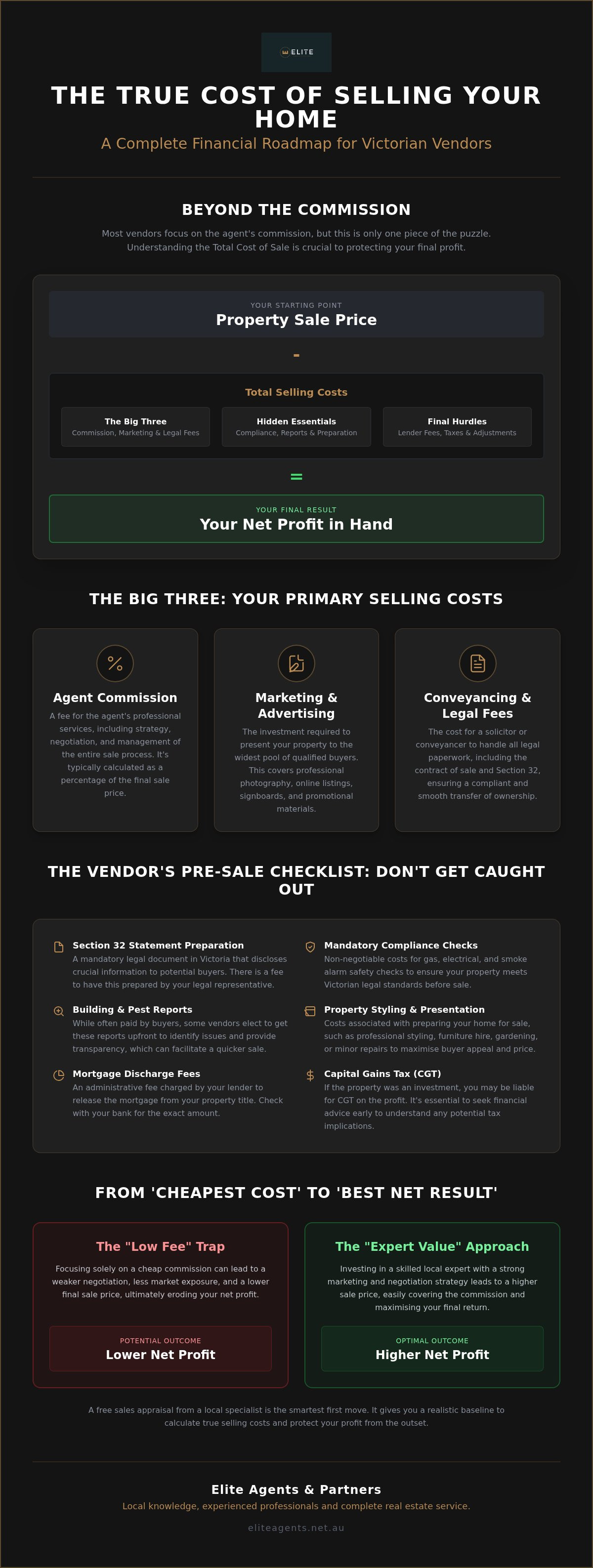
The Total Cost of Sale is the complete sum of every dollar spent to transact your property, from pre-listing compliance checks and conveyancing through to marketing campaigns, styling, and lender discharge fees. Agent commission sits within that total, but it doesn't define it. The only metric that truly matters to a vendor is the net sale result: what remains in your account after every cost has been settled and every obligation has been met.
Victorian vendors routinely underestimate their total selling costs. The gap between what people expect to spend and what they actually spend is a consistent pattern across the market, and it catches sellers at the worst possible moment: when they're already committed to a purchase on the other side.
The "Sticker Shock" of Victorian Property Sales
The psychology behind low-fee traps is straightforward. A discounted commission rate feels like an immediate, tangible saving. What's harder to see is how that saving gets absorbed, and then exceeded, by costs that were never properly discussed. Preparation fees, mandatory compliance certificates, and marketing levies accumulate quietly. By the time a vendor receives their settlement statement, the hidden costs of selling a house VIC-wide have often eroded a significant portion of what they expected to pocket, sometimes enough to affect the deposit available for their next purchase.
A comprehensive pre-sale budget should account for:
- Section 32 Vendor Statement preparation
- Building, pest, and compliance inspections
- Conveyancing and legal fees
- Marketing and advertising costs
- Property presentation, styling, and minor repairs
- Mortgage discharge and lender fees
- Settlement adjustments for rates and owners corporation fees
Building that budget before you list, not after, is what separates a confident vendor from a reactive one.
Why "Cheap" Agents Often Cost You More
There's a critical distinction between the cost of selling and the cost of selling well. An agent who charges a lower commission may appear to save you money, but the real question is what that lower fee reflects in terms of negotiation skill, local market knowledge, and campaign investment.
A weaker negotiation outcome on a $900,000 property doesn't need to miss by much to dwarf any commission saving. The hidden costs of selling a house VIC vendors often overlook aren't always line items on an invoice; sometimes they're the price difference between a well-negotiated sale and a quick, convenient one that serves the agent's pipeline more than your profit.
Local expertise in areas like Berwick and Narre Warren matters precisely because buyer behaviour, comparable sales, and campaign timing are hyperlocal. An agent who knows the streets, the seasonal patterns, and the active buyer pool is positioned to protect your net result in ways a discounted generalist simply isn't. That's not a premium for its own sake. It's the difference between a stale listing that breeds price reductions and a campaign that generates genuine competition from day one.
The Big Three: Marketing, Conveyancing, and Agent Commissions in 2026
Commission, marketing, and conveyancing. These three cost centres account for the lion's share of what Victorian vendors spend to complete a sale, and each one carries more nuance than most sellers realise until they're already in the process. Understanding how they interact, and where the real value lies, is central to protecting your net result.
Navigating Victorian Commission Structures
In Melbourne's South East, commission rates across metropolitan corridors like Berwick and Narre Warren generally differ from semi-rural fringe markets, where lower median prices and longer days-on-market can influence how agents structure their fees. The two most common models are fixed commission, a single agreed percentage regardless of sale price, and tiered commission, where the agent earns a higher rate on any amount achieved above a nominated threshold.
Tiered structures are worth serious consideration. They directly align your agent's financial incentive with your goal of achieving the highest possible price. A performance bonus structure, where an agent earns more for a record-breaking result, creates genuine motivation to negotiate hard rather than accept the first reasonable offer. Always confirm whether any quoted rate is GST-inclusive. A rate that sounds modest can shift meaningfully once GST is applied, and that distinction belongs in your budget from day one.
Marketing: Investment vs Expense
This is where the hidden costs of selling a house VIC vendors overlook most often become most consequential. Not all marketing spend is equal, and the gap between standard and premium campaign execution can directly influence your final sale price.
A competitive campaign in the City of Casey typically includes:
- Professional photography: High-resolution stills remain the foundation of any listing. Quality photography shapes a buyer's first impression before they ever step through the front door.
- Videography and drone footage: Increasingly expected in the South East market, particularly for properties with land, aspect, or streetscape appeal. Aerial footage contextualises the property within its neighbourhood in ways ground-level photography simply can't replicate.
- Premier portal placement: Upgraded listings on realestate.com.au deliver significantly greater visibility than standard placements. The difference in inquiry volume between tiers is real, and more qualified inquiries mean more competition at auction or during negotiation.
- Social media targeting: Geo-targeted campaigns on Meta platforms are no longer optional for properties in Casey. Buyers are increasingly discovered through social channels before they've even activated a portal search alert.
- Professional copywriting: Aspirational buyers respond to language that reflects the lifestyle a property offers, not just its specifications. Well-crafted copy positions your home within a narrative, not just a data set.
Vendors who treat marketing as a cost to minimise often find themselves with fewer bidders, a longer campaign, and a sale price that doesn't justify the saving. The ROI on a well-constructed campaign in a market like Berwick is measurable in buyer competition, and buyer competition is what drives prices above reserve.
For a deeper look at how campaign strategy shapes outcomes in this specific market, the Elite Guide to Selling in Berwick in 2026 covers local dynamics in practical detail.
Conveyancing: Local Knowledge Matters
Online conveyancing services offer apparent convenience, but they carry real limitations for Victorian vendors. A local solicitor familiar with Casey council requirements, Section 32 nuances, and owners corporation documentation common to South East estates brings contextual knowledge that a generic platform can't replicate. Errors or omissions in a Vendor Statement can delay settlement or expose you to legal risk, and the cost of fixing those problems invariably exceeds any fee saved upfront. Engaging a local conveyancer early, ideally before you list, is one of the clearest ways to protect your timeline and your net proceeds.
If you're starting to map your total selling costs, a free sales appraisal from a local specialist gives you the realistic baseline you need to build an accurate budget before committing to anything.
The Truly Hidden Costs: Compliance, Repairs, and Presentation
Commission gets discussed at the first agent meeting. Compliance certificates rarely do. Yet for many Victorian vendors, the hidden costs of selling a house VIC-wide that cause the most genuine surprise are the mandatory safety and legal requirements that sit entirely outside the agent's fee structure. These aren't optional line items you can defer or negotiate away. They're conditions of a legally compliant sale.
Victorian Compliance and Safety Certificates
Before a property can be sold in Victoria, vendors must meet a series of non-negotiable safety obligations. Gas and electrical safety checks, smoke alarm compliance, and the preparation of a Section 32 Vendor Statement are all required. Each carries its own cost, and together they add up faster than most sellers anticipate.
The Section 32 itself requires your conveyancer to compile council certificates, title searches, zoning information, and any relevant owners corporation documentation. In the City of Casey, properties within master-planned estates often carry more complex owners corporation schedules, which can extend preparation time and associated fees. Engaging your conveyancer before you list, rather than after you've accepted an offer, avoids the kind of last-minute scramble that delays settlement and creates unnecessary stress.
From 2026, Victorian vendors are also required to make energy efficiency disclosures as part of the sale process. If your property hasn't had a recent assessment, factor in the cost of obtaining one. Buyers are increasingly scrutinising running costs, and a poor disclosure can become a negotiating point you didn't invite.
Pool and spa owners in Berwick face an additional compliance layer. Registration, barrier inspections, and safety certificates are mandatory before sale, and non-compliance can expose vendors to significant liability. This is one area where discovering a problem mid-campaign is genuinely costly, both financially and in terms of buyer confidence.
Failing a building inspection mid-campaign is equally damaging. Buyers who receive a concerning report don't simply ask for a discount; they often walk away entirely, leaving you to relist with a stigma attached. Commissioning your own pre-sale building and pest report gives you the information you need to address issues on your terms, before they become someone else's leverage.
The ROI of Professional Home Styling
Styling is the cost that vendors most commonly dismiss and most consistently regret skipping. It's not about aesthetics for their own sake. It's about helping buyers emotionally connect with a property the moment they walk through the door, and that connection is what drives competitive offers.
Full styling involves hiring furniture, artwork, and accessories to present vacant or under-furnished rooms at their best. Partial styling works with your existing pieces, supplementing where the presentation falls short. Both approaches require budget, but the return in buyer engagement is consistently strong in the Berwick and Narre Warren market, where aspirational buyers are comparing your home against newly built display suites.
Beyond furniture hire, consider these often-overlooked presentation costs:
- Storage units: Decluttering is non-negotiable for a competitive presentation, and that furniture and excess belongings need somewhere to go during the campaign.
- Professional organisers: For larger homes or vendors who've accumulated years of possessions, a professional organiser can compress weeks of preparation into days.
- Landscaping and kerb appeal: In Berwick's established streets, first impressions are formed before a buyer reaches the front door. A tidy garden, fresh mulch, and a clean driveway cost relatively little but signal to buyers that the property has been cared for throughout.
- Minor repairs and touch-up painting: Scuffed walls and dripping taps read as neglect. Addressing them costs a fraction of the price reduction a buyer will request if they notice them first.
The hidden costs of selling a house VIC vendors tend to underestimate most aren't the compliance fees; they're the presentation investments they chose not to make. In a market where buyer competition determines your final price, arriving underprepared is a decision that shows up directly on your settlement statement.
Financial Loose Ends: Lender Fees, Capital Gains, and Moving Day
Settlement day has a way of producing costs that weren't on anyone's radar during the listing conversation. The hidden costs of selling a house VIC vendors consistently underestimate aren't always about the campaign or the compliance checks; some of the most significant financial obligations surface in the final days before you hand over the keys. Getting ahead of them isn't difficult, but it does require knowing where to look.
Mortgage Discharge Fees
If your property carries an existing mortgage, your lender will charge a discharge fee to formally close the loan and release the title. The amount varies between lenders and loan types, and the timing matters more than most vendors realise. Discharge paperwork must be lodged well in advance of settlement; delays on the lender's side can push settlement back, creating a cascade of complications if you're simultaneously purchasing elsewhere. Contact your lender early, confirm the fee, and ask for a realistic processing timeline before you set a settlement date with your agent.
Settlement Day Surprises
Victorian settlements involve pro-rata adjustments for council rates, water rates, and owners corporation levies. The calculation is straightforward in principle: the buyer reimburses you for any prepaid charges covering the period after settlement. But the direction of the adjustment depends entirely on where you sit in the billing cycle. If rates are in arrears, you'll owe the buyer a credit. If you've paid ahead, they owe you. Either way, the numbers on your final settlement statement will differ from your earlier estimates, sometimes by several hundred dollars.
Vacant possession cleaning is another cost that catches vendors off guard. Contracts of sale in Victoria typically require the property to be left in a reasonably clean condition. For larger homes or properties that have been tenanted, professional end-of-lease cleaning is a practical necessity, not an optional gesture.
Understanding your property's true market position before you commit to any of this is straightforward with a house valuation in Berwick from a local specialist who understands how settlement costs interact with your net proceeds.
Tax Implications for Victorian Vendors
Capital Gains Tax is the obligation that surprises vendors most when it arrives. If your property was ever used as an investment, even partially or for a limited period, CGT may apply to a portion of your sale proceeds. The primary residence exemption is not always absolute, and the rules around partial exemptions, the six-year rule, and cost base calculations are genuinely complex. Speak with a qualified tax professional before settlement, not after, so you understand your liability and can plan accordingly.
Land tax is a separate consideration. If land tax was assessed on the property for the current year, your conveyancer will apportion the remaining balance between vendor and purchaser at settlement. Vendors who weren't previously liable for land tax sometimes discover an adjustment they weren't expecting.
Developers selling new residential premises face an additional layer: GST obligations that differ significantly from standard residential sales. If there's any ambiguity about whether your property qualifies as new residential premises under the relevant legislation, specialist tax advice is non-negotiable before you sign a contract.
Knowing your complete financial position before you list is the foundation of a confident sale. Request a free sales appraisal from the local specialists at Elite Agents to build an accurate picture of your net proceeds from day one.
Maximising Your Net Result with Elite Agents & Partners
Every cost covered in this guide, from compliance certificates to settlement adjustments, has one thing in common: it can be anticipated, planned for, and managed. That's exactly what working with a local specialist makes possible. The hidden costs of selling a house VIC vendors encounter don't disappear, but they stop being surprises when you have a team that maps them out before the first open home is scheduled.
The Berwick Advantage
Local knowledge isn't a marketing phrase here. It's a practical asset that protects your budget at every stage. Elite Agents & Partners understands the buyer profiles active across Berwick, Narre Warren, and Pakenham: what they're searching for, what they'll pay a premium for, and what will give them pause during a building inspection. That insight shapes every decision, from how a property is prepared to how an offer is negotiated.
Access to a trusted network of local trades and stylists means preparation costs stay competitive without compromising quality. Rather than sourcing quotes independently and hoping for the best, vendors benefit from established relationships built on consistent results in the City of Casey. And unlike agencies that pad their invoices with vague "administration fees", Elite Agents & Partners operates with full transparency. What's quoted is what's charged. No exceptions.
Your Personalised Sales Strategy
Method of sale matters more than most vendors realise. Auction campaigns generate competitive tension that consistently drives prices above reserve in strong market conditions, but they carry specific marketing costs and timelines. Private sale suits certain property types and price points where a targeted buyer approach is more efficient. Choosing the wrong method doesn't just affect your result; it affects your total cost of sale. Elite Agents & Partners analyses your property, your timeline, and current market conditions to recommend the approach that protects your net proceeds, not just your listing date.
Pricing strategy is equally precise. Data-driven insights drawn from recent comparable sales across Casey inform every appraisal, ensuring your property enters the market positioned for genuine competition rather than sitting idle while buyers wait for a reduction.
Skilled negotiation is where the hidden costs of selling a house VIC vendors absorb throughout a campaign are most effectively offset. A single well-negotiated outcome on a mid-range Casey property can recover every dollar spent on styling, compliance, and marketing, and then some. That's the real measure of an agent's value: not the commission rate, but the net result they deliver.
Start with the most accurate baseline available. Book your free sales appraisal with Elite Agents & Partners today and build your selling budget on numbers you can trust.
Your Next Step Towards a Confident, Cost-Ready Sale
Selling a Victorian property in 2026 rewards vendors who prepare early and penalises those who don't. The hidden costs of selling a house VIC vendors face aren't unavoidable; they're manageable when you know they're coming. From compliance certificates and presentation investment through to lender discharge fees and tax obligations, every cost in this guide can be planned for, budgeted accurately, and absorbed without settlement day shock.
The clearest takeaways are these: your net result matters more than any single line item, cheap rarely means cost-effective when it comes to agent selection, and building your budget before you list is what separates a confident vendor from a reactive one.
Elite Agents & Partners brings local Berwick expertise, expert negotiation skills, and tailored marketing campaigns to every sale, all designed to protect and grow your final proceeds. The smartest first move is also the simplest one. Get your free, no-obligation sales appraisal today and build your selling strategy on numbers you can actually trust.
Frequently Asked Questions About the Hidden Costs of Selling a House in VIC
What is the average real estate commission in Victoria for 2026?
Victorian commission rates vary by location, property type, and agent, so there's no single fixed figure across the state. Metropolitan and inner-suburban markets tend to sit within a different range than outer corridors like Berwick and Narre Warren, where local market conditions influence how agents structure their fees. Some agents offer flat rates; others use tiered structures that reward higher sale prices. Always confirm whether any quoted rate includes GST before you compare figures side by side.
Do I have to pay for marketing upfront when selling my house?
Most Victorian agencies require vendors to contribute to marketing costs either upfront or at the commencement of the campaign, regardless of the sale outcome. Some agents offer vendor-paid advertising arrangements where costs are deducted from proceeds at settlement, but this varies between agencies. Clarify the payment structure before you sign an agency agreement, and make sure the full scope of the campaign is documented so there are no unexpected additions mid-campaign.
How much does a Section 32 cost in Victoria?
Section 32 preparation costs depend on the complexity of your property and your conveyancer's fee structure. Properties within master-planned estates in the City of Casey, which often carry detailed owners corporation schedules, can require more time to prepare than a straightforward freehold title. Engaging your conveyancer before you list, rather than after an offer is accepted, avoids rushed preparation and gives you a clear cost figure to include in your pre-sale budget from the outset.
Is professional home styling worth the investment in Berwick?
In Berwick's competitive market, where aspirational buyers are often comparing established homes against newly built display suites, professional styling consistently influences buyer engagement and offer levels. The hidden costs of selling a house VIC vendors most commonly regret skipping aren't compliance fees; they're the presentation investments that would have driven stronger competition at auction or during negotiation. Styling doesn't guarantee a specific price outcome, but it does position your property to attract more qualified buyers from the first open home.
What are the mandatory safety checks for selling a house in VIC?
Victorian vendors are required to meet several non-negotiable safety obligations before settlement. These include gas and electrical safety checks, smoke alarm compliance, and energy efficiency disclosure requirements introduced for 2026 sales. Properties with pools or spas carry additional obligations, including barrier inspections and safety certificates. Discovering a compliance issue mid-campaign is significantly more disruptive than addressing it before you list, so commissioning checks early is always the smarter approach.
Are real estate agent fees negotiable in Victoria?
Yes, agent fees in Victoria are negotiable, and there's no legislated rate that agents must charge. That said, negotiating purely on commission rate without considering the agent's local knowledge, negotiation skill, and campaign quality can cost you far more than you save. A modest difference in final sale price on a mid-range Casey property will typically exceed any commission saving many times over. Focus your negotiation on the total value delivered, not just the percentage quoted.
What happens to my mortgage when I sell my house?
Your existing mortgage is discharged at settlement using funds from the sale proceeds. Your lender will charge a discharge fee to formally close the loan and release the title, and the amount varies between lenders and loan products. The timing of your discharge application matters significantly; lenders require advance notice, and delays in processing can push back your settlement date. Contact your lender as soon as you decide to sell to confirm the fee and the required lead time.
Who pays for the conveyancing during a property sale?
Both parties in a Victorian property transaction pay their own conveyancing costs separately. As the vendor, you're responsible for engaging and paying a conveyancer to prepare your Section 32 Vendor Statement, manage contract documentation, and coordinate settlement on your behalf. The buyer engages and pays their own conveyancer independently. Choosing a local conveyancer familiar with City of Casey requirements and estate documentation is a practical decision that can protect your timeline and reduce the risk of last-minute complications.
Disclaimer
Disclaimer: This article was prepared with the assistance of artificial intelligence and reviewed for general informational purposes. While reasonable care has been taken to ensure accuracy, property-market conditions, prices, legislation and other information may change. The content does not constitute legal, financial, taxation, valuation or other professional advice. Readers should verify information and obtain advice appropriate to their circumstances before making property decisions. Elite Agents & Partners does not guarantee any specific sale price, rental return or outcome.


